There’s a specific kind of scholarship that doesn’t get talked about enough, the kind built not around prestige or rankings, but around genuine development aid. The Banach NAWA Scholarship Programme is exactly that. Run by Poland’s National Agency for Academic Exchange (NAWA) together with the Ministry of Foreign Affairs, it exists purely to widen access to higher education for citizens of countries where that access is often limited, funding full master’s degrees at Polish universities regardless of whether a student speaks a word of Polish going in.
What makes Banach worth a closer look isn’t just the funding itself, though a monthly stipend and full tuition waiver are nothing to dismiss. It’s the structure behind it, particularly the fact that the programme runs two distinctly different pathways depending on whether you study in Polish or in English, each with its own built-in support system designed around that choice. Here’s everything worth knowing before you consider applying.
Where This Scholarship Comes From:
Banach NAWA sits within a broader initiative called Polish Aid, a form of official development assistance coordinated jointly by Poland’s Ministry of Foreign Affairs and NAWA itself. Unlike merit scholarships built to attract top global talent regardless of background, Polish Aid programmes exist with a specific mission baked in: helping raise education and professional skill levels in developing economies. That mission shapes almost every rule in this scholarship, from who can apply to what gets funded.
The programme is named after Stefan Banach, one of Poland’s most celebrated mathematicians and a founding figure of modern functional analysis, which gives a sense of the intellectual weight Poland places behind this initiative, even though the scholarship itself isn’t limited to mathematics or science fields.
Snapshot of the Programme:
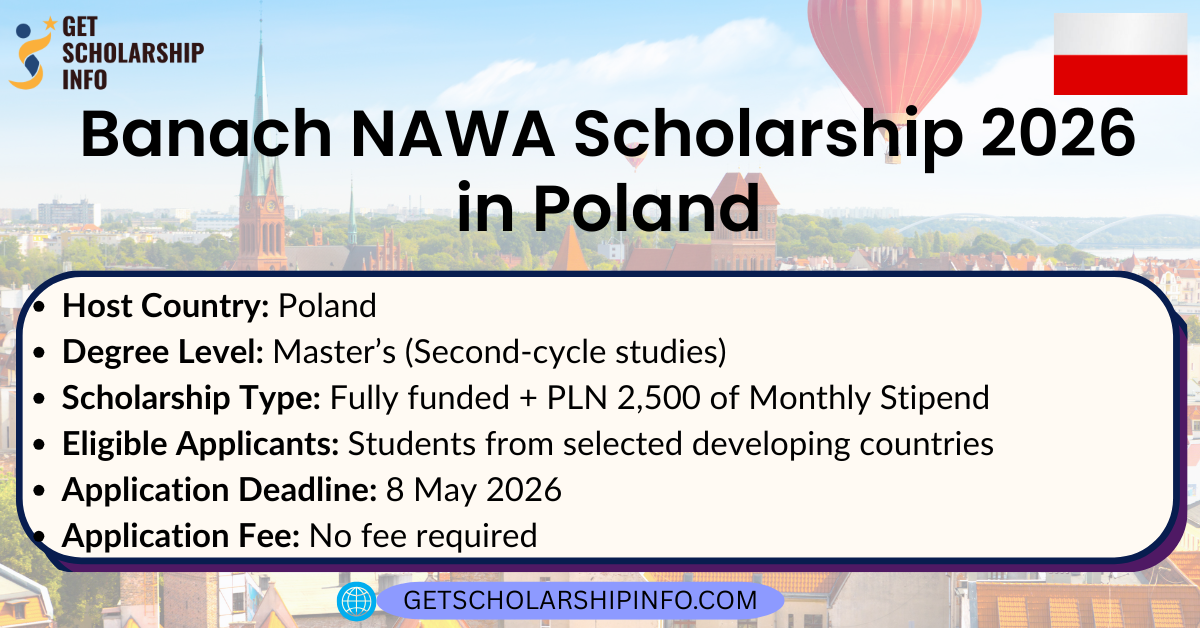
- Host Country: Poland
- Funding Body: Jointly administered by Poland’s Ministry of Foreign Affairs and the National Agency for Academic Exchange (NAWA)
- Degree Level: Full-time second-cycle (master’s) studies
- Study Language: Polish or English, depending on the track you choose
- Host Institutions: Universities supervised by Poland’s Minister of Science and Higher Education
- Eligible Applicants: Citizens of 36 countries covered under Polish Aid, spanning Eastern Europe, Asia, Africa, and Latin America
- Application Fee: None
- Funding Type: Fully funded, covering tuition exemption plus a monthly living stipend and travel support
- Latest Call: Announcement No. 16/2026, published April 13, 2026, covering studies or a preparatory course starting from the winter semester of 2026/27
Since the exact closing date for each yearly call shifts slightly, always check the current call announcement on NAWA’s official Banach programme page before finalizing your plans, rather than relying on last year’s timeline.
The Two-Track System: Why It Matters:
Most scholarship guides gloss over language logistics, but with Banach, this is genuinely one of the most important decisions you’ll make as an applicant, because it changes your entire first-year experience.
If you don’t speak Polish and choose the Polish-track: NAWA funds a preparatory course specifically designed to bring you up to a level where you can study your entire master’s degree in Polish. This is a serious investment on the programme’s part, essentially building your language competency from the ground up before your actual degree coursework even starts.
If you choose the English-track instead: You skip the intensive language preparation, since your coursework happens in English from day one. But you’re not left without any Polish exposure. The programme includes a Polish language and culture course specifically for English-track students, giving you enough grounding to navigate daily life, even if your academic work never requires fluency.
This dual structure means Banach genuinely works for two very different kinds of applicants: those who want to fully immerse in Polish academic life long-term, and those who want a quality European master’s degree without the language barrier standing between them and their coursework.
What You Actually Receive:
It helps to think about this scholarship less as “free tuition” and more as a full support package built around removing financial barriers at every stage of your move to Poland.
- A monthly scholarship of PLN 2,500, giving you consistent income to cover living costs throughout your studies rather than a single lump sum you have to budget out yourself
- Complete exemption from tuition fees at public universities, meaning your entire degree is funded without any tuition burden falling back on you
- A NAWA-funded preparatory course for Polish-track students, which functions as a genuine head start rather than a formality, since it’s specifically built to get you to academic-level Polish proficiency
- A one-time travel allowance of PLN 2,500, helping offset the cost of actually getting to Poland, which matters more than people expect when you’re relocating from another continent entirely
- The choice between Polish or English instruction, letting you pick the academic environment that fits your long-term goals, whether that’s building deep fluency in Polish or focusing purely on your subject area
- A Polish language and culture course for English-track students, so you’re not left completely disconnected from the local language and community even if your coursework doesn’t require it
- Genuine access to Poland’s public university system, opening the door to European-recognized master’s degrees without the price tag usually attached to international study
Beyond the financial mechanics, there’s also something less tangible but equally real here: a pathway into European higher education for students whose home country’s economic situation would otherwise make that path financially out of reach.
Who Qualifies:
Eligibility for Banach comes down to one central factor: citizenship. You need to hold citizenship in one of the 36 countries currently covered under the Polish Aid programme, which spans four broad regions:
- Eastern Europe
- Asia
- Africa
- Latin America
Since the exact list of 36 countries can be adjusted between calls as Poland’s foreign aid priorities shift, it’s essential to check the current call announcement directly rather than assuming your country’s inclusion from a previous year still applies. NAWA publishes the full, current list alongside each new call for applications.
Beyond citizenship, applicants generally need to meet standard academic requirements for entry into a master’s program, such as holding a relevant bachelor’s degree or equivalent qualification, along with any specific admission requirements set by the individual Polish university and programme you’re applying to.
Choosing Your University and Programme:
One detail that trips people up: Banach isn’t tied to a single university. It funds study at any university in Poland that falls under the supervision of the Minister of Science and Higher Education, which covers the vast majority of Poland’s public higher education institutions. That means your first real decision as an applicant isn’t just “should I apply,” it’s “which university, and which programme, fits what I want to study.”
Fields of Study You Can Pursue:
Because Banach funds master’s study broadly across Poland’s public university system rather than restricting itself to a narrow subject list, the fields available to you largely depend on what each individual university offers in Polish or English at the master’s level. Broadly speaking, applicants have historically pursued study across areas including:
- Engineering and Technical Sciences
- Computer Science and Information Technology
- Economics and Management
- Social Sciences
- Natural Sciences
- Medicine and Health Sciences
- Agricultural Sciences
- Humanities
- Law
- Education
Since this list reflects the general breadth of Poland’s public university offerings rather than an official Banach-specific subject restriction, it’s worth checking the current list of participating universities in the call announcement to confirm exactly which programmes are available in your field for the upcoming intake.
How the Application Process Works:
- Check NAWA’s official Banach NAWA programme page for the current, active call announcement
- Confirm your country of citizenship appears on the current list of 36 eligible Polish Aid countries
- Review the list of participating universities supervised by the Minister of Science and Higher Education to identify programmes matching your academic background and goals
- Decide between the Polish-track (with a funded preparatory course) or the English-track (with a Polish language and culture course included)
- Prepare your academic documents, including your existing degree qualifications and any required language certificates, referencing NAWA’s list of recognized Polish and English language certificates
- Submit your application according to the instructions and deadline specified in the current call for proposals
- If selected, plan your travel and relocation, keeping in mind the PLN 2,500 travel allowance is meant to offset, not fully replace, your actual travel costs
A Few Things Worth Understanding Before You Apply:
This is development aid, not a general merit scholarship. The entire structure exists to support students from specific developing economies, so if your country isn’t on the eligible list, this particular programme won’t be an option, regardless of your academic profile.
Your track choice is essentially permanent for that academic year. Once you commit to the Polish-track preparatory course or the English-track programme, you’re building your first year of study around that decision, so it’s worth genuinely thinking through your long-term plans in Poland (or beyond) before choosing.
Tuition exemption applies specifically at public universities. If you’re eyeing a programme at a private Polish institution, it’s worth double-checking whether that specific university falls under the Minister of Science and Higher Education’s supervision, since that’s the qualifying condition for the tuition waiver.
Calls open annually but timing shifts. The most recent announcement, numbered 16/2026 and published in April 2026, covers enrollment for the winter semester of the 2026/27 academic year. Future calls will likely follow a similar annual rhythm, but exact publication and closing dates can move slightly year to year, so treat each new announcement as its own timeline rather than assuming a fixed annual date.
Frequently Asked Questions?
Do I need to already speak Polish to apply for the Banach Scholarship?
No. If you don’t speak Polish, you can either join the Polish-track and receive a NAWA-funded preparatory course to build your language skills before starting your degree, or choose the English-track and study your master’s entirely in English while still receiving a Polish language and culture course on the side.
Which countries are eligible for this scholarship?
Citizens of 36 countries across Eastern Europe, Asia, Africa, and Latin America that are covered under Poland’s Polish Aid development programme. The exact list is published in each year’s official call announcement, since it can shift slightly between cycles.
Is there an application fee for the Banach NAWA Programme?
No. There is no separate fee required to apply for this scholarship.
Does the scholarship cover living expenses, or just tuition?
Both. Beyond the full tuition exemption at public universities, recipients receive a monthly stipend of PLN 2,500 to help cover living costs, along with a one-time PLN 2,500 travel allowance.
Can I choose any university in Poland?
You can apply to any university supervised by Poland’s Minister of Science and Higher Education, which covers the large majority of the country’s public higher education institutions, giving you a wide range of choice depending on your intended field of study.
What happens if I miss the current application window?
Banach NAWA runs on an annual call cycle, so if you miss one window, you’ll need to wait for the next official call announcement, which is typically published on NAWA’s website. Use the time in between to prepare your documents and confirm your eligibility so you’re ready the moment the next call opens.
Is this scholarship only for science or mathematics students, given it’s named after a mathematician? No. While the programme is named in honor of Polish mathematician Stefan Banach, it funds master’s study broadly across the fields offered by participating universities, not just mathematics or the sciences.
Final Thoughts:
The Banach NAWA Scholarship Programme is one of those funding routes that rewards students who genuinely do their homework early. Between the citizenship eligibility list, the choice between the Polish and English tracks, and the need to align your academic background with a specific university’s programme offerings, there’s real planning involved before you even reach the application stage.
But for students from one of the 36 eligible countries, the payoff is substantial: a fully funded master’s degree in the European Union, a monthly income to actually live on while studying, and a support structure built specifically to help you succeed whether you’re learning an entirely new language or diving straight into your subject in English. If you’re eligible and you’ve been looking for a genuine, no-strings entry point into European higher education, this is worth putting real time into.
Start by confirming your country’s current eligibility status, then explore which participating universities offer your intended field of study, so you’re fully prepared the moment the next official call for applications goes live.
For the most accurate and current details, always check NAWA’s official Banach Scholarship Programme page and the latest call announcement before applying.
Stay Updated:
Join our platforms to get the latest scholarships:
We share daily updates on fully funded and partially funded scholarships worldwide
