
Brazil isn’t the first place most researchers think of when planning their next career move, yet the state of São Paulo has quietly built one of the strongest research funding systems in Latin America. At the center of it sits FAPESP, the São Paulo Research Foundation, and one of its flagship offerings is the Post-Doctoral Fellowship. If you finished your PhD in the last few years and you’re wondering what comes next, this fellowship deserves a proper look before you scroll past it.
This program isn’t about handing out money randomly. It’s built to pull talented early-career scientists into active research groups across São Paulo’s universities and institutes, giving them the freedom to develop their own line of inquiry while working alongside experienced supervisors. The fellowship is fully funded, meaning recipients don’t need to worry about tuition-style costs or hidden charges eating into their research time. There’s also no application fee involved, so cost shouldn’t stop anyone from applying who otherwise qualifies.
Below, you’ll find everything broken down in plain language: who can apply, what you get, how the whole process works, and the small details that trip people up when they’re filling out the forms.
Why This Fellowship Stands Out:
Most postdoctoral programs are tied to a single lab or a single professor’s grant money, which means funding can dry up unexpectedly. FAPESP works differently. It runs its own dedicated budget line for these fellowships, reviewed through a structured peer process, so the funding commitment is stable for the entire approved duration. Researchers get monthly stipends, a separate research budget for the project itself, and support for relocating if they need to move to São Paulo state to take up the position.
Another thing worth mentioning: this isn’t limited to Brazilian citizens. Scientists from anywhere in the world, provided they meet the academic requirements, are welcome to apply. That openness is part of what makes the program genuinely competitive on an international level rather than being a local training scheme.
Snapshot: The Essentials
Here are the core facts you need before deciding whether to dig deeper into this opportunity.
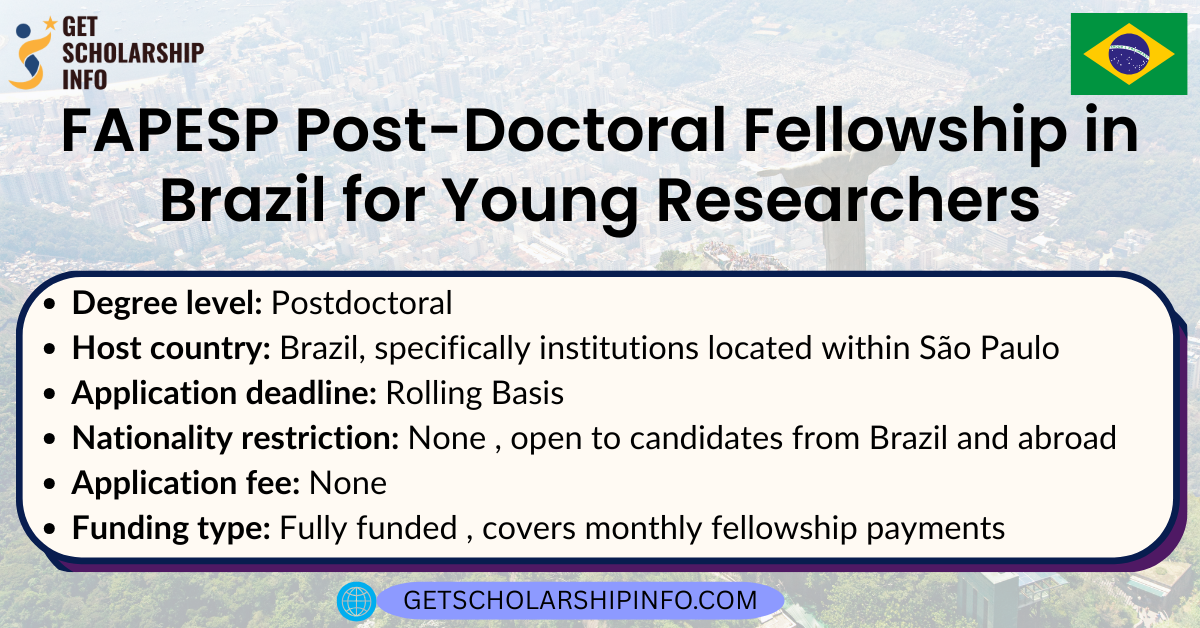
- Funding type: Fully funded , covers monthly fellowship payments plus a separate research overhead budget
- Degree level: Postdoctoral (candidates must already hold a PhD, or be very close to finishing one)
- Host country: Brazil, specifically research institutions located within the state of São Paulo
- Application deadline: Rolling , proposals can be submitted at any point during the year, there is no fixed cut-off date
- Nationality restriction: None , open to candidates from Brazil and abroad
- Application fee: None
- Fellowship duration: Up to 36 months initially, with possible renewal up to 48 months total for certain grant-linked cases
- Review timeline: Roughly 75 days on average, though this can stretch longer depending on reviewer availability
- Field of study: Open across nearly all academic disciplines, provided a qualified supervisor and host institution are secured
What Makes You Eligible:
Eligibility here runs on two tracks , one for the candidate (the person who will actually carry out the research) and one for the supervisor (the senior researcher who hosts and guides the project). Both sides need to check certain boxes for an application to move forward.
For the candidate:
- Completed a Doctorate less than seven years before applying, with some flexibility built in for documented career interruptions (parental leave, illness, caregiving duties, and similar circumstances are accounted for under current FAPESP policy)
- A postgraduate academic record that reviewers would describe as excellent, not just adequate
- A curriculum vitae showing genuine research output ; publications, participation in projects, or other evidence that demonstrates real potential rather than just completed coursework
- No outstanding unresolved obligations with FAPESP from any previous funding (reports, reviews, or paperwork left unfinished for more than 60 days will block a new application)
- A valid Individual Taxpayer Registration Number (CPF) is needed once the fellowship is accepted, though this can typically be arranged after acceptance
For the supervisor:
- Holds a PhD or an equivalent qualification
- Has a track record of leading internationally competitive research, not just participating in projects run by others
- Shows evidence of international research experience gained after their own doctorate, or active involvement in global research collaborations
- Is formally employed at a research institution located in São Paulo state (a loose academic affiliation on its own generally isn’t sufficient , FAPESP looks for a genuine employment relationship, though exceptions can be requested in specific situations)
- Has no unresolved obligations with FAPESP either
One rule that surprises a lot of applicants: FAPESP will not fund a fellowship where the supervisor and candidate are closely related. This is treated strictly as a conflict-of-interest issue, since it would undermine the fairness of evaluating the candidate’s actual qualifications.
What You Actually Gain From This Fellowship:
It helps to think about this less as “what will I be doing” and more as “what will I walk away with.” Here’s what recipients gain over the course of the fellowship:
- A stable monthly income for the full duration of the award, calculated according to FAPESP’s official fellowship value table, removing the usual financial stress that comes with early-career research work
- Direct access to a dedicated research budget (referred to as the Research Overhead), which recipients can use for things like lab materials, conference travel, or software ; resources that let a project actually move forward instead of stalling for lack of funds
- Relocation support through a Moving Cost Allowance for those who need to physically move to take up the position, easing one of the biggest practical barriers to accepting an international opportunity
- Protection during major life events , the program includes maternity and paternity leave provisions where payments continue uninterrupted
- Reimbursement toward social security contributions, which matters a great deal for anyone trying to plan a life around this fellowship rather than just survive it
- A genuine mentorship relationship with an internationally connected supervisor, rather than a token academic sign-off
- The option to pursue a structured overseas research internship (known as RIA) as part of the fellowship, letting recipients gain international exposure without giving up their base position in Brazil
- Enrollment in FAPESP’s own career mentoring program, designed specifically to help postdoctoral researchers build sustainable academic careers rather than just finishing one contract and starting the job search from zero
- A published, citable research output tied to a well-regarded funding body, which strengthens future grant applications and job prospects considerably
In short, this isn’t a stipend that just covers rent while you work in isolation. It’s structured to build an actual career trajectory.
Fields and Programs Covered:
FAPESP doesn’t restrict this fellowship to a narrow list of “approved” disciplines. As long as a qualified supervisor and a legitimate host institution in São Paulo state are involved, virtually every academic area is eligible. Broadly, applicants have been funded across fields such as:
- Natural Sciences
- Engineering and Applied Sciences
- Biological and Life Sciences
- Health Sciences and Medicine
- Agricultural Sciences
- Computer Science and Information Technology
- Mathematics and Statistics
- Physics
- Chemistry
- Earth and Environmental Sciences
- Social Sciences
- Humanities
- Economics and Business Studies
- Public Policy Research
- Education Research
If your specialization doesn’t appear here exactly, don’t assume you’re excluded , the guiding factor is whether a São Paulo-based research group is active in your area and willing to host you, not a fixed checklist of approved topics.
How the Fellowship Actually Works Behind the Scenes:
A detail people often miss: this fellowship can be linked to an ongoing FAPESP research grant, or it can be requested independently. If a supervisor already holds funding through programs like a Thematic Project Grant, a Young Investigator Grant, or a Research, Innovation and Dissemination Center, the postdoctoral fellowship can be formally tied to that existing project. This linkage can strengthen an application because it demonstrates the research infrastructure is already in place and actively producing results.
There’s also flexibility for researchers who want international exposure without leaving the Brazilian system altogether. Through the Research Internship Abroad option, a fellow can spend time at a prestigious institution overseas while their Brazilian fellowship is temporarily paused, then pick back up where they left off once the internship ends. This is treated as a genuine advantage during the review process, not an afterthought.
Documents You’ll Need to Prepare:
Getting the paperwork right the first time saves months of back-and-forth. Applicants should be ready to submit:
- A complete, well-written research project proposal
- Curriculum vitae for both the candidate and the supervisor
- An official Doctorate transcript, properly stamped or authenticated
- A signed statement from the Head of the Host Institution confirming support for the project
- Institutional infrastructure details approved by the host institution
- A short Data Management Plan describing how research data will be handled
- A development plan outlining the structure of the postdoctoral program itself
- Doctorate degree certificates (these can follow later if the fellowship is awarded before the degree is formally conferred)
- Proof of leave of absence or resignation, for candidates who currently hold formal employment elsewhere
Step-by-Step: How to Apply
The whole process runs through FAPESP’s own online platform, called SAGe. Here’s the general flow applicants should expect:
- Register both the candidate and the supervisor on the SAGe system, including a valid ID document for each
- Prepare the full research project proposal jointly with your supervisor, since FAPESP treats this as a shared responsibility, not a solo submission
- Gather every required supporting document listed above before starting the online form, since incomplete submissions slow everything down
- Submit the completed application through SAGe , there’s no fixed submission window, applications are accepted continuously throughout the year
- Wait through the review stages: eligibility screening, evaluation by independent expert reviewers, review by Area Coordinators, then a final decision from the Scientific Director
- Respond quickly if FAPESP requests clarifications, since delayed responses are one of the most common reasons reviews drag on longer than the typical timeframe
- Once approved, sign the Grant Contract together with your supervisor before the fellowship funds are released
Common Mistakes That Sink Applications:
Reviewers see the same weaknesses repeatedly, and knowing them in advance can save an otherwise strong candidate from rejection:
- A research project with vague, overly broad, or unrealistic objectives
- A proposal that reads as unoriginal or too similar to work the candidate already completed during their doctorate
- Weak justification for why the project fits a postdoctoral timeframe specifically
- A supervisor whose international research background isn’t clearly documented
- Missing or thin Data Management Plans
- Candidates applying long after finishing their doctorate without a strong justification for the gap
Frequently Asked Questions?
Is the FAPESP Post-Doctoral Fellowship fully funded?
Yes. It covers monthly stipend payments plus a separate research budget, along with additional support like relocation assistance and social security reimbursement.
Is there an application fee?
No, there is no fee to apply for this fellowship.
Can international candidates apply, or is this only for Brazilian researchers?
International candidates are fully eligible. The fellowship is open to applicants from Brazil and abroad, as long as the research will be carried out at a qualifying institution in São Paulo state.
What is the deadline to apply?
There isn’t one fixed annual deadline. Applications are accepted on a rolling basis throughout the year through the SAGe system.
How long does the review process usually take?
On average, around 75 days, though this can vary depending on reviewer response times and the volume of applications being processed at a given time.
Do I need a host supervisor before I apply?
Yes. The application must be submitted by a supervisor based at a São Paulo institution, and the candidate and supervisor prepare the research proposal jointly.
How long does the fellowship last?
Up to 36 months initially, with the possibility of renewal for certain grant-linked fellowships, up to a maximum of 48 months total.
Can I complete part of the fellowship abroad?
Yes, through the Research Internship Abroad option, which allows a temporary pause in the Brazilian fellowship while the recipient completes research at an overseas institution.
Do I need to have finished my PhD to apply?
Not necessarily. Applications can be submitted before the doctorate is formally completed, but proof of completion becomes necessary once the fellowship is accepted.
Is this fellowship limited to specific fields of study?
No. It’s open across almost all academic disciplines, provided there is a qualified supervisor and an eligible host institution willing to support the research.
Final Thoughts:
For early-career researchers weighing their options after finishing a PhD, this fellowship offers something genuinely rare: real funding stability, a defined career-building structure, and the flexibility to gain international experience without cutting ties with a strong home base. The rolling deadline also takes away a lot of the usual pressure that comes with once-a-year application cycles , there’s no need to rush a weak proposal just to catch a deadline. Take the time to build a solid research plan, line up the right supervisor, and the application itself becomes far more manageable than it might first appear.
