Every year, Yale University pulls together sixteen people from completely different corners of the world, different careers, different cultures, and puts them through one of the most focused clean energy leadership experiences out there. This is not a lecture hall program where you sit and take notes for a semester. It is a hands-on, globally networked fellowship that stretches across five months, two continents, and a packed calendar of expert-led sessions.
If you work in clean energy or climate policy in a developing country and have spent the last several years building something meaningful in your field, this program was built with people exactly like you in mind. Below, we walk through everything, from what the fellowship actually looks like day to day, to the fine print on fees and deadlines.
Fast Facts Before You Read Further:
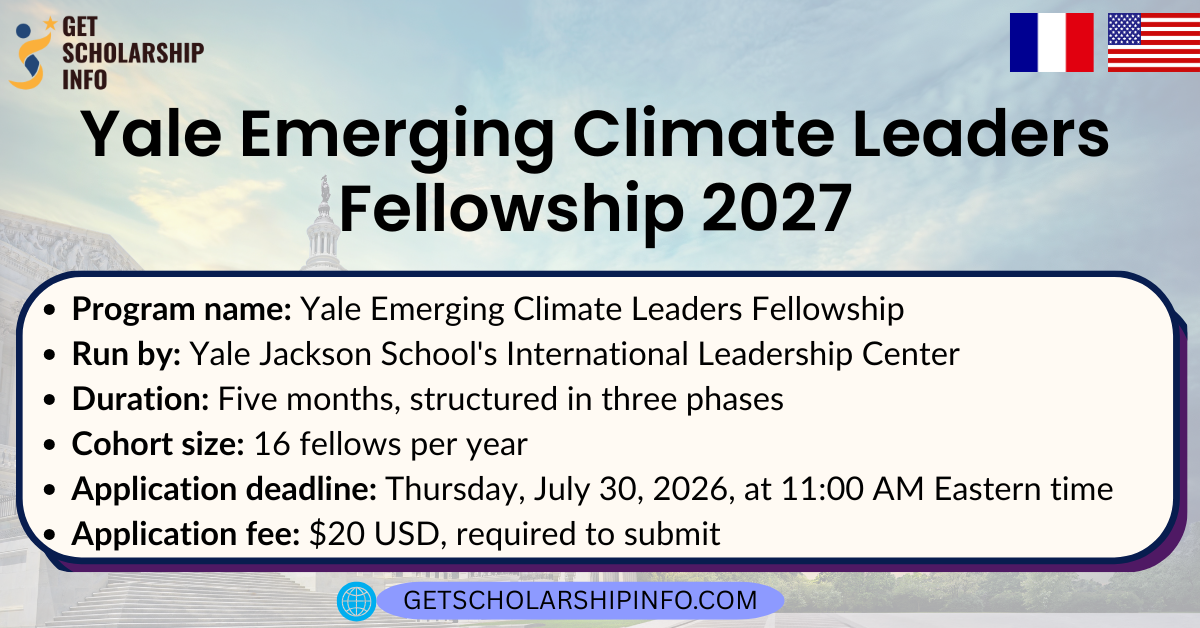
- Program name: Yale Emerging Climate Leaders Fellowship
- Run by: Yale Jackson School’s International Leadership Center
- Duration: Five months, structured in three phases
- Cohort size: 16 fellows per year
- Who it’s for: Mid-career climate and clean energy professionals from the Global South
- Host locations: New Haven, Connecticut (USA) for orientation, and Paris, France for the closing week, with remote sessions in between
- Application deadline: Thursday, July 30, 2026, at 11:00 AM Eastern time
- Application fee: $20 USD, required to submit
- Funding coverage: Yale covers round-trip airfare, hotels, transfers, and most meals for both in-person weeks
- Language requirement: Fluent English is mandatory
What This Fellowship Actually Is:
The Emerging Climate Leaders Fellowship brings together professionals who are already doing serious work in the clean energy and climate space, people ranging from government officials and entrepreneurs to journalists, lawyers, and legislators, and gives them direct access to Yale’s academic firepower alongside global institutions like the International Energy Agency.
The whole thing is anchored at Yale’s International Leadership Center, but it pulls in resources from all across the university, including centers focused on climate communication, carbon capture, environmental law, and sustainable business practices. The idea is not to teach fellows climate science from scratch. It is to sharpen skills they already have, connect them with people who can open doors, and push their thinking on some of the toughest questions in the clean energy transition.
What Fellows Actually Gain From This:
It is easy to list activities, but what matters more is what you actually walk away with once the program ends.
- A direct line to Yale faculty and global experts. You are not watching recorded lectures. You are in the room, or on the call, with people actively shaping climate policy and energy research at the highest levels.
- A professional network that spans continents. Between your cohort of 15 other fellows, Yale faculty, IEA staff, OECD officials, and French government representatives, you leave with contacts that most people spend a decade building.
- Public recognition of your policy work. Fellows present formal policy recommendations to a global advisory board in Paris, and those recommendations get published. That is a real publication credit tied to your name.
- Fully funded travel for the in-person components. Airfare, hotel stays, transfers, and most meals for both the Yale week and the Paris week are covered by the program, which removes a huge barrier for professionals who would otherwise struggle to justify the cost.
- Long-term access to an alumni network. The relationships do not end when the fellowship does. Fellows stay connected through an ongoing alumni community that continues to open professional doors well after 2027.
- A credential that carries weight. Being selected as one of sixteen fellows out of a highly competitive global applicant pool is, by itself, a marker that gets noticed by employers, funders, and international organizations.
Who Should Actually Apply:
This is not an entry-level program, and it is not aimed at recent graduates either. Yale is specifically looking for people who are already established but still climbing.
You are a strong fit if:
- You have somewhere between five and ten years of professional experience in a career connected to clean energy or climate change.
- You already have demonstrated accomplishments at a regional, national, or international level.
- You are based in and representing the Global South, meaning Africa, Asia, the Middle East, or Latin America and the Caribbean.
- Your English is fluent enough to fully participate in fast-paced discussions, presentations, and written work without a language barrier slowing you down.
- You can commit to being physically present for both in-person weeks (Yale in February 2027 and Paris in June 2027), plus six remote sessions on Wednesdays at 9:00 AM Eastern, plus a group project running from March through June.
There is no strict age cutoff. What matters more is where you sit in your career trajectory. Yale wants leaders who are still rising, not people at the very start or the very end of their professional journey.
Beyond the basic requirements, the selection committee is also weighing:
- A track record of real achievement in your professional field
- Genuine commitment to creating impact locally, nationally, or globally
- Clear potential to become a future leader on the national or international stage
- A real hunger to grow your network and learn from global leaders in this space, not just add a line to your résumé
Career Backgrounds Represented in the Cohort:
One of the more interesting things about this fellowship is how varied the fellows’ day jobs actually are. Past and current cohorts have included people from these professional tracks:
- Public servants and government officials
- Entrepreneurs
- Energy company and utility professionals
- Financiers and bankers
- Journalists
- Educators
- Researchers
- Civil society representatives
- Legal advisers
- Legislators
If your work touches climate change or clean energy in any of these capacities, you are within the pool of professions Yale is actively recruiting from.
How the Five Months Actually Unfold:
Understanding the structure matters, because this program asks for real time commitment across three distinct stages.
Stage one: Yale Orientation Week (February 1–5, 2027). This is your in-person introduction, based in New Haven, Connecticut. You will sit through interactive sessions with Yale faculty and outside practitioners, and get exposed to the university’s various climate-focused centers, covering everything from climate communication research to carbon capture technology and environmental law.
Stage two: Remote Learning Journeys (March–June 2027). This is the longest stretch, running as weekly sessions, typically on Wednesdays at 9:00 AM Eastern time. Topics rotate across a huge range of subjects, including global climate governance, decarbonization pathways, renewable energy integration, carbon pricing, energy access gaps, methane reduction, and the geopolitics of clean energy supply chains. Fellows also work together on a collaborative group project during this stretch.
Stage three: Paris Closing Week (June 14–18, 2027). The fellowship wraps up with an in-person gathering in Paris. Fellows meet with analysts from the International Energy Agency and the OECD, along with French government officials and representatives from civil society, academia, and the private sector. This week ends with fellows presenting formal policy recommendations to a global advisory board, which then get published.
Applying: What You Need to Prepare
The whole process runs online. There are no physical forms, no mailing documents anywhere.
Here is what your application needs to include:
- A résumé or CV, capped at three pages
- A short video statement
- A personal statement, no longer than 600 words
- One letter of recommendation
You can start your application anytime before the deadline, save your progress, and submit whenever it is ready. Once you create your account, you will be able to upload documents and request your recommendation letter directly through the portal.
A word of caution from the program itself: submit at least 24 hours before the deadline. No extensions are granted under any circumstances, so do not leave this until the final hour.
The Application Fee and Funding Setup:
Here is something worth flagging clearly since it trips people up. Submitting your application requires a $20 USD electronic fee. This is a relatively small amount compared to many international fellowship applications, but it is not free.
On the funding side, though, Yale is generous. Once you are selected, the program covers round-trip airfare, hotel accommodation, and transfers for both the Yale orientation week and the Paris closing week. Most meals during these periods are also provided. So while there is a modest cost to apply, the actual fellowship experience itself does not require fellows to cover the expensive parts, like international flights and hotel stays.
Key Deadline Information:
Applications for the 2027 cohort close on Thursday, July 30, 2026, at 11:00 AM Eastern time. Given the time zone differences most applicants will be working across, it is worth converting that exact time to your local zone well in advance so you are not scrambling at the last minute.
Frequently Asked Questions?
Is this fellowship fully funded?
Partially. There is a $20 application fee, but once selected, Yale covers travel, accommodation, and most meals for the two in-person weeks in New Haven and Paris.
Who runs the Yale Emerging Climate Leaders Fellowship?
It is housed at Yale’s International Leadership Center within the Jackson School, overseen by Paul Simons, a former IEA Deputy Executive Director and retired U.S. ambassador, alongside Director Emma Sky and the ILC team.
Can applicants from any country apply?
No. The program is specifically designed for representatives of the Global South, meaning applicants from Africa, Asia, the Middle East, or Latin America and the Caribbean.
Do I need a specific degree to qualify?
There is no stated degree requirement. What matters is five to ten years of professional experience with demonstrated accomplishments in a climate or clean energy related field.
Is remote participation enough, or do I have to travel?
Both in-person weeks are mandatory. Only the March through June learning sessions and group project work happen remotely.
What language is the program conducted in?
English. Fluency is required since all sessions, discussions, and written materials are conducted in English.
Is there an age limit to apply?
No official minimum or maximum age is listed. The focus is on career stage rather than age, specifically professionals who are still on the rise rather than just starting out or already at the very top.
What happens if I miss the submission deadline?
No extensions are granted, so late applications will not be accepted under any circumstances.
Why This Program Stands Out From Other Fellowships:
There are plenty of climate fellowships out there, but a few things separate this one from the pack. First, the selectivity works in your favor once you are in. With only sixteen spots filled from a global applicant pool, the group you end up sitting next to in New Haven and Paris is genuinely exceptional, which means the conversations, debates, and collaborative work carry real weight.
Second, the format avoids the trap that a lot of long-distance programs fall into, where remote sessions feel disconnected from the in-person components. Here, the structure is deliberately sequential. Orientation sets the foundation, the remote sessions build depth over several months, and Paris pulls everything together into a concrete, published output. You are not just attending sessions for the sake of attendance; you are working toward something that gets shared publicly and archived under your name.
Third, the emphasis on geographic and professional balance means you are not spending five months talking to people who think exactly like you. A journalist from Southeast Asia might be paired on a group project with an energy company executive from West Africa and a legislator from Latin America. That kind of friction and cross-pollination is exactly where the real learning tends to happen.
Tips for a Stronger Application:
Given how competitive this fellowship is, a few practical pointers can make a real difference in how your application comes across.
- Keep your personal statement focused on concrete accomplishments rather than broad ambitions. Reviewers are looking for evidence, not aspirations.
- Choose a recommender who can speak specifically to your leadership and impact, not just someone with a senior title.
- Treat the video statement as seriously as the written materials. It is often the first thing that puts a face and voice behind your application.
- Submit early. Technical issues, time zone confusion, or last-minute document requests can derail even a strong application if you wait until the final hours.
- Be specific about how your background connects to clean energy or climate change, even if your job title does not obviously suggest it, such as journalism, law, or finance roles that intersect with the sector.
Final Word:
This fellowship is built for people who already have something to show for their careers and are ready to take the next step with global exposure behind them. Between the funded travel, the Yale and Paris access, and the lasting network you walk away with, the $20 application fee is a small price for what is genuinely one of the more substantial international opportunities available to Global South climate professionals right now. If you fit the profile, the July 30 deadline is closer than it feels, so it is worth starting your materials sooner rather than later.
