Turkey is stepping into the global spotlight this November as it hosts COP31, one of the biggest climate gatherings on the planet, and the country is opening its doors to thousands of young people who want to be part of it. If you have ever wanted to sit at the same table as world leaders, diplomats, and climate experts, even if only as a volunteer wearing the official blue polo, this might be the opportunity you have been waiting for.
The COP31 Volunteer Program is not your average “help out for a weekend” gig. It is a structured, months-long journey that takes you from an online application form all the way to standing on the floor of the Antalya EXPO Center while presidents and ministers walk past you. Because interest has been so overwhelming, especially from applicants outside Turkey, the organizing committee has just pushed back the application deadline, giving more people a real shot at getting in.
Below, we have broken down everything you need to know, from who can apply to what you actually get out of it, so you are not left digging through scattered announcements.
What Exactly Is COP31?
Before diving into the volunteer side of things, it helps to understand what you would actually be volunteering for.
COP, short for Conference of the Parties, is the yearly meeting where countries that signed the United Nations Framework Convention on Climate Change come together to hash out climate policy. These conferences have been running since 1995, and they are where major global agreements on emissions, finance, and adaptation get negotiated. COP31 marks the 31st edition, and this year it lands in Antalya, Turkey, running from November 9 to 20, 2026.
Murat Kurum, who is presiding over COP31, has been vocal about wanting this edition to be different. His stated goal is to turn commitments into actual policy, and he has specifically pointed to youth as central players in that shift, not just spectators watching from the sidelines. That is a big part of why the volunteer program exists in the first place.
Key Program Details:
Here is the quick-reference version before we get into the finer points:
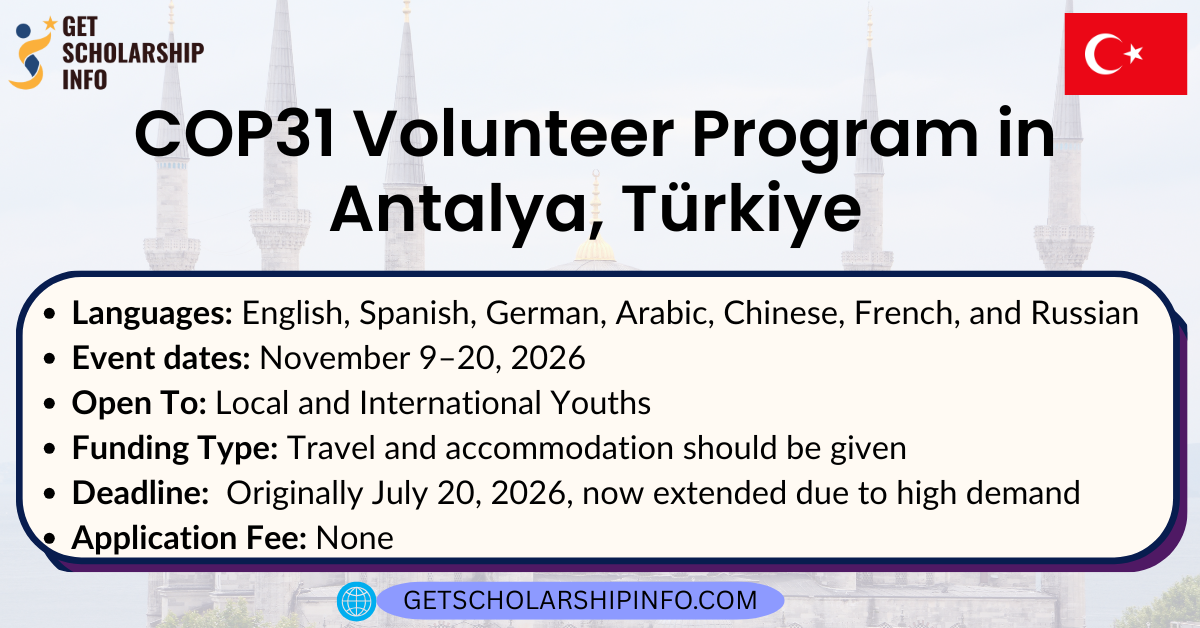
- Event dates: November 9–20, 2026, at Expo 2016 Antalya in the Solak neighborhood of the Aksu district
- Application window: Originally May 22 to July 20, 2026, now extended due to high demand, particularly from international applicants
- Who can apply: Turkish citizens, international students studying in Turkey, foreign youth nominated through diplomatic missions, and Turkish diaspora youth living in Europe
- Program size: Around 5,000 volunteers total, with roughly 1,500 spots reserved for international participants
- Cost to apply: No application fee is mentioned anywhere in the official materials
- Funding status: Not a paid position, but travel and accommodation for international volunteers are intended to be covered by their home country or nominating institution
- Languages assessed: English, Spanish, German, Arabic, Chinese, French, and Russian
- Application platform: Entirely online through the official COP31 Volunteers website
Why Bother Volunteering? What You Actually Gain:
A lot of volunteer programs promise vague things like “great experience,” and leave it at that. This one is a bit more concrete about what is in it for you.
First, there is the international exposure. You are not folding chairs at a local event; you are working alongside heads of state, ministers, and delegations from around the world. That kind of environment forces you to sharpen your communication skills fast, and it looks genuinely impressive on a CV or LinkedIn profile.
Second, the training itself has real value. Selected volunteers go through a structured online learning program covering topics like sustainability, carbon footprints, green transition, and event management. This is not a one-hour orientation video; it is described as a modular course built with expert trainers, meaning you walk away with knowledge you can actually use later, whether in a climate-related career or just in general professional life.
Third, there is a recognition system built into the whole thing. Volunteers earn digital badges, Bronze, Silver, and Gold, based on their contribution and performance. These badges are not just for show either. They directly feed into career and internship opportunities that come after the summit wraps up. In other words, the people who put in solid effort during COP31 get pointed toward internships in sustainability, environmental policy, or international organization management afterward.
Fourth, and this matters a lot for international applicants, there is a genuine attempt to remove financial barriers. The program states that travel and accommodation costs for international volunteers are targeted to be covered by their relevant countries or nominating institutions, which is a meaningful gesture toward making this accessible beyond wealthy applicants.
Finally, you become part of a long-term network. The organizers are explicit that this is not meant to be a one-off event volunteer pool. They want to build a lasting youth ecosystem around sustainability in Turkey, connecting national and international young people who care about climate issues.
Who Should Apply?
The eligibility net here is cast wide, which is refreshing compared to many international programs that quietly favor one nationality or background.
Four groups are explicitly named as eligible:
- Turkish Republic citizens who are university students or young professionals
- International students currently studying in Turkey
- International young volunteers nominated through their country’s foreign missions or diplomatic representations
- Turkish diaspora youth living across Europe
Beyond nationality, though, the organizers are looking for a specific mix of soft skills and mindset. This is where it gets a bit more selective:
- Strong command of English, with points for knowing additional UN languages
- Solid communication skills, including active listening and clear expression
- A genuine ability to work well in diverse, mixed teams
- Composure under pressure, since large international events can get chaotic fast
- Physical and mental stamina for long shifts and busy crowds
- Professional bearing and etiquette suitable for representing an international host country
- Sharp situational awareness and the ability to follow layered instructions correctly
- A willingness to actually engage with the training content and adapt to digital learning systems
- Real interest in climate change and sustainability, not just interest in attending a big event
- Openness to different cultures and comfort working alongside people from vastly different backgrounds
If you read between the lines, the program is not just filtering for English speakers who show up on time. They want people who can represent Turkey’s climate diplomacy vision to a genuinely global audience, so soft skills and cultural sensitivity carry real weight in the evaluation.
Where You Might Actually Work: Focus Areas of COP31:
Volunteers will not all be doing the same job. The summit itself revolves around ten priority themes that shape how the event runs and where different teams of volunteers may be deployed or briefed on:
- Zero Waste
- Oceans and Seas
- Food Security
- Climate-Resilient Cities
- Strengthening Climate Action through Financial and Institutional Support
- Youth and Education
- Green Industrialization
- Rio Synergy
- Clean Energy Transition
- Dynamic and Resilient Health Systems
Alongside these themes, cross-cutting topics like climate finance, technology transfer, and capacity building run through nearly every session, meaning volunteers with interests in those areas will likely find relevant tasks no matter which team they land on.
The Application Process, Step by Step:
This program does not hand out volunteer badges to anyone who fills out a form. It runs through a multi-stage filtering process, and understanding each stage ahead of time will help you prepare properly instead of getting caught off guard.
- Announcement and awareness stage: The program is promoted through universities, youth centers, civil society groups, and digital platforms, both inside Turkey and internationally
- Online application: You submit your details through the official website, where a digital system collects and manages candidate data
- General knowledge and aptitude check: Candidates are tested on general awareness and reasoning ability
- Foreign language evaluation: Your proficiency gets assessed in your chosen language, with English being the primary requirement and six other UN languages available
- Video interview: A one-on-one style interview conducted remotely
- Group interview: Candidates are evaluated together, likely to assess teamwork and how you interact with others under a group setting
- Results and selection: Successful candidates are notified and moved into the training phase
The Full Program Timeline:
Because this runs over several months, it helps to see the whole arc laid out:
- Application phase: May 22 to July 20, 2026 (now extended)
- Evaluation phase: July 20 to August 10, 2026
- Training phase: August 10 to September 25, 2026
- Summit coordination: November 2 to November 21, 2026
- Internship and career program: December 2 to December 25, 2026
Notice that the commitment does not end when COP31 wraps up in late November. There is a dedicated follow-up phase in December specifically built around internship and career placement, which reinforces that this program is genuinely trying to be more than a two-week event badge.
A Quick Note on the Deadline Extension:
If you have been holding off because you thought you missed your chance, here is some good news. The organizing team announced that due to unexpectedly strong interest, particularly the high volume of applications coming from outside Turkey, they have extended the application window. So if you assumed the July 20 date was your final shot, it is worth checking the current status on the official site before you count yourself out.
Frequently Asked Questions?
Who is actually allowed to attend COP31 itself?
COP31 is open to accredited delegations, observers, media outlets, and civil society partners. For the general public, participation happens through the Green Zone, which anyone can access without special accreditation.
Where exactly is the venue, and how do people get there?
The summit takes place at Expo 2016 Antalya, located in the Solak neighborhood of the Aksu district. It is reachable from Antalya Airport, which handles international flights, and dedicated shuttle services are being arranged specifically for COP31 attendees and volunteers.
Will there be help with travel and accommodation for volunteers?
This is still being coordinated at the administrative level, so specifics have not been finalized. The advice from organizers is to keep an eye on official announcements as the event gets closer.
What are the main themes COP31 will focus on?
The action agenda centers on ten themes: Zero Waste, Oceans and Seas, Food Security, Climate-Resilient Cities, the Climate Action Bridge, Youth and Education, Green Industrialization, Clean Energy Transition, Rio Synergy, and Dynamic and Resilient Health Systems. Finance, technology transfer, and capacity building run underneath all of these as supporting elements.
I applied but never got a confirmation email. What happened?
This usually comes down to a typo in the email address entered during application. Double-check the address you submitted, and if it was entered incorrectly, you may need to reapply or contact the support team through the official website.
Is there a fee to apply for the volunteer program?
No application fee is mentioned anywhere in the official program materials, so applying should not cost you anything.
Is this a paid volunteer position?
No, it is unpaid. However, international volunteers are expected to have their travel and accommodation costs covered by their home country or nominating institution, rather than paying out of pocket.
Final Thoughts:
If you care about climate issues and want more than a certificate to show for it, this program offers a rare combination: direct exposure to international diplomacy, structured training with actual educational value, a recognition system tied to real career outcomes, and a genuine attempt to include young people from outside Turkey without pricing them out through travel costs. With the deadline now extended, there is still time to put together a strong application before the evaluation phase begins in August.
Whether you are a university student in Istanbul, an exchange student in Ankara, or a young diaspora Turk living in Berlin or Paris, the door is open right now, and it will not stay that way indefinitely once the extended window closes.
