There is a certain kind of opportunity that does not show up with a flashy countdown timer or a one-time deadline. The United Nations Volunteers program is exactly that kind of opportunity. It runs continuously, pulling in professionals from over 180 nationalities, and placing them in assignments that range from refugee protection camps to logistics hubs during humanitarian crises. If you have professional experience and a genuine interest in international development, peacekeeping, or humanitarian work, this program deserves a serious look.
Unlike a typical scholarship with a fixed application window, UNV works through an open talent pool. You register once, keep your profile updated, and apply whenever assignments matching your background come up. That structure alone makes it worth understanding properly, since there is no single “deadline” to rush toward. Instead, your goal is to get your profile ready and visible for the right opportunity whenever it lands.
Quick Snapshot of the Program:
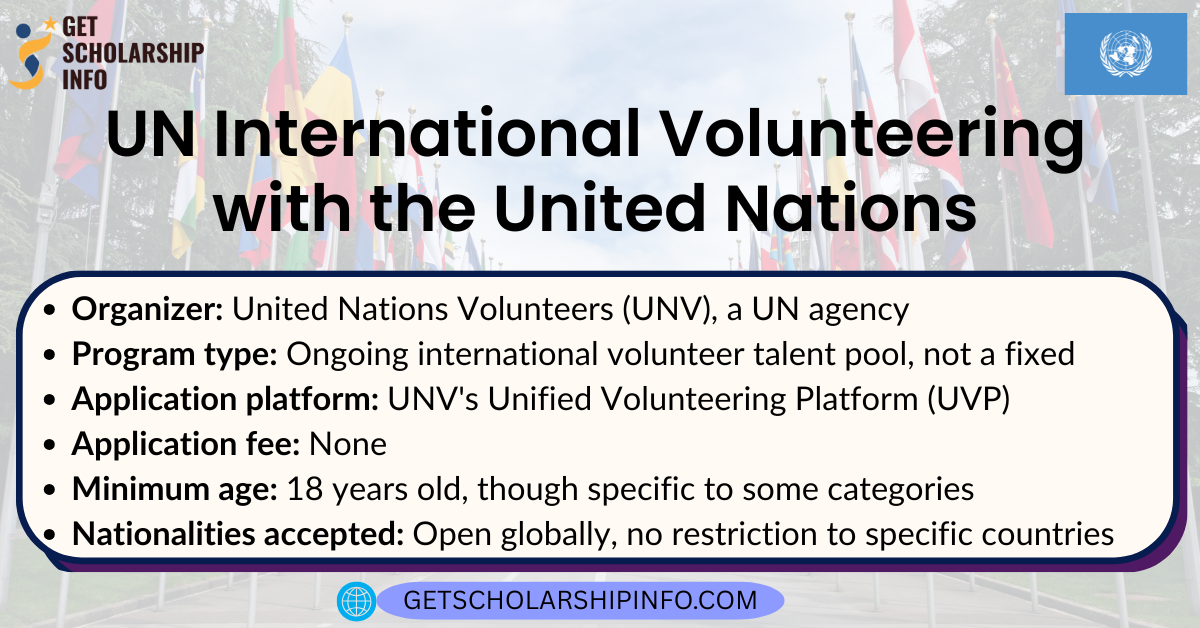
- Organizer: United Nations Volunteers (UNV), a UN agency
- Program type: Ongoing international volunteer talent pool, not a fixed-cycle program
- Application platform: UNV’s Unified Volunteering Platform (UVP)
- Application fee: None
- Minimum age: 18 years old, though specific categories set different age ranges
- Education needed: Higher technical diploma, bachelor’s, or master’s degree for most assignments
- Experience needed: Ranges from 0 years for youth volunteers to 15 or more years for expert volunteers
- Languages: English, French, or Spanish, at a good working level
- Compensation: A Volunteer Living Allowance to cover basic living costs at your duty station, plus other entitlements
- Nationalities accepted: Open globally, no restriction to specific countries
Why This Program Is Different From a Regular Scholarship or Job:
Most opportunities you come across online fall into one of two buckets: a scholarship that funds your education, or a job that pays you a salary. UNV sits somewhere in between. It is not free tuition, and it is not a conventional paycheck either. Instead, volunteers receive a living allowance designed to cover their basic needs at their assigned duty station, along with additional entitlements laid out in UNV’s official Conditions of Service.
What makes this genuinely different is the mission behind it. You are not filling a seat in a classroom or clocking hours for a company’s bottom line. You are stepping into roles that directly support UN agencies working on peace, humanitarian relief, and development in places that need it most, sometimes in the middle of an active crisis response.
What You Actually Walk Away With:
It helps to separate what you do from what you gain, because the long-term value here goes well beyond the assignment itself.
- A living allowance and defined entitlements, so your basic needs at your duty station are covered while you serve.
- International, resume-defining experience that employers consistently recognize as a marker of adaptability and cross-cultural competence.
- A genuinely global professional network, built from working alongside people from 180-plus nationalities and multiple UN agencies.
- Direct exposure to real humanitarian and development operations, not simulated case studies or theoretical coursework.
- Language and cultural fluency gained from living and working in a country different from your own.
- A tangible sense of impact, since your work contributes to the UN’s Sustainable Development Goals and supports communities facing poverty, conflict, or post-conflict recovery.
- Long-term career mobility, as many international UN Volunteers go on to permanent roles within the UN system or related international organizations after their assignments.
Do You Actually Qualify?
Eligibility depends heavily on which volunteer category you fall into, since UNV runs several tracks based on age and experience level.
Age requirements by category:
- UN Youth Volunteers and UN University Volunteers: 18 to 26 years old
- UN Volunteer Specialists: 27 to 80 years old
- UN Expert Volunteers: 35 to 80 years old
Experience requirements by category:
- UN Youth Volunteers and University Volunteers: 0 to 3 years of experience
- UN Volunteer Specialists: 3 to 15 years of experience
- UN Expert Volunteers: 15 years of experience or more
Beyond age and experience, a few other requirements apply across the board:
- A higher technical diploma, bachelor’s degree, or master’s degree is required for most assignments, and you will need to provide credentials.
- You must have good working knowledge of at least one of UNV’s three official working languages: English, French, or Spanish.
- Depending on where you are assigned, additional language skills such as Arabic, Portuguese, or Russian may be required.
- Prior volunteering or working experience in a developing country is considered a strong asset, though not always mandatory.
- You need strong interpersonal and organizational skills, along with a real willingness to work in multicultural, sometimes difficult, environments.
- A demonstrated commitment to the values of volunteering and respect for diversity matters just as much as your technical qualifications.
UNV is also explicit about wanting broader representation. Women and candidates from minority groups are actively encouraged to apply, and application processes are designed to remain accessible to marginalized applicants, not just those with strong internet access or formal networks.
Where the Demand Is Right Now:
UNV maintains a list of fields where they consistently need people, both for rapid emergency deployment and for longer-term assignments. If your background falls into any of these areas, your profile is likely to attract attention faster.
Fields in high and consistent demand include:
- Information Technology
- Engineering
- Logistics and Transport
- Legal Services
- Medicine and Health
- Political Science
- Public Information
- Administration and Finance
- Development Studies
- Management
- Humanitarian Affairs
- Peacekeeping Operations
- Refugee and Human Rights Protection
- Information Management and GIS
- Water, Sanitation, and Hygiene (WASH)
- Monitoring and Evaluation
For rapid emergency deployment specifically, UNV concentrates its readiness around five core areas: Protection, Information Management, Logistics, Water and Sanitation, and Monitoring and Evaluation. These are the teams activated first when something like a natural disaster, disease outbreak, or refugee crisis hits and a coordinated UN response needs to move fast.
A Closer Look at the Rapid Deployment Roles:
If emergency response work interests you specifically, it is worth understanding what each of these five priority areas actually requires.
Protection work covers refugee protection, child protection, and human rights protection. You will typically need a university degree in law, international law, human rights, international relations, or a related social science field, along with two to three years of direct experience working with refugees or other populations of concern.
Information Management roles need a degree in information systems, GIS, social sciences, statistics, or economics. Two to three years of relevant experience is expected, ideally with governmental bodies, NGOs, or international organizations, along with solid reporting skills and familiarity with mapping tools like ArcGIS.
Logistics positions call for a degree in business administration, engineering, logistics, or mathematics, paired with two to three years of hands-on experience in supply chain work, transport, warehousing, port operations, or air transport.
WASH (Water, Sanitation, and Hygiene) assignments require a background in civil engineering, mechanical engineering, sanitation engineering, geology, hydrology, or environmental public health, along with two to three years of relevant field experience in water supply systems, purification, or pump installation.
Monitoring and Evaluation roles need a degree in economics, statistics, project planning, development studies, or a related social science, plus at least three years of proven experience in project monitoring and evaluation within development or humanitarian contexts, including familiarity with results-based management approaches.
How the Selection Process Actually Works:
Every UNV assignment comes with its own specific description, covering the exact education, age, and competency requirements for that role. There is no single universal checklist since roles vary so widely, from central offices to remote field duty stations.
Once you have applied for a specific assignment, the process typically unfolds like this:
- Your application and profile are reviewed against the specific description of the assignment
- Shortlisted candidates go through a competitive interview process
- The UNV Field Unit evaluates your track record, motivation, attitude toward volunteering, and personal qualities such as teamwork and leadership
- The Host Entity, meaning the specific UN agency requesting the volunteer, separately assesses your technical skills
- Successful candidates are matched to their assignment and briefed on next steps
Registering in the Global Talent Pool: Step by Step
Before you can apply for anything, you need a complete profile on UNV’s Unified Volunteering Platform. Here is how that process works.
- Create an account by entering your basic information. You will receive a numeric verification code by automated message, which you then enter to activate your account.
- Once inside your account, you will see a task on your dashboard prompting you to complete your profile. This is where you enter your skills, education, and professional experience in full.
- Fill in every required field. Missing mandatory information will stop you from submitting.
- Submit your completed profile.
- Start browsing available assignment descriptions and apply to the ones matching your background.
A few practical details worth knowing before you start:
- You can build your profile in English, French, or Spanish, but profiles in French or Spanish are mainly matched to assignments in French- or Spanish-speaking countries. If you are comfortable in English, UNV recommends using it for broader visibility.
- Your profile is the only source of information UNV uses to match you with assignments, so vague or incomplete descriptions of your past work will hurt your chances. Be thorough and specific.
- You can reuse parts of previous applications when applying to new assignments, but tailoring each one to the specific role gives you a real edge.
- You cannot upload or email your CV directly. Instead, you copy and paste relevant details straight into the platform fields.
- Creating a full profile takes roughly 45 minutes, and it is worth logging back in at least once a year to keep it active and current.
The Bigger Picture: Why This Work Matters
Beyond the personal career benefits, it is worth remembering the scale of what this program contributes to globally. In 2022 alone, over 12,000 UN Volunteers were deployed worldwide, with a little over 60 percent serving as national volunteers and just over half of all volunteers being women. These numbers reflect a program that is not just symbolic but operationally significant, feeding real capacity into UN agencies tackling some of the world’s toughest humanitarian and development challenges.
Frequently Asked Questions?
Is there an application fee to become a UN Volunteer?
No. Registering on UNV’s Unified Volunteering Platform and applying for assignments is completely free.
Do UN Volunteers get paid a salary?
Not a traditional salary. Volunteers receive a Volunteer Living Allowance to cover basic living costs at their duty station, along with other entitlements outlined in UNV’s Conditions of Service.
What is the minimum age to apply?
You must be at least 18 years old to register on the platform. Specific age ranges apply depending on the volunteer category, from 18-26 for youth volunteers up to 80 for specialist and expert volunteers.
Do I need a specific degree to become a UN Volunteer?
Most assignments require at least a higher technical diploma, bachelor’s degree, or master’s degree, though exact requirements vary by role and are listed in each individual assignment description.
What languages do I need to know?
Good working knowledge of at least one of English, French, or Spanish is required. Some duty stations may also require Arabic, Portuguese, or Russian depending on the assignment location.
How long does it take to complete a profile on the platform?
Roughly 45 minutes for a full, complete profile, though you can return and update it at any time afterward.
Can I apply without prior international experience?
Yes, particularly for Youth Volunteer and University Volunteer categories, which accept candidates with 0 to 3 years of experience. Prior international or developing-country experience is a plus, not a strict requirement.
Final Thoughts:
The UN Volunteers program is not a quick, one-off application like many scholarships you might be used to. It asks for a genuinely complete profile, patience while assignments come up, and a real willingness to work in demanding, sometimes unpredictable environments. In exchange, it offers something few other programs can match: a direct role in real UN operations, a living allowance to support you while you serve, and a professional network and experience base that stays with you for the rest of your career. If your background fits any of the high-demand fields listed above, there is no reason to wait for a specific deadline. Registering your profile today puts you in the pool the moment the right assignment appears.
