Australia’s top-ranked university has put real money behind a single, focused cause: funding graduate researchers whose work centres on human rights. The University of Melbourne’s Human Rights Scholarship isn’t a broad, catch-all research grant. It’s built specifically for students digging into human rights as their core research focus, and it backs that commitment with one of the more generous funding packages you’ll find attached to a graduate research degree in Australia. If that’s the kind of research you’re planning, or already doing, here’s everything worth knowing before you apply.
The Scholarship in a Nutshell:
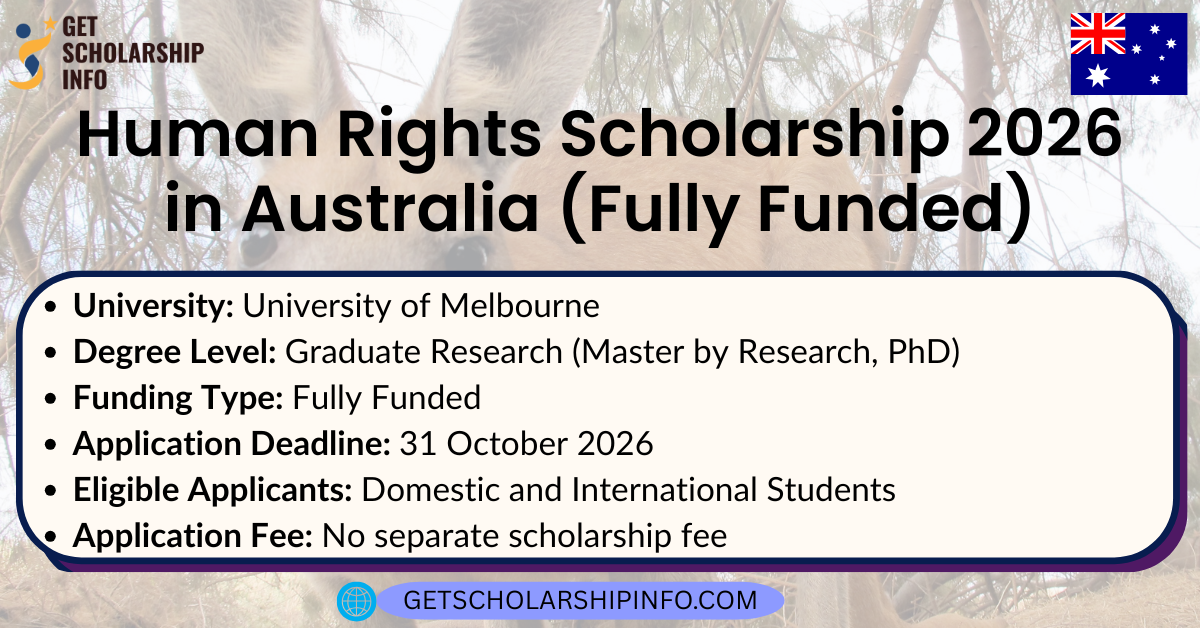
This scholarship exists to support both domestic and international students undertaking graduate research specifically in the field of Human Rights. It covers tuition in full and pairs that with a substantial living allowance, meaning successful candidates aren’t just getting help with fees while quietly struggling to cover rent and daily expenses. Only four scholarships are awarded, so this is a genuinely competitive, merit-based process rather than something offered broadly to every eligible applicant.
Key Details Worth Knowing First:
- Scholarship Name: Human Rights Scholarship
- Host Institution: University of Melbourne, Australia
- Study Level: Graduate research, covering both Master by Research and Doctoral degrees
- Field of Research: Human Rights
- Application Window: Opens 1 April 2026 and closes 31 October 2026
- Number of Scholarships: 4 available
- Total Value: 100 percent fee remission, plus a benefit amount ranging from $89,000 to $155,000 depending on your course and duration
- Nationality: Open to both domestic and international students
- Application Fee: Not mentioned, so there’s no cost tied to applying
- Outcome Notification: Applicants are informed by email in February of the following year
What This Scholarship Actually Covers:
It’s worth breaking this down properly, since the total benefit isn’t just one lump sum but a combination of several types of support working together.
- A living allowance of $44,500 per year, pro rata based on the 2026 full-time study rate, provided for up to 2 years for a Master by Research degree or up to 3.5 years for a Doctoral degree
- Annual indexing of the living allowance, meaning the amount is adjusted over time rather than staying fixed for the full duration
- Limited paid sick, maternity, and parenting leave built into the living allowance structure
- Full fee offset, covering up to 2 years for a Master by Research degree or up to 4 years for a Doctoral degree
- A relocation grant of $2,000 for students moving from another Australian state or territory, or $3,000 for students relocating from outside Australia entirely
- Overseas Student Health Cover (OSHC) Single Membership, provided for international students who require a student visa to study in Australia
Beyond the direct financial support, being awarded this scholarship also means joining a research environment at Australia’s number one ranked university, with all the academic infrastructure, supervision quality, and professional credibility that comes with that standing.
Who Should Be Applying:
Eligibility here is tightly defined, since the scholarship is designed for a specific stage of your academic journey rather than open broadly to anyone interested in human rights research.
- You must have already received an offer for a graduate research degree, commencing in the same year the scholarship is awarded
- Your intended research must sit specifically within the field of Human Rights
- You must not have already completed a research qualification at the same level, or a higher level, than the course you’re applying for the scholarship to support
Because an actual course offer is a prerequisite, it’s worth treating your university application and your scholarship application as two connected steps rather than something you can leave until after enrolment is sorted.
How Applications Are Actually Assessed:
The selection process here is straightforward but genuinely competitive. Scholarships are awarded to the highest-ranked candidates based on a combination of their written application and their course entry score. Because only four scholarships are available each cycle, a strong, well-articulated application matters just as much as your academic record.
Which Field of Study This Scholarship Supports:
Unlike broader research scholarships that span multiple disciplines, this one is intentionally narrow. It’s designed to fund research within a single core area:
- Human Rights
Within that field, the scholarship supports two graduate research pathways: a Master by Research degree, or a Doctoral degree. Whichever pathway you choose, your proposed research needs to clearly connect to human rights as its central focus, since that’s the specific criteria the selection panel is assessing against.
What Your Application Actually Needs to Show:
This scholarship asks for more than academic credentials alone. As part of your online application, you’re expected to address your genuine commitment to the peaceful advancement of respect for human rights, extending beyond your academic work into things like voluntary work or relevant professional experience. You’ll also need to clearly explain how your proposed research will deepen your understanding of human rights and position you to contribute meaningfully to the field going forward.
Steps to Apply:
- Confirm you already have, or are in the process of securing, an offer for a graduate research degree commencing in the relevant year
- Make sure your proposed research is clearly and specifically framed within the field of Human Rights
- Prepare your written application, including a clear account of your commitment to human rights beyond your academic studies
- Submit your application online within the specified application window, from 1 April 2026 to 31 October 2026
- Wait for the outcome, which will be communicated by email in February of the following year
- Understand that individual feedback or reasons for non-selection are not provided, so it’s worth putting genuine care into your written submission the first time around
Understanding How Your Scholarship Payments Actually Work:
If you’re awarded this scholarship, there’s a fair amount of practical administration worth understanding early, since it affects when and how you actually receive your funding.
- Scholarship payments are processed fortnightly through the University’s payroll system
- Your first payment depends on payroll cut-off dates, so if your course commencement date falls after a cut-off, your first payment may not arrive until the following pay cycle, sometimes with a delay of up to three weeks
- Any missed stipend from that delay is automatically processed as a back payment in your next pay cycle
- Taking a leave of absence during your research can affect your stipend payments, so it’s worth reviewing your scholarship offer letter closely for the specific terms that apply to you
- You’ll need to provide the details of an Australian bank account through the university’s online portal to receive payments, since scholarship funds can only be paid into an Australian account
- If you’re located outside Australia and don’t yet have a local bank account, you can wait until you arrive and set one up, though this will delay your first payment until it’s been added
Fee Remission and Health Cover Details:
Domestic students awarded a Masters by Research or Doctoral place through this scholarship are enrolled in a fee-exempt position and receive a Research Training Program Fee Offset Scholarship, acknowledging the Australian Government’s contribution to tuition costs. It’s worth noting this fee remission doesn’t cover the Student Services and Amenities Fee, so if that appears on your Statement of Liability, it remains your responsibility to pay.
International students receiving a partial or full fee remission will have that remission activated once they’ve accepted both their course and scholarship offers, ahead of their course start date. If an invoice still appears afterward, reaching out to the university’s student service centre directly resolves that. For those requiring a student visa, Overseas Student Health Cover is arranged and covered automatically as part of the scholarship where applicable.
Acknowledging Government Funding in Your Research:
Since much of this scholarship’s structure ties back to Commonwealth funding, there’s a formal requirement around acknowledgment. If your scholarship includes a Research Training Program component or fee offset, your thesis, publications, or related creative works need to include a specific acknowledgment statement referencing the Commonwealth’s support, along with the official RTP DOI reference. If you maintain an ORCID profile, that same acknowledgment needs to be added there as well. Domestic graduate researchers automatically receive this fee offset scholarship as part of their course offer, meaning this acknowledgment requirement applies broadly across recipients.
Tax and Centrelink Considerations:
A few financial details are worth understanding if you’re an Australian resident managing your own finances alongside your research. Scholarship payments are generally exempt from income tax, provided you’re enrolled full-time and the funding is for educational purposes rather than tied to an employment agreement. If you’re studying part-time, the university will withhold tax from your payments to avoid an unexpected tax debt building up over time.
For those receiving or applying for Centrelink benefits, most University of Melbourne scholarships are treated as equity or merit-based, meaning they’re exempt from the Centrelink income test as long as they stay below a set payment threshold. Amounts above that threshold may affect your Centrelink payment rate, and it’s your responsibility to notify Centrelink of any scholarship funding you receive, since the university won’t do this on your behalf.
What Happens If Your Circumstances Change:
Scholarships under this program are generally awarded for their maximum duration and can’t simply be extended. That said, changes to your enrolment, such as taking leave, adjusting your study rate, withdrawing from your degree, or submitting your thesis early, can all affect your payments or the overall duration of your funding. Your specific scholarship offer letter outlines the exact terms that apply, so it’s worth keeping that document on hand throughout your candidature rather than relying on memory.
Frequently Asked Questions?:
Is the University of Melbourne Human Rights Scholarship fully funded?
Yes. It includes 100 percent fee remission along with a living allowance, relocation grant, and health cover for eligible international students, with a total benefit value between $89,000 and $155,000.
Can international students apply for this scholarship?
Yes. It’s open to both domestic and international students undertaking graduate research in Human Rights.
Is there an application fee?
No application fee is mentioned in the official scholarship details.
How many scholarships are awarded each cycle?
Four scholarships are available.
Do I need a course offer before applying for this scholarship?
Yes. You must have already received, or be in the process of receiving, an offer for a graduate research degree commencing in the relevant scholarship year.
How long does the funding last?
Up to 2 years for a Master by Research degree, or up to 3.5 years for the living allowance and up to 4 years for the fee offset in a Doctoral degree.
When is the application deadline?
Applications open on 1 April 2026 and close on 31 October 2026.
When will I find out if I’ve been selected?
Outcomes are communicated by email in February of the following year. Specific feedback or reasons for non-selection are not provided.
Can I have completed a similar qualification before applying?
No. You must not have already completed a research qualification at the same or a higher level than the course you’re seeking the scholarship for.
Does the scholarship affect my Centrelink payments?
It can, if the amount you receive exceeds the relevant payment threshold. You’re required to notify Centrelink of any scholarship funding you receive.
Before You Submit Your Application:
Given how specifically this scholarship is tied to human rights as a field, and how directly the panel evaluates your broader commitment to the cause, the strongest applications tend to come from candidates who can speak honestly about their engagement with human rights beyond the classroom, whether through volunteering, prior work, or lived research experience. Take real time to connect your proposed project to that bigger picture before you submit, since a strong course entry score alone won’t carry your application on its own in a process this competitive.
