Not many doctoral programmes ask you to genuinely work across five different academic fields at once, rather than narrowing you down to one from day one. Scuola Superiore Sant’Anna in Pisa, Italy, has built exactly that kind of PhD, sitting at the crossroads of law, politics, and philosophy, and fully funding every candidate who’s admitted. If your research interests refuse to sit neatly inside one discipline, this programme deserves a proper look, whether you’re preparing for the next call or simply mapping out your options for the year ahead.
Since this year’s call has already closed, here’s a full breakdown of how the programme works, based on the most recent cycle, so you know exactly what to prepare before the next round opens.
An Italian Doctoral School Built Around Interdisciplinary Work:
Scuola Superiore Sant’Anna is one of Italy’s most selective public universities, and its PhD in Human Rights, Global Politics and International Studies reflects that same academic rigour. Rather than assigning students to a single narrow specialism, the programme is deliberately structured around five overlapping research areas, encouraging candidates to explore genuine intersections between international law, political philosophy, and global governance. The entire programme runs in English, is fully residential in Pisa, and every admitted student receives a scholarship, since Italian regulations don’t permit self-funded candidates on this kind of doctoral track.
How the Most Recent Call Was Structured:
Understanding the shape of the last cycle gives you a realistic sense of what to expect once the next call is published.
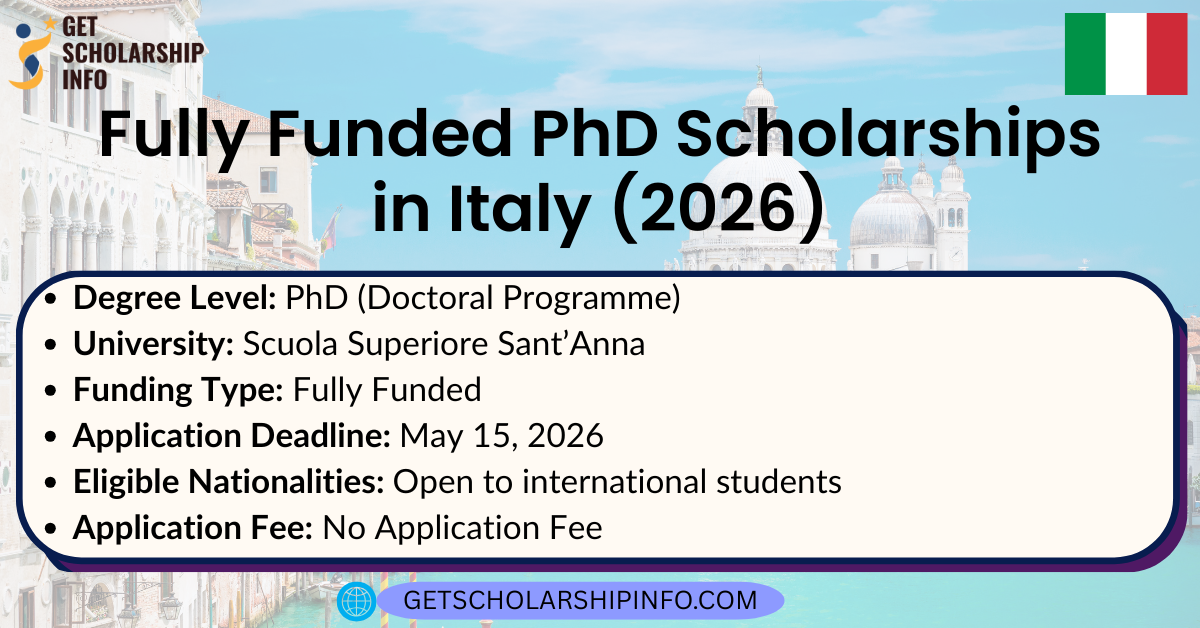
- Programme Name: PhD in Human Rights, Global Politics and International Studies
- Host Institution: Scuola Superiore Sant’Anna, Pisa, Italy
- Degree Level: Doctoral (PhD)
- Programme Length: 3 years, full-time and residential
- Application Deadline (2026/2027 cycle): 15 May 2026, at 12:00 p.m. CEST
- Interview Schedule: 15 June 2026, starting at 9:00 a.m.
- Ranking List Published By: 15 July 2026
- Funded Positions Available: 5 positions funded directly by Scuola Superiore Sant’Anna, with additional positions sometimes added later depending on external funding
- Nationality: Open to international applicants, with no restriction based on country of origin
- Application Fee: Not mentioned, meaning applying appears to be free of cost
- Language of Instruction: English throughout the entire programme
If you missed this cycle, keep an eye on the school’s website for the next call, since Sant’Anna typically follows a similar yearly rhythm for its PhD announcements.
What Every Admitted Candidate Actually Receives:
This is a fully funded doctoral programme, and the financial package reflects that clearly.
- A three-year doctoral scholarship worth €19,740 gross per year, plus a housing allowance of €2,200 gross per year, working out to roughly €1,600 net per month
- 26 free meals per month at the School’s canteen for the entire duration of the programme
- A 50 percent scholarship increase during the compulsory research period abroad
- A personal research budget equal to 10 percent of the scholarship, dedicated to research-related expenses
- Full access to the School’s library and campus-wide Wi-Fi
- Supervision from faculty members working directly within your chosen research areas
- A structured pathway toward publishing in international academic journals, supported by your supervisor throughout the process
- Membership in a genuinely international and interdisciplinary academic community, with direct exposure to seminars, conferences, and intensive courses beyond your own coursework
Altogether, successful candidates aren’t simply handed a stipend and left alone for three years. They’re placed inside an active, well-resourced research environment built specifically to support ambitious interdisciplinary work.
Who Should Be Preparing to Apply:
- Candidates must hold a Master’s degree or an equivalent qualification, or be on track to complete one by 30 September of the application year, in which case admission is conditional on obtaining the degree by that date
- Applicants coming from a different academic background than the programme’s core subject areas can still apply, provided they can demonstrate a sound understanding of the fields covered
- Every admitted candidate must accept a scholarship, since self-financed admission isn’t permitted under Italian doctoral regulations
- Strong proficiency in English is expected, since the entire programme is delivered in that language
- Applicants must be prepared to relocate to Pisa for the full three years, since this is a residential programme with genuine presence requirements
The Five Research Areas at the Core of the Programme:
Rather than a single subject, the PhD is built around five interconnected fields, and every application must clearly address at least two of them, with one identified as the main research area and the other as complementary.
- Agricultural, Food, and Environmental Law
- Public International Law
- European Studies
- Political Philosophy
- International Relations
Each of these areas comes with its own faculty specialists. Agricultural, Food, and Environmental Law focuses on how agri-food systems are regulated across international, EU, and domestic legal frameworks, along with their relationship to climate and sustainability goals. Public International Law covers humanitarian law, criminal law, disaster law, and the law of international organisations, with particular strength in human rights protection during armed conflict and emergency situations. European Studies examines the political and constitutional dimensions of European integration, alongside comparative analysis of European law and political systems. Political Philosophy digs into global ethics, the theoretical foundations of human rights, climate ethics, and the philosophy of technology. International Relations centres on security, conflict, and governance, examining political violence, regime change, migration, and informal power structures across regions.
Since your research project needs to genuinely engage two of these areas, spending time reviewing faculty research profiles before applying is worth the effort, both to sharpen your proposal and to confirm the school has the right supervisory expertise for your topic.
What Life as a PhD Candidate Actually Looks Like:
The three years aren’t structured the same way throughout, and understanding that rhythm helps you plan realistically.
- Year One involves a minimum of 150 hours of mandatory lectures, covering methodological skills, academic writing, presentation skills, and three core multidisciplinary courses centred on Human Rights, Global Politics, and Sustainability
- Year Two requires a compulsory research period abroad lasting at least six months, supported by the additional scholarship increase mentioned earlier
- Year Three is primarily dedicated to completing the final dissertation, culminating in a public oral examination, or viva, conducted by a committee of experts
Throughout all three years, candidates are expected to actively participate in the School’s academic life, attending seminars, conferences, and other ongoing research activities, not just their own required coursework.
How Supervision and Research Direction Are Assigned:
One detail that surprises a lot of applicants: you don’t need to contact a potential supervisor before applying, unlike many European PhD programmes. Instead, supervisors and co-supervisors are formally appointed by the Faculty Board based on a proposal submitted by each candidate within one month of starting the programme. That said, reviewing faculty research profiles ahead of applying is still strongly encouraged, since it helps ensure your intended topic genuinely aligns with the school’s supervisory capacity before you commit to the process.
Documents You’ll Need to Prepare:
When the next call opens, here’s what your application will likely need to include, based on the most recent cycle’s requirements.
Mandatory documents:
- A valid identity document
- Self-certification of your qualification obtained, or to be obtained, in Italy, including a full list of examinations taken
- An official certificate from the awarding institution if your qualification was obtained abroad, including your examination record
- A Curriculum Vitae et Studiorum
- A motivation letter
- A research project written in English
Optional documents:
- Copies of any additional qualifications or publications relevant to the programme
- Up to three academic letters of reference, submitted directly by your referees through a link sent to their institutional email, with a submission deadline of three days after the main application deadline
- A copy of your Master’s thesis or its abstract, or a final draft if your qualification hasn’t been awarded yet
Missing any mandatory document typically results in exclusion from the call, so it’s worth starting document preparation well ahead of the next deadline announcement.
Steps to Apply Once the Next Call Opens:
- Confirm you meet the minimum degree requirements, or that you’re on track to meet them by 30 September of the application year
- Review the five research areas and identify which two genuinely align with your intended project
- Read through faculty research profiles to check supervisory fit before finalising your proposal
- Prepare all mandatory documents, along with any optional materials that strengthen your application
- Submit your application entirely online before the stated deadline
- Arrange for your referees to submit their letters within the specified window after the deadline, if you’re including academic references
- Prepare for a scheduled interview if shortlisted, followed by the publication of a ranking list
A Few Practical Realities Worth Knowing in Advance:
Since this is a full-time residential programme, doctoral students are not permitted to hold other work commitments during their studies. Special arrangements for students with families aren’t offered, and while campus facilities such as the library and Wi-Fi are accessible, dedicated office space can be limited due to campus constraints. Most students find accommodation through shared flats in the surrounding Pisa area rather than on campus itself. Language-wise, while the programme runs entirely in English, students are also required to reach a good working level, roughly A2, in a second foreign language by the end of the programme, and international students are welcome to attend Italian courses during their first year to ease daily life in the city.
Frequently Asked Questions?:
Is the Sant’Anna PhD in Human Rights fully funded?
Yes. Every admitted candidate receives a three-year scholarship worth roughly €1,600 net per month, along with free canteen meals, a research budget, and additional funding during the compulsory research period abroad.
Can I apply if my previous degree is in an unrelated field?
Yes, as long as you can demonstrate a solid understanding of the programme’s core research areas. The Examining Board reviews your academic record to determine your fit.
Is there an application fee?
No application fee is mentioned in the official programme details.
How long does the PhD take to complete?
The programme runs for three years full-time, with the final dissertation due by the end of the third year.
Do I need to secure a supervisor before applying?
No. Supervisors are formally appointed by the Faculty Board after admission, based on a proposal candidates submit within their first month in the programme.
Is this a residential programme?
Yes. Candidates are required to live in Pisa for the full three years and are strongly encouraged to take part in the School’s ongoing academic activities.
What language is the programme taught in?
English. Strong English proficiency is expected from all candidates, alongside a requirement to reach a working level in a second foreign language by the end of the programme.
Can I work while completing this PhD?
No. The programme is full-time and considered incompatible with other work commitments, since the scholarship is intended to cover living expenses in place of outside income.
How many research areas must my proposal address?
At least two of the five available research areas, with one clearly identified as your main focus and the other as a complementary area.
When does the next application cycle open?
This information isn’t published until Scuola Superiore Sant’Anna releases its next official call, so prospective applicants should monitor the school’s website directly for updates following the most recent cycle.
Getting Ready Before the Next Call Is Announced:
Given how specific the documentation and research proposal requirements are, the strongest applications tend to come from candidates who start preparing months in advance rather than scrambling once a new deadline is published. Spend time now reviewing faculty research profiles, drafting a research project that genuinely bridges two of the five core areas, and reaching out to potential referees early, so you’re ready to submit a polished application the moment Sant’Anna opens its next call.
