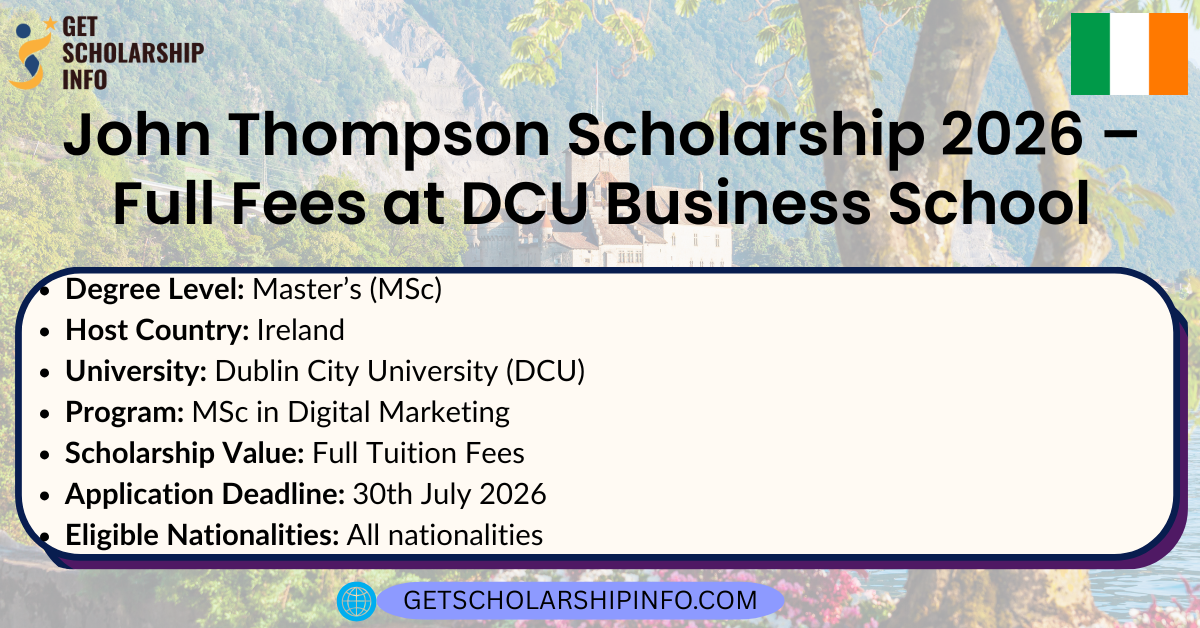
Every year, DCU Business School sets aside one fully funded place on its MSc in Digital Marketing in memory of a man who spent most of his career on the other side of the media industry entirely. The John Thompson Scholarship isn’t run by a corporate sponsor or a government body. It’s funded and kept alive by John Thompson’s own family and friends, alongside the business school itself, and it covers the complete cost of tuition for one student, whether they’re from Ireland, elsewhere in the EU, or outside it altogether. The closing date sits at July 30, there’s no fee to apply, and the only real prerequisite is that you’ve already applied to the master’s programme itself before you touch this scholarship application.
What makes this one worth a longer look isn’t just the free tuition. It’s the story behind why the scholarship exists, and the fact that it deliberately targets people who don’t necessarily come from a marketing background at all. If you studied journalism, business, or something else entirely and you’re now eyeing a shift into digital marketing, this scholarship was actually built with you in mind.
Fast Facts Before You Read Further:
- Scholarship name: The John Thompson Scholarship
- Host institution: DCU Business School, Dublin City University
- Host country: Ireland
- Degree level: MSc, specifically the full-time Digital Marketing programme
- Application deadline: July 30
- Application status: Currently open
- Value: Full tuition fees covered, for one student per year
- Open to: Both EU and non-EU applicants
- Application fee: None mentioned anywhere in the process
- Number of places: One per academic year
Who Was John Thompson, and Why Does This Scholarship Exist:
This isn’t a scholarship named after a donor who wrote a cheque and moved on. John Thompson spent almost three decades working in the Irish newspaper industry, and he was one of the country’s more influential media executives during that stretch. He was directly involved in launching and growing some of Ireland’s best-known publications, including U Magazine, The Sunday World, and The Irish Farmers Journal. Later in his career, he served as Chief Executive of Associated Newspapers Ireland, the publisher behind the Irish Daily Mail and the Irish Mail on Sunday, and before that he was Managing Director of Independent Star Limited, publisher of the Irish Daily Star.
The scholarship was set up in 2008, while these connections were still fresh, specifically to reflect something John believed throughout his career: that journalism and marketing aren’t separate disciplines competing for attention, but two things that reinforce each other when it comes to genuinely engaging an audience. That belief is baked directly into how the scholarship is positioned today. It isn’t just for marketing graduates. It’s aimed at people coming from journalism, business, or other varied academic backgrounds who want to combine an appreciation for media and online journalism with formal digital marketing training.
What Winning This Scholarship Actually Gets You:
- Full coverage of tuition fees for the entire MSc Digital Marketing programme, removing what is usually the single biggest financial barrier to a master’s degree
- A place on a programme that blends academic theory with direct exposure to the tools and platforms currently used across the digital marketing industry
- Access to lecturers who, based on past recipients’ own accounts, focus heavily on how quickly digital marketing practices shift, which matters a lot if you want a career that doesn’t go stale within a few years of graduating
- A genuine head start for anyone relocating internationally to study, since the scholarship makes no distinction between EU and non-EU applicants when it comes to who can be awarded the funding
- Recognition tied to a well-regarded name in Irish media and marketing circles, which can carry weight later when networking within Ireland’s marketing or publishing industries
- The option to reach out to DCU’s global office during the application process for guidance on other scholarships you might also qualify for, even if you’re only applying for this one initially
Who Can Actually Apply:
- You must already have applied to DCU Business School’s full-time MSc in Digital Marketing programme before you can apply for this scholarship at all
- There’s no stated restriction based on nationality or EU status, meaning applicants from Ireland, the rest of the EU, and non-EU countries are all eligible
- You cannot hold more than one DCU Business School scholarship at the same time, so if you’ve already been awarded a different one, this particular award isn’t stackable on top of it
- Beyond having secured a programme offer, the scholarship doesn’t list rigid academic thresholds, though your transcript and personal statement are what the selection committee will actually be judging you on
The One Field This Scholarship Covers:
Unlike broader scholarship programmes that span multiple disciplines, this one is tied to a single postgraduate degree:
- MSc Digital Marketing
That narrow focus is intentional. The scholarship was never meant to fund a wide spread of business degrees. It exists specifically to support people building expertise in digital marketing, ideally while bringing some appreciation of journalism or media into that mix.
How the Application Process Actually Works:
There are effectively two stages here, and skipping the first one means you can’t move on to the second at all.
Step One: Apply to the Programme Itself:
- Begin your application to the full-time MSc Digital Marketing programme at DCU Business School directly
- If anything about the programme application process is unclear, reach out to DCU’s global office, whose contact details are listed on the university’s official global page
- The global office can also flag any additional scholarships you might be eligible for beyond this one, so it’s worth asking even if your main focus is this specific award
Step Two: Apply for the Scholarship Once You Have an Offer:
Once you’ve actually received an offer for the programme, not before, you can put together your scholarship application. This requires three documents:
- A current CV
- A statement of motivation explaining your interest in the scholarship and why you’re a strong fit, capped strictly at 250 words
- A copy of your academic transcript or proof of your final degree award
All three documents go to the Group Head for Marketing at DCU Business School by email, at businessscholarships@dcu.ie.
What a Past Recipient Actually Experienced:
Scholarships often read as abstract funding on paper, so it helps to hear from someone who actually went through it. Kate Minogue, the 2021 John Thompson Scholar, was living in Melbourne at the time she applied, right in the middle of a strict lockdown. She ended up deciding to move back to Ireland around the same time, and being selected for the scholarship made that transition noticeably easier financially.
Once she started the programme, she found real value in how much theoretical grounding it gave her behind digital marketing practices she’d likely encountered already in a more surface-level way, combined with hands-on exposure to tools actually used across the industry. She specifically pointed to how clearly the lecturers communicated just how fast digital marketing changes as a discipline, which reinforced for her why ongoing upskilling matters so much in this particular industry rather than treating a master’s degree as a finish line.
A Few Extra Things Worth Knowing:
- The scholarship doesn’t come with a published opening date, only a closing date of July 30, so it’s worth checking DCU’s scholarships page periodically rather than assuming a fixed annual window
- Because only one student receives this award each year, competition is naturally tight, and a strong, tightly written 250-word motivation statement matters more here than in scholarships that fund multiple recipients
- DCU Business School holds broader accreditations, including AMBA reaccreditation, which is worth knowing if you’re weighing this master’s degree against similar programmes elsewhere
- If you’re rejected for this particular scholarship, that doesn’t necessarily close the door on other DCU Business School funding, though remember you can only hold one at a time if you do end up successful elsewhere
Frequently Asked Questions?:
Is the John Thompson Scholarship fully funded? Yes. It covers full tuition fees for one student on DCU’s full-time MSc Digital Marketing programme each year. There’s no partial funding version of this particular award.
Can non-EU students apply for this scholarship? Yes. The scholarship makes no distinction between EU and non-EU applicants, so students from anywhere in the world are eligible as long as they’ve secured a place on the programme.
Is there an application fee for the John Thompson Scholarship? No fee is mentioned anywhere in the process. The only cost implied is whatever your standard programme application fee might be, separate from the scholarship itself.
Do I need to apply to the MSc programme before applying for the scholarship? Yes, and this step is mandatory. You cannot submit a scholarship application until you’ve already applied to, and received an offer from, the full-time MSc Digital Marketing programme.
Can I hold this scholarship along with another DCU Business School scholarship? No. DCU Business School only allows students to hold one of its scholarships at a time, so this award cannot be combined with any other scholarship from the same school.
What documents do I need to submit for the scholarship application? A CV, a motivation statement of no more than 250 words explaining your fit for the scholarship, and a copy of your academic transcript or proof of your final degree award. These go directly to the Group Head for Marketing by email.
Is this scholarship only for marketing graduates? No. It was deliberately designed to welcome graduates from journalism, business, and other varied academic backgrounds, reflecting John Thompson’s own belief that marketing and journalism reinforce each other.
When is the deadline to apply? The closing date is July 30. There’s no published opening date, so it’s best to start the programme application process well ahead of that deadline given the two-step nature of the process.
