Introduction:
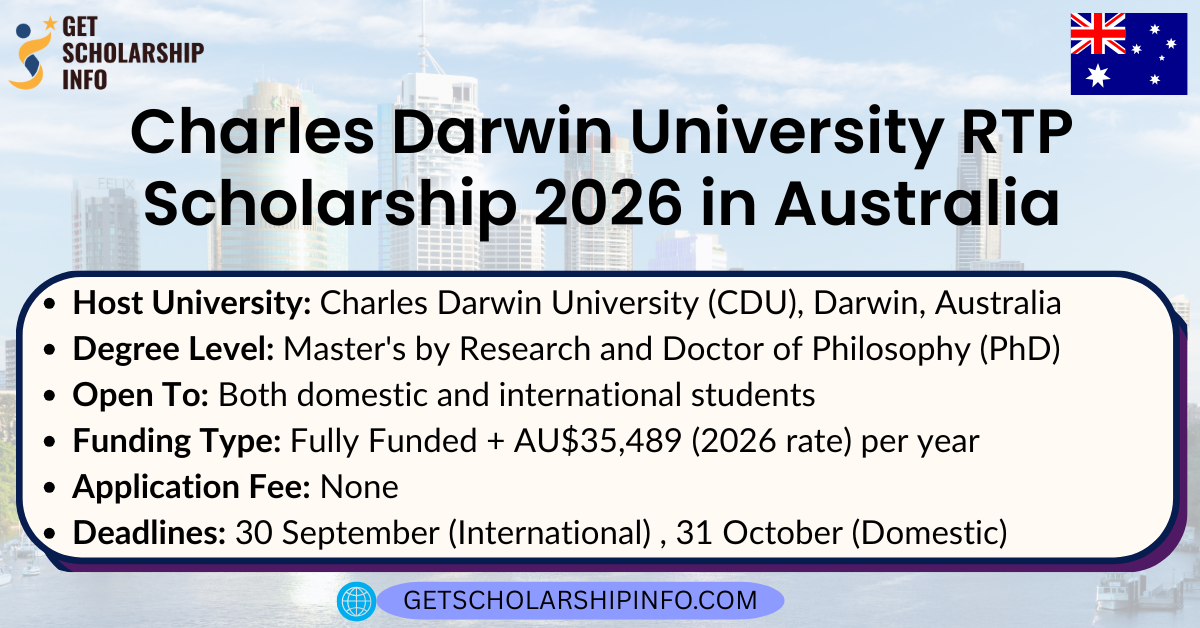
Applications are now open for the Charles Darwin University (CDU) Research Training Program (RTP) Scholarship 2026, a fully funded government-backed scholarship for students who want to pursue a Master’s by Research or a PhD in Australia. This scholarship is funded by the Australian Government and is open to both domestic and international students, which means almost anyone from any country in the world can apply. There is no application fee.
The RTP Scholarship covers your full tuition fees and provides a living stipend of AU$35,489 per year (2026 rate) for full-time students, paid every two weeks directly into your account. On top of that, you also get a relocation allowance to help you move to Darwin. The scholarship runs for three years for PhD students and two years for Master’s by Research students.
This is not a scholarship you apply for and automatically receive with your admission. It is competitive. CDU invites eligible students to apply, ranks all applications based on academic performance, research publications, and research experience, and then awards scholarships to the strongest candidates. So if you are serious about research and have a solid academic background, this is one of the best opportunities available in Australia right now.
Key Details:
- Scholarship Name: Charles Darwin University Research Training Program (RTP) Scholarship
- Funded By: Australian Government (Research Training Program block grant)
- Host University: Charles Darwin University (CDU), Darwin, Australia
- Host Country: Australia
- Degree Level: Master’s by Research and Doctor of Philosophy (PhD)
- Open To: Both domestic and international students
- Funding Type: Fully Funded (tuition + stipend + relocation allowance)
- Annual Stipend: AU$35,489 (2026 rate) per year, tax-free, for full-time students
- Part-Time Stipend: AU$17,744.50 (2026 rate) per year, taxable
- Duration: 3 years full-time for PhD | 2 years full-time for Master’s by Research
- Application Fee: None
- Invitation Required: Yes , you must be invited to apply by the CDU HDR team
What This Scholarship Actually Gives You:
A lot of scholarship pages just say “fully funded” without explaining what that actually means in practice. Here is exactly what you receive if you are selected for the CDU RTP Scholarship:
- Full tuition fee coverage — Your entire tuition for the duration of your HDR program is waived. You do not pay a single dollar in course fees, whether you are a domestic or international student.
- AU$35,489 per year living stipend (2026 rate) — This is paid to you as a tax-free fortnightly payment if you are studying full-time. That comes out to roughly AU$1,365 every two weeks going directly into your bank account to cover rent, food, transport, and daily living costs.
- Part-time stipend option — If you are studying part-time, you receive AU$17,744.50 per year, though this amount is taxable.
- Relocation allowance — If you need to move to Darwin to start your studies, you receive up to AU$2,000 if you are a domestic student and up to AU$2,500 if you are an international student. This is a one-time payment to help with moving costs.
- Paid sick leave — If you fall ill during your studies, the scholarship includes provisions for paid sick leave so your funding is not simply cut off while you recover.
- Paid maternity and parental leave — The RTP Scholarship also includes paid maternity and parental leave entitlements, which is something many scholarships do not offer.
- Research cost coverage — Beyond your personal stipend, CDU uses RTP funding to cover systemic research costs including library access, laboratory use, computing infrastructure, consumables, and support staff. You are not expected to personally fund your research activities.
- Access to world-class research facilities — CDU is recognised globally for its research in areas related to tropical environments, Indigenous communities, health, and sustainability. As an RTP scholar, you have full access to CDU’s laboratories, research centres, and academic networks.
- Supervision from experienced researchers — Every RTP scholar works with a confirmed CDU supervisor throughout the entire duration of the scholarship. This is not just a formality , your supervisor actively guides your research direction, helps with publications, and supports your development as a researcher.
Who Can Apply — Eligibility Criteria:
The RTP Scholarship has specific conditions that every applicant must meet before their application is even considered:
- You must be either a domestic or international student. Domestic students are Australian citizens, permanent residents, or New Zealand citizens. Everyone else is considered international.
- You must meet CDU’s academic entry requirements for the HDR program you are applying to
- You must meet CDU’s English language requirements (international students need to provide evidence of English proficiency)
- You must be invited to apply by the CDU HDR team , this is not an open application that anyone can submit independently without going through the HDR admission process first
- You must submit a complete RTP scholarship application by the deadline notified to you
- You must not already be receiving equivalent financial support from another source for your HDR studies. Specifically, you cannot hold another scholarship or income source that provides more than 75% of the RTP stipend rate for your living costs
HDR programs at CDU include the Doctor of Philosophy and Master by Research only. Other postgraduate programs do not qualify.
Research Experience Required Before Applying:
This is an important point that many applicants overlook. Depending on which degree you are applying for, you need to have already completed a certain amount of formal research activity before applying:
- Master by Research applicants must have completed at least half a semester full-time equivalent (20 credit points) of research activity at AQF Level 8 or above in a relevant course
- PhD applicants must have completed at least one full semester full-time equivalent (40 credit points) of research activity at AQF Level 8 or above in a relevant course
This research experience can come from a prior Honours degree, a Master’s degree with a research component, or a postgraduate research course. If your degree had a thesis or dissertation, that counts , but you need to provide documentation proving it was at the right level and involved genuine research work.
How Applications Are Ranked — The Scoring System:
Because this scholarship is competitive, it helps to know exactly how CDU evaluates and ranks applications. There are four scoring categories:
1. Qualifications and Academic Performance
This is the biggest scoring category , up to 6 points for domestic students and up to 4 points for international students. CDU looks at your GPA, the quality of your degree, whether it included research, and how strong your academic record is overall. Transcripts, grading system details, and copies of any theses must be officially translated into English if they are in another language.
2. Research Publications and Outputs
Up to 4 points. CDU wants to see peer-reviewed publications where you were the first author or a co-author. Non-traditional research outputs like creative works, exhibitions, or performances are also accepted in certain disciplines. You can submit up to four outputs that best show your research quality. The focus is on quality, not quantity , submitting many weak outputs will not help. Only outputs that have been formally accepted, are in press, or are already published will be considered. Anything still under review or not yet accepted will not be scored.
3. Research Experience and Portfolio
Up to 2 points. This covers research-related work experience or additional research outputs beyond what you submitted in the publications category. Evidence must be documented , general statements without proof will not be counted. Researcher profiles on Google Scholar, ResearchGate, or ORCID are accepted as supporting evidence.
4. Strategic Priority Alignment
Additional points may be awarded if your proposed research aligns with CDU’s institutional research priorities and strategic focus areas. This is worth considering when writing your research proposal , if your work connects to areas CDU is actively investing in, it can give your application an edge.
Research Fields Available at CDU:
- Health Sciences and Public Health
- Tropical Medicine and Infectious Diseases
- Environmental Science and Ecology
- Indigenous Studies and Community Health
- Engineering and Information Technology
- Cybersecurity and Digital Innovation
- Education and Arts
- Social and Public Policy
- Business and Law
- Disaster Management and Risk
- Humanities, Social Sciences and Languages
- Tropical Agriculture
- Aquaculture and Marine Science
- Biosecurity and Animal Science
- Veterinary Science
- Nutrition and Food Science
- Conservation Biology
- Midwifery and Nursing Research
- Data Science and Machine Learning
- Urban and Regional Planning
About Charles Darwin University:
CDU is based in Darwin, in Australia’s Northern Territory , a unique research environment that sits at the edge of the tropics and is closely connected to some of the most ecologically significant and culturally rich landscapes in the country. The university has built a strong international reputation, particularly for research that supports rural, regional, and Indigenous communities. It ranks among the world’s top 100 universities in several subject areas related to its regional strengths.
For international students, studying in Darwin means living in a relatively affordable Australian city compared to Sydney or Melbourne, while still having access to high-quality research infrastructure and supervision. The tropical environment also makes it an ideal base for research in ecology, agriculture, health, and environmental science.
How to Apply — Step by Step:
The application process for the CDU RTP Scholarship has two stages. You need to complete both:
Step 1 — Apply for HDR Admission
- Choose your research topic and identify a potential supervisor at CDU
- Contact your preferred supervisor early to discuss your research idea and confirm their willingness to supervise you
- Submit your online application for admission into the PhD or Master’s by Research program at CDU
- Your admission application will need to include academic transcripts, proof of English language proficiency, a CV, and a brief research proposal or statement of interest
Step 2 — Apply for the RTP Scholarship
- Once your HDR admission application is submitted, the CDU HDR team will assess whether you meet the eligibility criteria
- If you are eligible and competitive, you will be invited to apply for the RTP Scholarship
- Submit your complete scholarship application by the deadline communicated to you by the HDR team
- Include all required evidence for each ranking category , transcripts, research publications with quality evidence, employment verification for research experience, and any other supporting documents
Documents you will likely need:
- Official academic transcripts and degree certificates (translated into English if necessary)
- Grading system information from your institution
- Copies of any theses or dissertations you completed
- Links to or electronic copies of your research publications, with evidence of peer review and journal rankings
- Researcher profile links (Google Scholar, ORCID, ResearchGate)
- Official employment verification letters for any research-related work experience
- Confirmation of supervision from a CDU academic
Deadlines — Domestic vs International:
The application deadline at CDU differs depending on whether you are a domestic or international student, and these dates can vary by intake cycle. Based on the most recent cycle:
- International students — HDR admission applications are typically due around 30 September, with scholarship applications closing shortly after
- Domestic students — HDR admission applications are typically due around 31 October
- Fellowship start — Successful recipients generally begin their HDR between January and March of the following year, aligning with Semester 1 intake
Always check the official CDU website for the exact deadlines for the current round, as these are confirmed when each scholarship round opens.
Things to Know Before You Apply:
- The RTP Scholarship is not automatically given with admission , it is a separate competitive process
- You cannot hold another scholarship worth more than 75% of the RTP stipend rate at the same time
- All academic documents not in English must be officially translated before submission , CDU will not retrieve information from external websites
- Only published or formally accepted research outputs will be scored , do not submit anything still under review
- Older publications (more than 10 years old) may score lower unless you make a strong case for their ongoing relevance
- Aligning your research proposal with CDU’s strategic research priorities can give you additional points in the ranking process
- The process of finding a supervisor and confirming their support is your responsibility , CDU will not match you with a supervisor automatically
Contact and More Information:
For specific queries about the HDR program or scholarship application process, visit the official CDU Research and Innovation website or contact the HDR team directly through CDU’s official contact channels.
Official website: www.cdu.edu.au
