Germany continues to be one of the most generous countries when it comes to supporting independent researchers, and the Institute for Advanced Study in the Humanities (KWI) in Essen has just opened its doors again to scholars from across the globe. If you work in the humanities, cultural studies, or social sciences and you have been looking for a quiet, well-resourced place to finish a book, sharpen a research proposal, or build new academic partnerships, this six-month fellowship deserves a spot on your radar.
The KWI International Fellowship Program is fully funded, meaning selected researchers receive a monthly allowance along with office space, research infrastructure, and administrative support for the entire duration of their stay. There is no application fee, so the only real cost of applying is your time in putting together a strong proposal. The program is open to researchers of nearly every nationality, with one small exception for German citizens, which we explain further down. Whether you are a postdoc looking to consolidate your first major project or a scholar rebuilding your career after a disruption, this call is worth a close read.
What Makes This Fellowship Worth Applying For:
Before diving into the paperwork, it helps to understand what kind of opportunity this actually is. KWI is not a teaching post, and it is not a typical university job. It is an independent institute for advanced study, built on the older European tradition of giving scholars uninterrupted time and space to think. The institute sits within the University Alliance Ruhr, which connects it to three major universities, and it also hosts the Academy in Exile, a program supporting academics whose freedom to work has been threatened in their home countries.
That context matters, because it shapes the kind of intellectual community fellows join. This is not a program where you disappear into a library for six months and never speak to anyone. Fellows are expected to be active participants in a lively academic environment, and in exchange, they get real institutional backing for their work.
Key Details at a Glance:
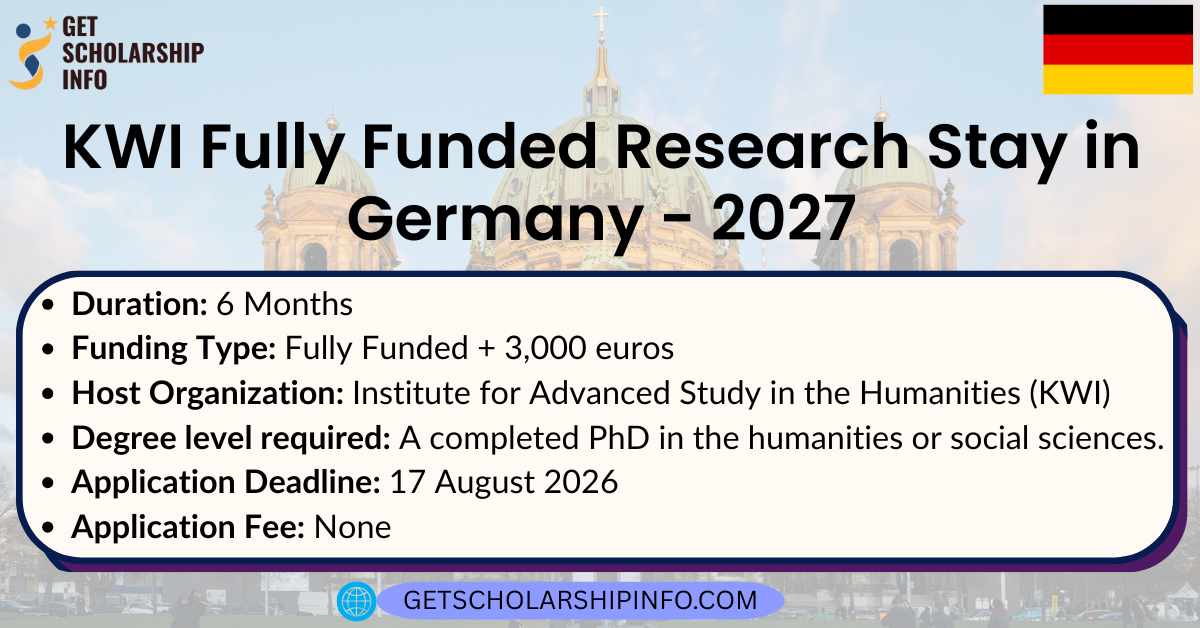
- Fellowship duration: Six months, running from 1 April 2027 to 30 September 2027, with fixed start and end dates that cannot be adjusted.
- Application deadline: 17 August 2026, by midnight Central European Time.
- Funding type: Fully funded through a monthly allowance, not a salaried employment contract.
- Monthly allowance: 3,000 euros before tax, meant to cover housing, insurance, and everyday living costs.
- Application fee: None.
- Host institution: Institute for Advanced Study in the Humanities (KWI), located in Essen, Germany.
- Degree level required: A completed PhD in the humanities or social sciences.
- Experience window: Up to six years of postdoctoral experience, meaning applicants who finished their PhD in 2021 or later can apply for this round.
- Nationality restrictions: Open worldwide, though German nationals may only apply if they currently hold a position at an institution outside Germany.
- Team applications: Not accepted, since this fellowship is designed for individual researchers only.
About the Institute for Advanced Study in the Humanities:
KWI operates from Essen, right in the heart of Germany’s Ruhr Area, and it was created to bring together scholars from different disciplines who might not normally cross paths. Its research agenda currently circles around a handful of connected themes: science studies, visual literacy, aesthetic practices, the long reach of historical events on the present, and the ongoing conversation between the cultural sciences and the social sciences.
Rather than boxing researchers into narrow disciplinary categories, KWI is genuinely trying to find new ways of connecting philology, cultural studies, and the social sciences. If your own project sits at the intersection of two or more fields, this environment is built precisely for that kind of thinking. The institute also places a strong emphasis on international collaboration, so incoming fellows are not treated as visitors passing through but as active contributors shaping the institute’s direction during their stay.
What This Fellowship Offers Its Fellows:
It is easy to list activities, but what actually matters is what a fellow walks away with. Here is what you gain by joining this program:
- A steady monthly income of 3,000 euros that removes the financial pressure of relocating and living in Germany for half a year.
- Freedom from teaching duties, which means your working hours genuinely belong to your own research rather than a classroom.
- A dedicated office and full research infrastructure, so you are not scrambling to find workspace or basic academic resources on arrival.
- Access to a specialized library service along with event and research management support, which takes a lot of the logistical burden off your shoulders.
- Administrative and communicative assistance from KWI staff, meaning you can focus on writing and thinking rather than paperwork.
- Partial reimbursement for your travel to and from Essen, easing the financial strain of relocating internationally.
- A genuine academic network stretching across the Ruhr Area universities, plus nearby institutions in Düsseldorf, Cologne, Münster, and Bielefeld, and even cross-border ties reaching into Belgium and the Netherlands.
- The chance, depending on scheduling and available resources, to organize your own workshop at the institute, giving you a platform to shape academic conversation around your own research interests.
- A collegial structure through the Colloquium, lectures, reading groups, and other academic events, giving you built-in opportunities to test your ideas in front of engaged peers.
- Visibility for your work through the KWI Blog, where fellows are invited to share their research with a wider audience beyond academic journals.
In short, this fellowship is not just about a paycheck. It hands you time, space, and a community, three things that are often in short supply during the early years of an academic career.
Who Can Apply: Eligibility Criteria:
KWI has laid out fairly clear eligibility rules, but there is more flexibility built in than you might expect at first glance.
- You must hold a completed PhD in a humanities or social science discipline.
- Your postdoctoral experience should fall within roughly six years of completing your doctorate. For this particular round, that means anyone who finished their PhD in 2021 or later is eligible to apply.
- If you have had a career break, for instance due to caregiving responsibilities or because you were working as a scholar at risk, you are still encouraged to apply. Simply explain the gap in your cover letter, and the selection committee will factor it into their assessment rather than penalizing you for it.
- Applicants of any nationality are welcome, with one specific condition: German citizens can only apply if they are currently employed at an institution outside Germany.
- This call is strictly for individual researchers. Applications submitted on behalf of a group, lab, or team will not be considered.
- Your proposed research should connect meaningfully to KWI’s ongoing academic agenda. Projects that speak directly to the institute’s focus areas, or that could contribute to conversations already happening there, tend to stand out.
Fields and Disciplines Eligible for This Fellowship:
KWI welcomes proposals from a wide stretch of the humanities and social sciences. If your work fits broadly into any of the areas below, you have grounds to apply:
- Humanities
- Cultural Studies
- Social Sciences
- Philology
- Science Studies
- Aesthetics and Aesthetic Practices
- Visual Studies and Visual Literacy
- History and Historical Studies
- Interdisciplinary Studies connecting the above fields
What Is Expected From Fellows During Their Stay:
Funding always comes with a few responsibilities, and KWI is upfront about what it expects in return for its support.
- Fellows should be physically present at the institute at least three days a week, which keeps the academic community active and connected.
- Participation in entry and exit interviews is required, giving the institute a chance to understand your goals at the start and your progress at the end.
- Active involvement in the Colloquium, lectures, conferences, and reading groups is expected, not optional.
- Fellows are asked to contribute at least one piece of writing to the KWI Blog during their stay.
- There is no obligation to teach, though fellows are welcome to sit in on or participate in lectures and seminars at nearby universities if they wish.
- Any publications that come out of your time at KWI should acknowledge the institute.
- German language skills are not required. The entire program runs in English, so a strong command of English is enough to fully participate.
- The starting date of 1 April cannot be moved due to the institute’s semester scheduling, so applicants need to be certain they can commit to that specific timeline.
Life in the Ruhr Area:
One detail that often gets overlooked in fellowship announcements is where you will actually be living, and it is worth mentioning here. Essen sits in the middle of the Ruhr Area, a region home to more than five million people and one of the largest metropolitan areas in Europe. It was once known primarily for heavy industry, but the area has spent decades transforming itself into a greener, culturally rich region, a shift that earned it recognition as European Capital of Culture back in 2010.
For a fellow settling in for six months, this means easy access to Cologne and Düsseldorf, plus the option of quick day trips into the Netherlands or Belgium. Combined with the academic density of the Ruhr Alliance universities nearby, it is a location that offers both intellectual and cultural stimulation outside the office.
How to Apply:
The application process is entirely digital, but KWI is strict about format, so pay close attention to the instructions.
- Applications must be submitted as a single PDF file, with a maximum size of 20 MB.
- Send your completed application by email to international.fellowship@uni-due.de.
- Applications sent through external platforms or shared links will not be accepted, due to the institute’s IT security policies.
- Everything must be written in English.
- Your file needs to include a CV, a full list of your publications, a copy of your PhD certificate, and a project proposal describing your planned work at KWI.
- The project proposal has a strict limit of 5,000 characters, so keep it focused and precise rather than trying to cover everything.
- Submissions that arrive after the deadline, are missing any required document, are split across multiple files, or exceed the character limit for the proposal will not be reviewed.
- A committee made up of KWI’s governing board members and the institute’s director will handle the selection process.
Given how specific these formatting rules are, it is worth double and triple checking your file before you hit send. A strong application can still get disqualified over something as simple as sending two files instead of one.
Frequently Asked Questions?:
Is the KWI International Fellowship fully funded?
Yes. Selected fellows receive a monthly allowance of 3,000 euros before tax, along with office space, research infrastructure, and administrative support. There is no cost to apply.
Who can apply for this fellowship?
Researchers from any country can apply, provided they hold a completed PhD in the humanities or social sciences and have up to six years of postdoctoral experience. German nationals may only apply if they are currently employed outside Germany.
Is German language proficiency required?
No. The fellowship program operates in English, so applicants only need a strong command of English to participate fully.
Can I apply as part of a research team or group?
No. This fellowship is designed exclusively for individual researchers, and group or team applications are not accepted.
What documents do I need to submit? You need a CV, a list of your publications, your PhD certificate, and a project proposal of no more than 5,000 characters, all combined into a single PDF file.
Can the fellowship start date be changed?
No. The program has fixed dates, starting 1 April 2027 and ending 30 September 2027, and these dates are not negotiable due to the institute’s academic calendar.
Will I be required to teach during the fellowship?
No. Teaching is not a requirement, though fellows are welcome to attend or take part in lectures and seminars at nearby universities if they choose to.
What happens if I had a career break before applying?
Career breaks, including those related to caregiving or working as a scholar at risk, will not disqualify you. You simply need to explain the gap in your cover letter, and the committee will take it into account during evaluation.
When is the application deadline?
The deadline is 17 August 2026, at midnight Central European Time. Late submissions will not be considered under any circumstances.
Is there an application fee?
No, applying to this fellowship is completely free.
