
Okinawa Institute of Science and Technology, better known as OIST, has opened its doors once again for students who want a real taste of research life before committing to a full doctoral journey. This isn’t a classroom exchange or a summer camp dressed up as research , interns here sit inside actual OIST labs, working alongside faculty who are active in fields ranging from quantum physics to marine biology. The program runs for four to six months, it is fully funded, and it comes with none of the usual “pay your own way” catch that ruins so many international opportunities. Bachelor’s students in their final two years, master’s students at any stage, and recent graduates from either level can throw their name in the ring. There’s a modest application fee attached, but beyond that, everything from your flight to Okinawa to your daily living allowance is taken care of by the institute.
If you’ve been hunting for a way to get inside a world-class lab without years of prior research experience holding you back, this is worth your full attention.
What Exactly Is This Internship About:
OIST isn’t a typical university , it’s a graduate-only research institute perched on the island of Okinawa, and it operates entirely in English. The Research Internship Program lets students step into one of dozens of active labs and contribute to ongoing projects, whether that means running experiments, analyzing data, or assisting with fieldwork. You’re not shadowing anyone. You’re doing the work, under supervision, with access to the same equipment and resources that OIST’s own PhD candidates use.
The institute places students across an unusually wide spread of disciplines. Physics, chemistry, mathematics, computational science, marine biology, neuroscience, ecology, molecular and cellular biology, environmental science, and quantum technology all have active units accepting interns. So whether your background is in wet-lab biology or you spend your days writing code for machine learning models, there’s likely a unit that fits.
Key Details at a Glance:
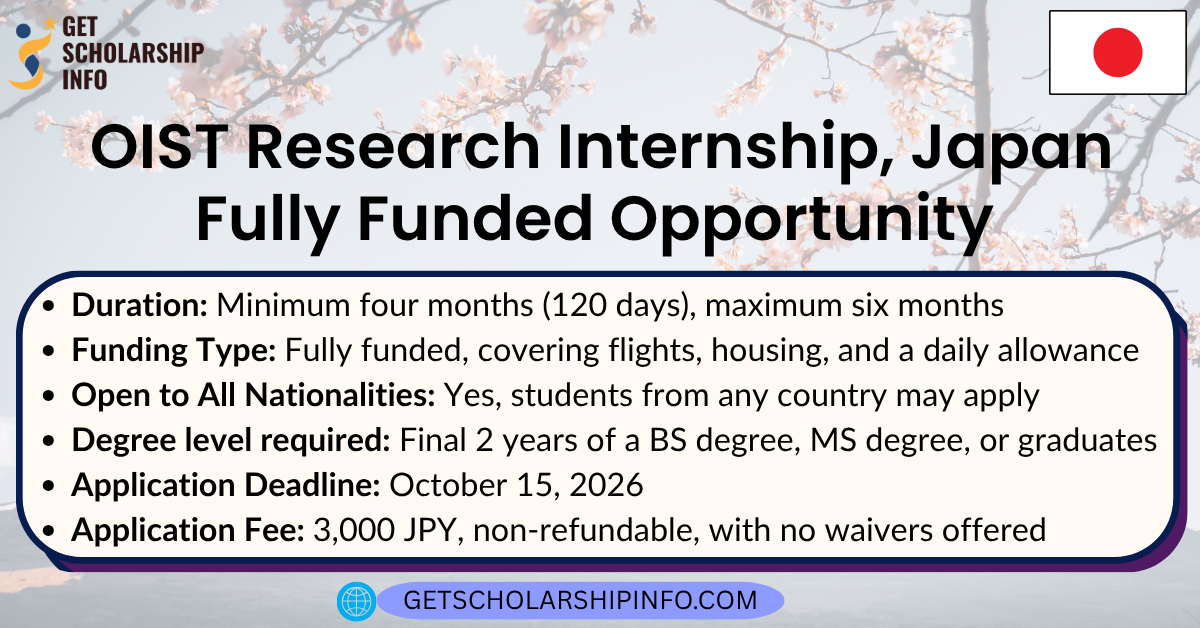
- Degree Level: Final two years of a bachelor’s degree, any year of a master’s degree, or graduates holding a bachelor’s or master’s qualification
- Host Country: Japan, at the OIST campus in Okinawa
- Internship Length: Minimum four months (120 days), maximum six months
- Fall 2026 Deadline: April 15, 2026, 23:59 Japan Standard Time
- Spring 2027 Deadline: October 15, 2026, 23:59 Japan Standard Time
- Fall 2026 Result Announcement: Mid-June 2026
- Spring 2027 Result Announcement: Mid-December 2026
- Open to All Nationalities: Yes, students from any country may apply
- Funding Type: Fully funded, covering flights, housing, and a daily allowance
- Application Fee: 3,000 JPY, non-refundable, with no waivers offered
- English Test Requirement: Not required, though scores may be submitted voluntarily
- PhD Students: Not eligible for this program
What This Internship Offers:
Rather than listing what you’ll be doing day to day, it helps to think about what you actually walk away with. Interns leave OIST with more than a line on their CV.
- A round-trip flight to Okinawa, booked around your internship dates, so there’s no out-of-pocket travel cost
- Furnished housing, either on campus or nearby, arranged and paid for by OIST or the hosting research unit
- A daily allowance of 2,400 JPY for every working day, giving you a steady income while you’re on placement
- Full visa support, including help obtaining a Certificate of Eligibility and guidance through the registration process once you land
- A free shuttle bus pass to move around campus and the surrounding area without added transport costs
- Direct mentorship from senior faculty and access to equipment that many undergraduate and even graduate programs elsewhere simply don’t have
- A possible shortcut into OIST’s PhD Program — interns who later apply to the doctoral program within a year of finishing may count their internship as one of the required lab rotations, provided they request this at the start and meet the assessment criteria
- Genuine international exposure, since OIST’s community draws staff and researchers from more than 70 countries
Who Can Apply:
Eligibility here is broader than most funded programs of this caliber, but there are firm lines you need to check before spending time on your application.
- You’re currently in the final two years of a bachelor’s degree, at any institution in Japan or abroad
- You’re enrolled in a master’s degree, in any year of study
- You’ve already graduated with a bachelor’s or master’s degree
- You’ll have finished your first two years of a bachelor’s program by the time your internship begins, even if you’re not there yet at the point of applying
- You have written approval from your home institution if you’re currently enrolled somewhere
- Your academic background reasonably matches the research unit or units you’re hoping to join
A few groups are explicitly excluded. Current and graduated PhD students cannot apply through this channel — OIST directs them instead toward Workshops or Careers listings if they want to collaborate. And if you’re a Japanese national or affiliated with a Japanese institution, you’ll need to arrange your own insurance coverage (a combination of Gakkensai and Gakkenbai, or something with equivalent protection) once accepted.
Fields and Research Units You Can Apply To:
OIST’s host units span an enormous range, but broadly, applicants can seek placement across these fields:
- Physics and Quantum Science
- Chemistry and Chemical Engineering
- Mathematics and Computational Sciences
- Neuroscience
- Molecular, Cellular, and Developmental Biology
- Marine Science and Marine Biology
- Ecology and Evolutionary Biology
- Environmental and Climate Science
- Data Science, Machine Learning, and Artificial Intelligence
- Materials Science and Nanotechnology
- Biophysics and Complex Systems
Within each of these broad areas sit dozens of individual research units, each led by a different professor with their own specific project themes. Availability changes every application round, and not every professor accepts interns each cycle, so it’s worth checking OIST’s faculty availability page close to your intended deadline rather than relying on older information.
Documents You’ll Need to Prepare:
The application process happens entirely online, and it rewards people who prepare their paperwork ahead of time instead of scrambling the night before the deadline.
- Academic transcripts covering your current and any past degrees, translated into English if the originals aren’t already
- A diploma if you’ve graduated, or a certificate of enrollment with your expected graduation date if you haven’t
- A Statement of Purpose, capped at 400 words, explaining your fit with OIST, what you hope to gain, and how the internship supports your longer-term goals
- A current CV covering your academic background, research experience, and skills
- Between one and three recommendation letters, written in English by professorial-level faculty (letters from postdocs or lab members won’t be accepted)
- A valid passport, or another form of government identification if you don’t yet hold one
- A recent photo of yourself, taken within the last three months, in standard passport style
- An English proficiency score, though this step is entirely optional
- Payment of the 3,000 JPY application fee
How to Apply:
Getting your application in requires a bit of sequencing, since some steps depend on others being completed first.
- Create an account on OIST’s online application system before you begin filling anything out
- Gather every required document as a PDF file, since the system won’t accept anything else for text-based materials
- Invite your recommenders early, because you cannot submit your application until at least one letter has been received
- Fill in your Statement of Purpose, CV, and personal details, saving your progress if you need to step away and return later
- Upload your transcripts, diploma or enrollment certificate, passport scan, and photo
- Pay the application fee once every section is complete
- Submit before the deadline, keeping in mind that submitted applications cannot be edited without a formal request through OIST’s Contact Us page
It’s worth noting that OIST recommends applying from a computer rather than a mobile device, and finishing the process in one sitting where possible, since technical hiccups are more common with unstable connections or too many browser tabs open at once.
Timeline After You’re Accepted:
Once you receive an offer, the process moves in stages rather than all at once.
- Around three and a half months before your start date, OIST confirms your placement dates with you and the hosting unit
- Three months out, the Student Affairs Section begins logistics, including your Certificate of Eligibility if a visa is required
- One month before you arrive, your flight gets booked and housing gets assigned
- You land in Okinawa the day before your internship officially begins
- After settling in, you’ll attend a Research Intern Orientation to get oriented on campus
Why This Program Stands Out From Other Research Placements:
Plenty of universities and institutes advertise “research internships,” but a good number of them turn out to be glorified observation periods where you sit in the corner of a lab and watch someone else work. OIST doesn’t operate that way. Because the institute itself has no undergraduate program, every single resource on campus, from electron microscopes to high-performance computing clusters, exists purely to support research. Interns aren’t competing with hundreds of undergraduate classes for lab time or equipment access. You get treated, for the length of your stay, much closer to how an early-stage graduate student would be treated.
There’s also the matter of scale. With well over a thousand staff members from more than 70 countries working on one relatively small campus, the everyday environment pushes you into conversations and collaborations you wouldn’t stumble into elsewhere. Lab meetings happen in English by default, seminars draw scientists from wildly different fields, and it’s common to find yourself having lunch with someone whose research has nothing to do with yours but who ends up shaping how you think about your own project anyway.
For students unsure whether a PhD is really the right next step, this kind of exposure answers questions that no amount of reading a program’s website ever could. You find out what it actually feels like to be immersed in full-time research, five days a week, months at a time, and whether that rhythm suits you.
A Few Honest Tips Before You Apply:
Because thousands of students apply to OIST across its various programs each cycle, a strong application isn’t just about ticking every box, it’s about making the reviewer’s job easy.
- Keep your Statement of Purpose tightly focused. You only get 400 words, so don’t waste them restating your CV; use the space to explain why this specific unit or field, and why now
- Reach out to your recommenders well ahead of the deadline. Recommendation letters are frequently the bottleneck that holds up an otherwise-ready application
- If you’re interested in more than one research unit, say so clearly in your statement rather than leaving reviewers to guess at your priorities
- Double check that your transcript and diploma scans are legible before uploading them; blurry or cropped documents cause unnecessary delays
- Don’t wait until the final day to submit. Technical issues are far more common when thousands of applicants are uploading files at once close to the deadline
- If you’re unsure whether your academic background fits a particular unit, look closely at the unit’s project description rather than just the professor’s title, since the actual work sometimes spans more than one discipline
None of these tips guarantee acceptance, since the process is genuinely competitive and depends heavily on space and funding within each unit. But they remove the avoidable mistakes that knock otherwise-strong applicants out of contention.
What Happens If You’re Not Selected:
Not hearing back with an offer isn’t the end of the road. OIST runs two intake rounds every year, one for the fall period and one for spring, so a rejection in one cycle doesn’t rule you out of applying again later with an updated transcript or a stronger statement. The institute doesn’t provide individual feedback on why an application wasn’t successful, largely because of the sheer volume of applicants each round, but that shouldn’t be read as a reflection of your overall potential as a researcher. Admissions decisions here, like at most competitive institutes, come down to a mix of available space, funding in a given unit, and how closely your background lines up with what a specific lab needs at that moment.
Final Thoughts:
For a student trying to figure out whether a life built around research actually suits them, few opportunities offer as complete a picture as this one. You’re not paying to be there, you’re not confined to a single narrow task, and you’re placed inside a campus that treats research as its entire reason for existing. Between the funding, the mentorship, and the possibility of it counting toward a future PhD rotation, this is the kind of internship worth clearing your calendar for.
Frequently Asked Questions?
Is the OIST Research Internship fully funded?
Yes. Interns receive a round-trip flight, furnished accommodation, a daily allowance of 2,400 JPY, visa support, and a shuttle bus pass. The only cost applicants bear upfront is the 3,000 JPY application fee.
Can I apply if I don’t have a passport yet?
Yes. You can upload another form of government-issued identification instead and provide your passport details later, once you’re accepted and preparing for travel.
Do I need an English proficiency test like IELTS or TOEFL?
No. This particular internship does not require an English test score, though you’re welcome to include one if you feel it strengthens your file.
Can current or former PhD students apply?
No. This program is reserved for those who haven’t yet started a PhD and are looking to gain research experience before applying to one. PhD holders should look at OIST’s other collaboration routes instead.
Is there a fee waiver available for students who can’t afford the application fee?
Unfortunately no, though the fee payment page can be shared, so a friend or family member is able to cover it on the applicant’s behalf if needed.
Can I work a part-time job while doing the internship?
No. Because the daily allowance is meant to cover your living costs during the internship, outside part-time work isn’t permitted.
Does this internship count toward OIST’s PhD Program later on?
It can. If you apply to the OIST PhD Program within a year of finishing your internship, it may count as one of your required lab rotations, provided you requested this at the start of your internship and meet the assessment criteria.
How long does the internship last?
Anywhere from four months to six months, within either the October-to-March or April-to-September intake windows.
Can I change my internship dates once I’m accepted?
Minor adjustments are generally fine, but only one change is permitted, and major shifts can put your placement at risk of cancellation.
If a research career in one of the world’s most internationally diverse science campuses sounds like something you want on your record, this is a program worth building your calendar around. Mark the deadline, start reaching out to your recommenders now, and give yourself enough runway to put together an application that actually reflects the work you’ve done.
