
Sweden has opened its doors again this year for experienced researchers who are currently working outside Europe and want a genuine chance to build long-term ties with a Swedish institution. This isn’t your typical short exchange or a summer fellowship. The Swedish Research Council (Vetenskapsrådet) is putting close to 30 million SEK behind this call, and each successful recruitment can receive up to 2 million SEK to cover a full year of work and relocation in Sweden. If you’re a senior academic, or if you know one, and Europe hasn’t been part of your career path in the last couple of years, this could be worth a serious look.
What makes this call different from most funding opportunities floating around online is who actually applies. It isn’t the researcher who submits the paperwork. It’s the Swedish university or research organisation that wants to bring them in. So if you’re a researcher reading this, the first thing to understand is that your role is to be nominated, not to fill out the forms yourself. That said, understanding every detail still matters, because you’ll need to work closely with your host department and confirm your participation formally before anything moves forward.
Below, we’ve broken everything down so you don’t have to dig through pages of official call text to figure out whether you or your institution qualifies.
What This Grant Is Really About:
The Swedish Research Council wants to strengthen specific research fields at Swedish institutions by bringing in researchers who already have an established international reputation. The idea is simple on paper: invite someone doing excellent work abroad, give them the resources to spend a year in Sweden, and hope that this visit turns into something more permanent, or at least leaves a lasting mark on the department that hosted them.
It covers a wide spread of subject areas, so this isn’t limited to lab sciences or engineering. The eligible fields include:
- Humanities and Social Sciences
- Clinical Therapy Research
- Artistic Research
- Medicine and Health
- Natural and Engineering Sciences
- Educational Sciences
Because the scope is this broad, researchers from almost any academic background stand a chance, provided the rest of the eligibility conditions line up.
Key Details at a Glance:
Here’s the information most people search for first, laid out simply.
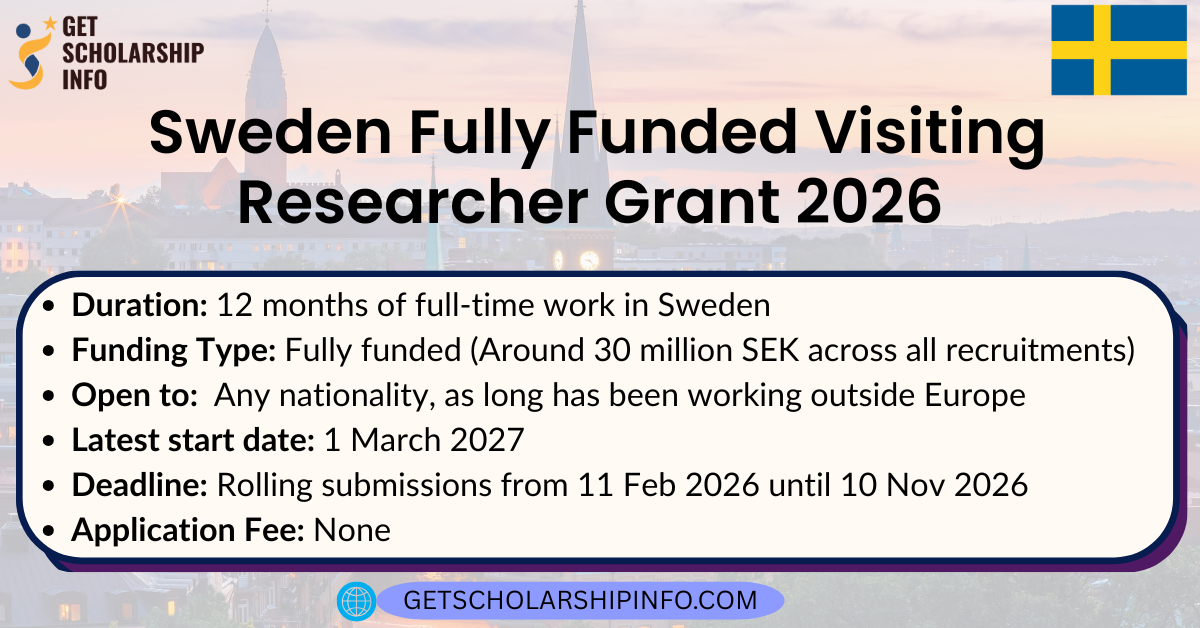
- Grant name: Grant for Recruiting International Visiting Researchers to Sweden 2026
- Funding body: Swedish Research Council (Vetenskapsrådet)
- Funding type: Fully funded — covers salary, relocation, and related costs
- Grant amount: 2 million SEK per recruitment, for one year
- Total budget for the call: Around 30 million SEK across all recruitments
- Grant duration: 12 months of full-time work in Sweden
- Earliest start date: 1 May 2026
- Latest start date: 1 March 2027
- Who applies: The host organisation in Sweden, not the researcher directly
- Application deadline: Rolling submissions from 11 February 2026 at 2 pm until 10 November 2026 at 2 pm
- Decision timeline: Roughly two months after an application is registered
- Application fee: None
- Open to which nationalities: Any nationality, as long as the researcher has been working outside Europe
One thing worth repeating here because people often miss it: this is a rolling call. Applications aren’t reviewed in one big batch at the end. Each one gets processed as it comes in, which means earlier applications may hear back sooner, and the funding pool could realistically be affected by how many strong applications come in early versus late.
What the Grant Actually Covers:
Instead of just listing what happens during the visit, it helps to think about what the researcher walks away with by the end of it.
- A full year’s salary in Sweden, so there’s no financial gap between leaving the current position and settling into the new one.
- Relocation support, including costs tied to moving, such as shipping belongings or handling the logistics of an international move.
- Housing costs, since rent in Sweden can be a real barrier for someone arriving without local support.
- Travel expenses between the researcher’s home country and Sweden, which matters a lot for anyone bringing a family along or making multiple trips.
- Support for accompanying family members, which is a detail many similar grants leave out entirely.
- Some research-related costs tied specifically to the move, giving the researcher room to hit the ground running instead of waiting months to access basic resources.
- A genuine pathway toward longer-term employment, since the whole design of the programme pushes toward the researcher settling into the department beyond the one-year period.
This isn’t a stipend meant to just get by. It’s structured so that a researcher can actually live and work in Sweden without needing outside income or a second job on the side.
Who Can Apply (And Who Can’t):
This section trips people up the most, so let’s go slowly through it.
The grant is not open to just anyone doing research abroad. There are specific boxes that need to be checked before a nomination even makes sense.
- The researcher must have been working and doing research outside Europe for at least two years at the time of application.
- The researcher needs a career age of at least five years after completing a PhD or an equivalent foreign degree.
- The researcher must not already be established in Sweden. If someone already holds a research grant from the Swedish Research Council, for example, they won’t qualify.
- Only Swedish higher education institutions, or other Swedish organisations approved as administrating organisations, can submit the application.
- The application needs a named project leader from the host department, and that person has to remain employed there for the entire grant period.
- No other researchers can be added to this particular application. It’s built around one recruitment at a time.
- The nominated researcher must agree to the nomination and confirm they understand what a successful application actually involves. If they say no, the university cannot simply swap in someone else under the same application.
- A single researcher can only be nominated once, by one institution. Institutions themselves can submit as many applications as they want, just not for the same person twice.
- If the recruitment is already funded through something like Horizon Europe or another mobility programme, it’s not eligible here.
There’s also a small but useful detail for anyone who applied last year and got turned down: if your recruitment was rejected in the 2025 round, you’re allowed to submit it again for this call.
Fields and Programmes Covered Under This Grant:
As mentioned earlier, this isn’t limited to one discipline. Here’s a clean list of the eligible research areas:
- Humanities and Social Sciences
- Clinical Therapy Research
- Artistic Research
- Medicine and Health
- Natural and Engineering Sciences
- Educational Sciences
If your work falls under any of these umbrellas, even loosely, it’s worth checking whether a Swedish department in your field might be interested in hosting you.
The Application Process, Explained Without the Jargon:
Because this is an organisation-led application, the process looks a bit different from a typical scholarship where you fill out a form and hit submit.
Step one: Getting access to Prisma. Prisma is the online system the Swedish Research Council uses for all its grant applications. For this specific call, access isn’t automatic. Someone from the host organisation has to email the Council’s contact person to request a link before they can even open the application form.
Step two: Confirming who leads the application. Whoever starts the process in Prisma may not be the final project leader. If that’s the case, they need to invite the actual project leader into the application so that person can take over responsibility for completing it.
Step three: Filling in descriptive information. This includes the project title, which should be written in a specific way, such as the researcher’s name, their current university, and their country. For example: “Anna Smith, XX University, USA.” Alongside this, an abstract is required, summarising the researcher’s background, the planned start date, and their research programme. This abstract has a strict limit of 1,500 characters, including spaces, roughly a third of a page.
Step four: Writing the research description. This is the heart of the application, capped at four A4 pages using Arial, size 11, single spacing, and 2.5 cm margins. It has to follow four required sections, in this exact order:
- Who the researcher is and what their research covers
- Why this particular visit makes sense, and how it connects to a longer-term plan
- How the researcher’s work can benefit Swedish research in that field
- A detailed plan for how the researcher will be involved with the host department, and any other departments
Step five: Adding recruitment-specific details. This part covers practical information: the researcher’s full name, title, date of their doctoral degree, current job and workplace, what skills or expertise they’ll bring, the planned dates for the visit, and what happens with their employment after the grant period ends. It also needs the name of the department head or equivalent contact at the host department.
Step six: Attaching a CV and publication list. The CV should be short, no more than three pages, and must include contact details along with the researcher’s current title. Alongside it, a list of research outputs from 2018 through 2026 needs to be attached, split into two categories: peer-reviewed work (articles, books, conference results, and similar) and non-peer-reviewed work (like preprints or popular science writing). This list can run up to five pages.
Step seven: Getting a signed certificate from the researcher. This is a one-page document confirming that the nominated researcher understands the terms of the grant and agrees to the recruitment, with genuine intent to build their research presence at the host institution.
Step eight: Budget justification. Since the grant amount is fixed, there’s no need to build a detailed budget from scratch. Instead, a short explanation, up to 2,000 characters, is enough to describe how the funds will be used.
Step nine: Naming the administrating organisation and site. This simply confirms where the researcher will actually be based during their time in Sweden.
Step ten: Adding participants, if needed. The project leader can invite administrative staff to help manage the application, but no additional researchers are allowed to join.
How Applications Get Reviewed:
Once submitted, applications go to a review panel made up of people with broad expertise across the relevant fields. If the panel feels they need outside input, external reviewers may also weigh in. After reviewing, the panel sends a recommendation to the Council’s Director General, who makes the final call.
Every applicant eventually receives a written statement explaining the panel’s decision, including a score and a summary of how the discussion went.
Applications are judged on two main criteria, each scored from 1 to 7:
- The researcher’s scientific standing. This looks at how strong their academic record is and how they’re viewed internationally within their field.
- Relevance to the goals of this specific call. This checks whether the visit could meaningfully push forward research in that area, how well thought-out the department’s plan is for involving the researcher, and whether there’s a realistic path toward long-term impact after the grant period ends.
A Few Things Worth Knowing Before You Start:
There are some smaller details buried in the official call text that are easy to skip past but genuinely matter.
- The visit needs to be completed within 18 months of the grant period starting, so timing matters more than it might first seem.
- On the Prisma form itself, the start date defaults to 1 January 2027 automatically. This can’t be edited directly on the form, so the real intended start date has to be written clearly in the abstract and research description sections instead.
- A researcher can technically be nominated for both this grant and the Swedish Research Council’s separate visiting professorship grant, but if both happen to get approved, the institution has to pick one.
- The grant can’t be used to fund scholarships. It’s specifically for salary and relocation-related costs.
- No CV information or publication details should appear anywhere else in the application outside the designated attachment. Duplicating this information elsewhere isn’t accepted.
Frequently Asked Questions?
Is this scholarship fully funded?
Yes. The grant covers the researcher’s salary for a full year in Sweden, along with relocation costs, housing, and travel. There’s no application fee involved either.
Can researchers apply for this grant directly?
No. Only the Swedish host institution can submit the application. The researcher’s role is to be nominated and to confirm, through a signed certificate, that they agree to the recruitment.
What’s the deadline to apply?
The call runs on a rolling basis from 11 February 2026 at 2 pm until 10 November 2026 at 2 pm. Applications are reviewed as they come in rather than all at once at the end.
Who is eligible to be nominated for this grant?
The nominated researcher must have worked outside Europe for at least two years, have at least five years of career experience after their PhD, and must not already be established in Sweden.
Can a researcher apply through more than one Swedish university at the same time?
No. A researcher can only be nominated once, by a single institution, in one application.
What happens if the nominated researcher declines?
The university cannot replace them with someone else under the same application. A new application would need to be submitted separately.
How long does it take to hear back after applying?
The Swedish Research Council estimates around two months from when an application is officially registered to when a decision is published.
Does this grant support family members who move with the researcher?
Yes. Costs related to accompanying family members are included as part of what the grant can cover.
Can someone who was rejected in 2025 apply again this year?
Yes. The Swedish Research Council specifically allows applications for a recruitment that was rejected in the 2025 call to be resubmitted for the 2026 round.
What subject areas does this grant cover?
It spans Humanities and Social Sciences, Clinical Therapy Research, Artistic Research, Medicine and Health, Natural and Engineering Sciences, and Educational Sciences.
