Since 2001, one quiet but well-funded programme has been sending young researchers to Japan without most people outside academic circles ever hearing about it. The UNESCO/Japan Young Researchers’ Fellowships Programme, more commonly known by the name of its founder, Keizo Obuchi, has already supported 291 researchers from 101 countries. For 2026, the programme is opening its doors again, and this round comes with a sharper focus than usual: heritage conservation, sustainable development, and artificial intelligence, funded through the Japanese Funds-in-Trust and open only to a specific set of countries this year.
If research in Japan has ever been on your radar, or if you’re simply looking for postgraduate funding that doesn’t require you to already be enrolled in a Japanese university, this fellowship is worth understanding properly. It’s not a degree scholarship in the traditional sense. It’s a research grant that funds a stay of a few months at a Japanese institution, built around a specific project you propose yourself.
About the Programme:
The Keizo Obuchi Fellowship was set up as a tribute to the former Japanese Prime Minister, using funds the Japanese government committed toward building research capacity around the world. UNESCO administers it, but the money and the final decision-making sit with Japan. Over more than two decades, it has become one of the more consistent research fellowship schemes connecting researchers from developing regions with Japanese academic institutions.
For the 2026 cycle, UNESCO and Japan are awarding 10 fellowships. This year, eligibility is restricted to researchers from Africa, Small Island Developing States, Ukraine, and Türkiye. That’s a narrower pool than some years, but it also means less competition if you happen to qualify by nationality.
Quick Snapshot:
Here’s everything at a glance before we get into the finer points.
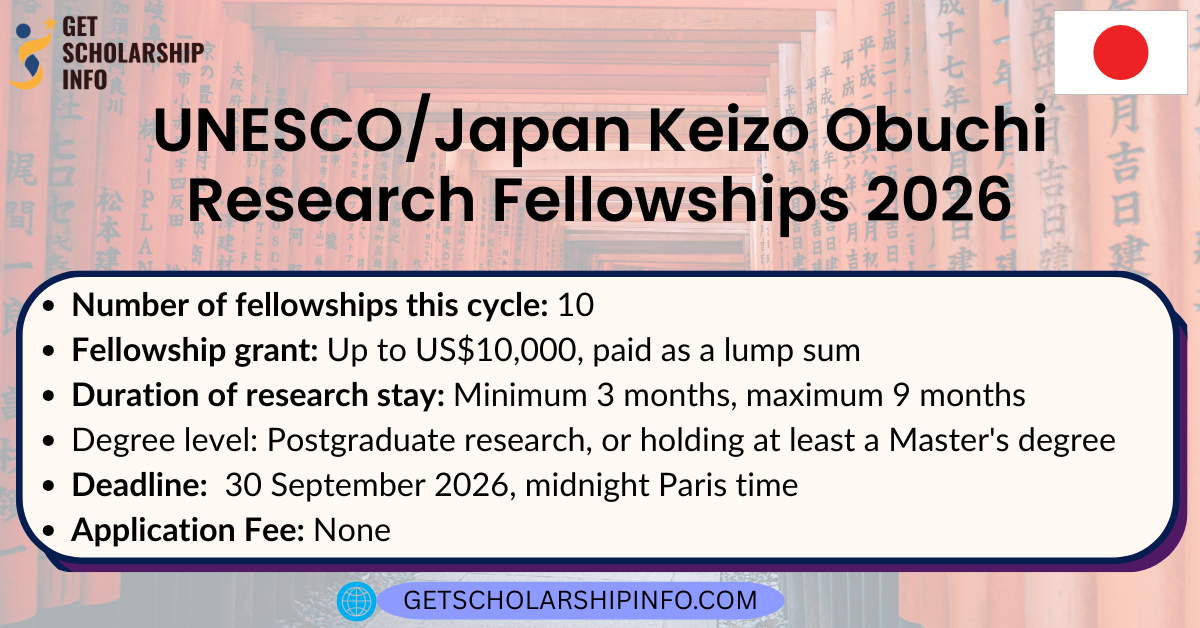
- Number of fellowships this cycle: 10
- Fellowship grant: Up to US$10,000, paid as a lump sum
- Duration of research stay: Minimum 3 months, maximum 9 months
- Host country: Japan, at a university or research institution
- Timing: Research stay begins from February 2027 and must finish by December 2027
- Application deadline: 30 September 2026, midnight Paris time
- Degree level: Postgraduate research, open to those holding at least a Master’s degree
- Eligible nationalities this cycle: Africa, Small Island Developing States, Ukraine, and Türkiye; 83 Member States and 8 Associate Members combined, listed in Annex 1
- Submission route: Not sent directly to UNESCO , applications go through your country’s National Commission for UNESCO
- Application fee: None mentioned by UNESCO for submitting your candidature
What You Actually Get Out of This:
It’s easy to read “fellowship” and picture only a research trip. Here’s what it really means for the person selected.
- A funded research stay in Japan, giving you access to a Japanese university’s labs, libraries, archives, or fieldwork resources that you might not have back home.
- Up to US$10,000 in your pocket, covering flights, accommodation, daily living costs, and local transport, so you’re not funding this out of your own savings.
- A built-in academic mentor, since the programme requires you to already have an accepted supervisor at your host institution before you even apply.
- Mandatory medical insurance arranged for you, which UNESCO sets up on your behalf so you’re covered for the length of your stay.
- A credential that carries weight. Being selected as a Keizo Obuchi fellow puts you in a small, respected group of researchers with a direct link to UNESCO and the Japanese government.
- A foothold in Japan’s research community, useful whether you plan to continue collaborating with your host institution afterward or simply want international research experience on your CV.
- Contribution toward global research priorities. Your work becomes part of a wider effort UNESCO is building around heritage, climate, and AI governance, which can open doors to future collaborations or funding.
Who Is Eligible:
This isn’t open to everyone, and the criteria are specific. You need to meet every one of these points.
- You must hold the nationality of one of the invited Member States or Associate Members for this cycle. This year, that means a country in Africa, a Small Island Developing State, Ukraine, or Türkiye ; the complete list is in Annex 1 of the official documents.
- You must be 40 years old or younger at the time you submit your application.
- You need to already hold at least a Master’s degree, or an equivalent qualification, in a field related to your proposed research.
- You should be able to show strong academic and research potential, not just a completed degree.
- You must have sufficient reading and writing ability in the language your host institution in Japan will use for instruction or supervision. This is confirmed through the UNESCO Certificate of Language Knowledge, filled out by someone qualified to assess your ability.
- You need a signed acceptance from an academic supervisor at a Japanese university or research institution before you apply. Without this, your application cannot move forward.
Where the Money Comes From and Where It Doesn’t Go:
Since this fellowship revolves entirely around a research stay, it’s worth being clear about what the grant is meant to fund.
The fellowship grant, up to US$10,000, is intended to cover:
- International and domestic travel connected to your approved research plan
- Accommodation during your stay in Japan
- Medical insurance, which is compulsory and arranged directly by UNESCO
- Daily living costs, including meals, local transport, and small incidental expenses
- Other research-related costs, where relevant to your project
It’s equally important to know what it won’t cover. The grant does not pay for tuition fees, equipment such as computers, publication costs, or conference attendance, unless you can clearly show that attending a conference is a direct and necessary part of your research. Also worth noting: the cost of your mandatory medical insurance gets deducted from your total grant before you receive the rest, so the amount that actually lands in your hands will be a little less than the full US$10,000.
Which Countries Can Apply This Cycle:
Eligibility for the Keizo Obuchi programme changes from cycle to cycle depending on where UNESCO and Japan want to direct funding. For 2026, applicants must come from one of these groups:
- Africa — 47 Member States, ranging from Angola and Nigeria to Zimbabwe and Zambia
- Arab States — Bahrain is the only eligible country from this region this cycle
- Asia and the Pacific — 17 Member States and 2 Associate Members, largely made up of Pacific Small Island Developing States such as Fiji, Samoa, Tonga, and Vanuatu, along with Singapore
- Latin America and the Caribbean — 16 Member States and 6 Associate Members, almost entirely Caribbean Small Island Developing States including Jamaica, Haiti, Cuba, and Trinidad and Tobago
- Europe — Only Türkiye and Ukraine qualify this cycle
Altogether, that’s 83 Member States and 8 Associate Members, including 48 Small Island Developing States. If your country isn’t on this list, this particular cycle isn’t for you, though future cycles may shift focus elsewhere.
Research Fields You Can Apply Under:
Your proposed research has to sit inside one of five broad areas, and within each one, you’ll need to pick a specific sub-area that matches your project. Here’s the full list of main fields:
- Heritage Conservation and Management
- AI for Sustainable Management of Natural Resources and Climate Action
- Ethical, Inclusive, and Human Centred AI for Sustainable Development
- AI for Sustainable Cities, Infrastructure, and Societal Resilience
- AI and Education
Notice how four out of five categories connect directly to artificial intelligence. This cycle is clearly built around AI’s role in solving real-world problems, paired with just one heritage-focused track. If your research touches on AI ethics, climate modelling, urban planning, education technology, or cultural heritage protection, there’s very likely a sub-area that fits your work. The full breakdown of sub-areas sits in Annex 2, and picking the right one matters, since your primary field and sub-area shape how your proposal gets evaluated.
Documents You’ll Need to Put Together:
Getting your paperwork right matters just as much as having a strong research idea. Here’s what you’ll need before you approach your National Commission.
- A completed application form, using the official template (Annex 3)
- Your research proposal, following the required structure (Annex 4)
- Copies of your academic qualifications, showing you hold at least a Master’s degree
- A recommendation letter supporting your candidacy
- An acceptance letter from your host institution in Japan, confirming a supervisor has agreed to oversee your research
- A completed UNESCO Certificate of Language Knowledge (Annex 5), assessing your ability in the language used at your host institution
Since the acceptance letter from a Japanese supervisor is required before you apply, it’s worth reaching out to potential host institutions early. This step alone can take weeks, so don’t leave it until close to the deadline.
How the Application Process Works:
Unlike many scholarships where you apply directly to the funding body, this one runs through a national gatekeeper. Here’s the sequence:
- Start by reading the official Application Guide carefully, so you understand exactly what’s expected
- Contact the National Commission for UNESCO in your home country to find out their specific process and internal deadlines
- Pull together every required document: application form, academic records, recommendation letter, host acceptance letter, language certificate, and research proposal
- Submit your complete application to your National Commission at least two weeks before the final deadline
- Once your National Commission nominates you as a candidate, send your application form and supporting documents directly to keizoobuchi.fellowships@unesco.org
- Your National Commission then forwards the full nomination package to UNESCO, and this must happen no later than 30 September 2026, midnight Paris time
Two things are worth repeating here because they trip people up. First, UNESCO only accepts applications that have been formally nominated by a National Commission, so going around this step isn’t an option. Second, incomplete applications or anything submitted after the deadline gets excluded automatically, regardless of how strong the research proposal is.
How Selection Actually Works:
Once applications land with UNESCO, a Selection Committee made up of experts from both UNESCO and the Japanese government reviews them. They’re weighing the strength of the candidate alongside the quality, relevance, and originality of the proposed research. It’s not purely about academic credentials; the actual research idea carries real weight in this process.
After the Committee makes its recommendations, the final call rests with the Japanese authorities. They also factor in gender equality and diversity when making their final decisions, so the outcome isn’t based on research merit alone.
A Few Things Worth Keeping in Mind:
- This fellowship is not a scholarship for a degree programme. It funds a research stay only, so you need to already be at postgraduate level with a clear project in mind.
- Since the grant doesn’t cover tuition, this only works if your research stay doesn’t require formal enrolment with fees attached.
- Getting a Japanese supervisor on board before applying is often the hardest part of this whole process, so start that conversation as early as possible.
- Because this goes through National Commissions, each country may have its own internal deadline earlier than 30 September, so check with your national office right away rather than assuming you have until the last day.
Frequently Asked Questions?
Is this fellowship fully funded or partially funded?
It’s best understood as a fixed grant rather than an open-ended full scholarship. You receive up to US$10,000 as a lump sum to cover your travel, accommodation, insurance, and living costs during the research stay. It does not cover tuition, equipment, or conference fees.
Can I apply if I don’t have a supervisor in Japan yet?
No. You need a signed acceptance letter from an academic supervisor at a Japanese university or research institution before you can submit your application. This has to be arranged in advance.
Do I apply directly to UNESCO?
No. All applications must go through the National Commission for UNESCO in your home country first. UNESCO only accepts applications that arrive with a formal nomination from your National Commission.
Is there an age limit?
Yes. You must be 40 years old or younger at the time you submit your application.
Which countries can apply for the 2026 cycle?
Eligibility this cycle is limited to nationals of African Member States, Small Island Developing States across Asia-Pacific and the Caribbean, plus Türkiye and Ukraine. The complete list of eligible countries appears in Annex 1.
What happens if my National Commission misses the deadline?
Your application won’t be considered. UNESCO requires nomination letters and full application documents to reach them by 30 September 2026, midnight Paris time, with no exceptions for late or incomplete submissions.
Does the fellowship cover my tuition fees in Japan?
No. The grant specifically excludes tuition fees, along with equipment purchases and most conference costs, unless conference attendance is essential to your research project.
Is there an application fee to apply for this fellowship?
UNESCO does not mention any fee for submitting an application through your National Commission.
