
Japan keeps opening its doors wider for students from Asia, and Tokyo Metropolitan University has one of the more generous doors right now. I want to walk you through this one carefully because it’s not a small scholarship, it covers your entire tuition, gives you a monthly stipend, pays for your flight, and even helps you find housing. If you’re from Pakistan, India, Bangladesh, or one of several other Asian countries, this is worth reading to the end.
This is the Tokyo Global Partner Scholarship Program, run by Tokyo Metropolitan University (TMU) under the support of the Tokyo Metropolitan Government. The whole point of the program is to bring talented students from across Asia and TMG’s partner cities to study at graduate level in Tokyo, then send them back into the world as people who understand Japan and can build bridges between it and their home countries. It’s open for both Master’s and PhD applicants, it’s fully funded, and there’s no fee to enter the process. The catch, if you can call it that, is that requirements shift a bit depending on which graduate school within TMU you’re applying to, so you’ll need to double-check the specific guidelines for your chosen department once you’ve read this.
Let me break everything down the way I wish someone had done for me when I was researching Japanese scholarships.
Quick Snapshot:
Before you read the long version, here’s the short one. I’m putting the numbers and facts first so you can decide in thirty seconds whether this is worth your time.
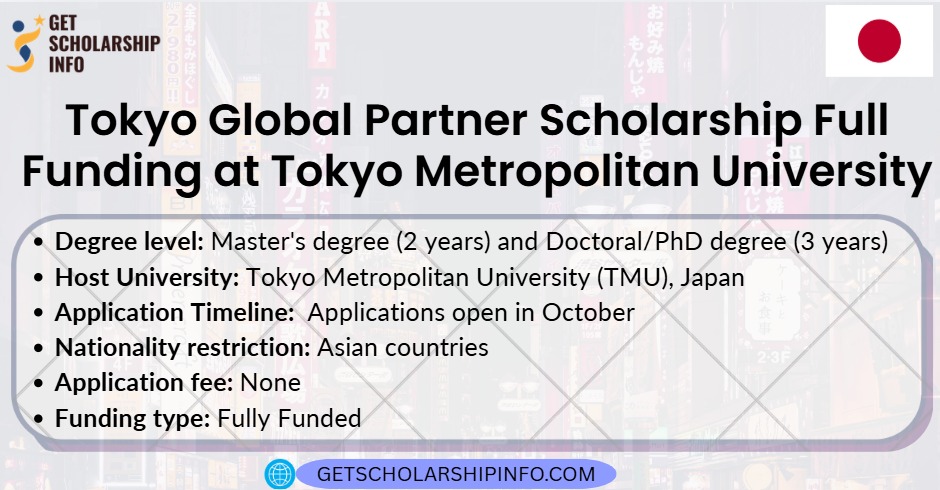
- Host university: Tokyo Metropolitan University (TMU), Japan
- Degree levels: Master’s degree (2 years) and Doctoral/PhD degree (3 years)
- Funding type: Fully funded — tuition, admission fee, monthly stipend, and airfare all covered
- Monthly stipend: 150,000 Japanese Yen
- Application fee: None. The entrance examination fee is also waived for applicants
- Who can apply: Students and working professionals from Asian countries, TMG sister and friendship cities, or TMU’s partner institutions
- Enrollment start: April 1, 2027 (Spring admission cycle for this round)
- Fields offered: Seven graduate schools covering humanities, law, business, science, and more (full list below)
- Language requirement: English or Japanese proficiency, depending on your program
Now let’s go deeper into each part, because a scholarship this good deserves more than a bullet list.
What Makes This Scholarship Worth Your Time:
I always tell readers not to chase every scholarship they see online — chase the ones that actually change your financial situation. This one does. Once you’re accepted and you complete your admission paperwork, here’s what lands in your hands:
- Zero admission fee. You don’t pay a single yen just to enroll.
- Complete tuition coverage for your whole program. That’s two full years for a Master’s student and three full years for a PhD student, so you’re not just funded for year one and left guessing about the rest.
- A monthly living stipend of 150,000 JPY, paid from the month you start your studies until you complete the standard duration of your program. This is meant to cover your daily life in Tokyo, not just token pocket money.
- A one-way flight ticket into Japan when you begin your studies, and another one-way ticket home once you’ve earned your degree. TMU covers the cost between the international airport closest to where you live and either Narita or Haneda Airport.
- Free entrance exam fee, so you’re not paying just to sit the test.
- Housing referral support, meaning TMU connects you with a partner company that helps you find and secure accommodation. You still pay rent yourself, but you’re not left to figure out Tokyo’s housing market alone on your first week in the country.
What I appreciate about this list is that it’s not vague “support provided” language. Every item has a number or a clear boundary attached to it, which tells me the program is serious about following through.
A few honest notes so you don’t get surprised later: your family’s housing isn’t covered, meals and daily rent come out of your own pocket, and if you drop out early or overstay your program duration, the return ticket isn’t guaranteed. None of this takes away from how strong the offer is, but I’d rather you know the fine print now than after you’ve applied.
Who Is Actually Eligible:
This section trips people up the most, so read it slowly. TMU has built eligibility around three main groups, and you only need to fit into one of them.
Group one: you’re currently studying, working, or recently graduated (within the last year) from a university, government body, or company whose main office sits in an Asian country or region, or in one of Tokyo’s sister and friendship cities.
Group two: you’re enrolled in or recently graduated from one of TMU’s official international partner universities. If your current university has a partnership agreement with TMU, you fall here.
Group three: you’re already living in Japan, currently enrolled in a Master’s-level course at a Japanese university, and holding a Student visa at the time you apply.
Beyond which group you belong to, here’s what else TMU checks:
- Age requirement: You must be at least 22 years old for the Master’s course, or at least 24 years old for the doctoral course, by the time you enroll.
- Academic background: Master’s applicants need a completed or expected bachelor’s degree (or equivalent academic standing). PhD applicants need a completed or expected Master’s degree.
- Minimum GPA of 2.30 out of 4.0, calculated using TMU’s own conversion formula if your university uses a different grading scale.
- Language proficiency: either JLPT N2 or higher in Japanese, or CEFR B2 or higher in English, or proof that your previous education was conducted primarily in one of these languages. Some graduate schools may also accept an equivalent judged by the department itself.
- A written commitment to learn basic Japanese to a conversational level by the time you graduate, even if your whole program is taught in English.
- Career intent after graduation. You need to be willing to work for a company with an office in Tokyo, a university or research institute, or a government organization — inside or outside Japan.
- A new Student visa. Most applicants must obtain a fresh Student visa before entering Japan, unless you already hold Student status through one of the eligibility groups above.
There are also a few things that automatically disqualify you: holding Japanese citizenship or permanent residency, being active-duty military personnel, already receiving another scholarship at the time you’d start this one, or having previously studied in Japan on a Japanese Government Scholarship at the same degree level you’re applying for now.
If English is your working language rather than Japanese, don’t worry — plenty of applicants get in with CEFR B2 English scores alone, since Japanese fluency is only required after you’ve enrolled, not before.
Countries and Cities That Qualify:
Since eligibility depends heavily on where your current institution or employer is based, here’s the actual list of Asian countries recognized under this program:
- India
- Pakistan
- Bangladesh
- Sri Lanka
- Nepal
- Bhutan
- Maldives
- Indonesia
- Malaysia
- Singapore
- Thailand
- Vietnam
- Myanmar
- Cambodia
- Laos
- Brunei
- Philippines
- East Timor
- China
- South Korea
- Mongolia
- Taiwan
On top of this, students or professionals based in Tokyo’s sister and friendship cities also qualify. These include cities such as New York City, Beijing, Paris, Seoul, Cairo, Moscow, Berlin, Rome, London, and several member cities of the Asian Network of Major Cities 21, like Bangkok, Delhi, Hanoi, Manila, and Kuala Lumpur.
Graduate Fields You Can Apply Into:
TMU offers this scholarship across seven graduate schools. If your subject area falls into one of these, you’re in good shape:
- Humanities
- Law and Politics
- Management
- Science
- Urban Environmental Sciences
- Systems Design
- Human Health Sciences
I’ll be straightforward here, a few of these schools publish their detailed guidelines only in Japanese, so if you’re applying to Humanities, Law and Politics, or Management, you may need to reach out directly to the department or use translation tools carefully while reading their site.
How the Application Timeline Works:
One thing that confuses a lot of applicants is that TMU runs two separate intakes each year, and the steps land on different months depending on which one you’re targeting.
If you’re aiming for Fall admission:
- Applications open in February
- Applications close in April
- Written exams and interviews happen in May
- Results are announced in June
- Studies begin on October 1st
If you’re aiming for Spring admission:
- Preliminary screening (where required) happens in August
- Applications open in October
- Exams and interviews take place in November
- Results are announced in December
- Studies begin on April 1st
Keep in mind that some graduate schools require a preliminary screening or a pre-application step before you’re even allowed to submit your full application. This isn’t universal across all seven schools, so check your specific department’s page before assuming you can skip straight to the main application.
Steps to Actually Apply:
Here’s the practical part — what you need to do, in order:
- Find a prospective academic supervisor first. Most departments expect you to secure informal approval from a professor before you formally apply. Browse the “Research” or “Faculty Introduction” section of your target graduate school’s website to identify someone whose work matches yours.
- Confirm whether your school requires pre-screening. Some do, some don’t. This step happens before the main application window opens, so don’t miss it.
- Prepare your required documents. These vary between graduate schools, so pull the checklist from your specific department’s latest application guidelines rather than assuming one list fits all.
- Submit your documents, usually by postal mail. Very few departments accept digital-only submissions, so plan your mailing timeline with extra buffer for international shipping.
- Sit your written and/or oral examination, scheduled according to whichever intake you applied for.
- Wait for the results announcement, then complete your admission procedures once accepted, since scholarship benefits only activate after this step.
If you’re currently in Pakistan or a similar location, mail delivery times can be unpredictable, so I’d personally start preparing documents at least six to eight weeks before the deadline just to be safe.
Frequently Asked Questions?
Is there an age limit for this scholarship?
No upper age limit exists. The only requirement is a minimum age — 22 for Master’s applicants and 24 for PhD applicants — at the time of enrollment.
Can I apply if I already have a Master’s degree and want to do another Master’s?
Yes, this is allowed as long as you meet all other eligibility requirements listed above.
Do I need to know Japanese to apply?
Not necessarily. English proficiency at CEFR B2 level or higher is accepted for many programs. However, you must commit to reaching a conversational level of Japanese by the time you finish your studies.
Can I receive this scholarship alongside another one?
No. You cannot hold another scholarship at the same time as this one. After you complete this program, you’re free to apply for other funding as long as it doesn’t overlap with your Tokyo GP period.
I’m currently working full-time. Can I still apply?
Yes. Working professionals are eligible, provided their employer’s office is located in a qualifying country or city and all other criteria are met.
What if I’m already living in Japan?
You can still apply if you’re currently enrolled in a Master’s course in Japan on a Student visa, which qualifies you under a separate eligibility category.
Is the application guideline the same for every graduate school?
No. Each of the seven graduate schools sets its own document requirements and screening process, so always check the specific guidelines published by your target department.
