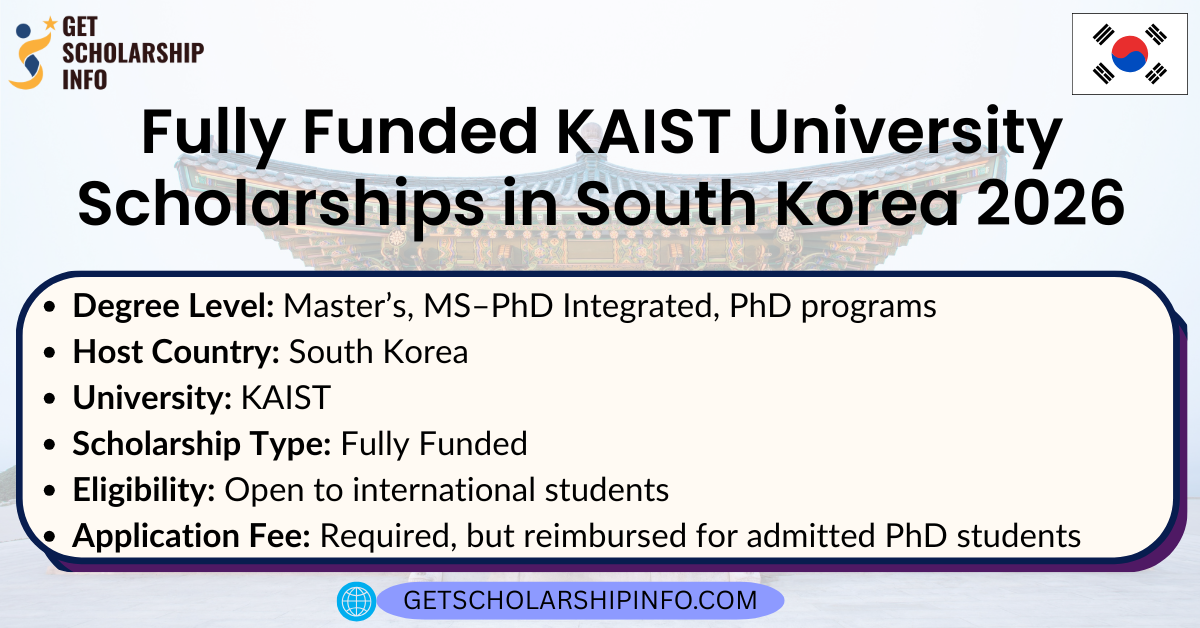
The Korea Advanced Institute of Science and Technology, widely known as KAIST, is one of Asia’s top ranked science and technology universities and offers some of the most generous funding available to international students anywhere in the world. KAIST scholarships cover full tuition fees, a monthly living stipend, and health insurance for undergraduate, Master’s, integrated Master’s to PhD, and standalone PhD applicants, and crucially, there is no separate scholarship application to complete. If you are admitted as an international student, you are automatically considered.
This guide walks through exactly what KAIST covers at each study level, clears up the confusion around application fees that trips up a lot of applicants, and explains realistic timelines for both the Fall and Spring intakes.
What KAIST Scholarships Actually Cover:
Coverage differs slightly by study level, so it helps to see them side by side rather than as one blended figure.
Undergraduate level:
- Full tuition fee waiver for up to 8 semesters
- Monthly stipend of approximately KRW 350,000
- National health insurance
- Renewal requires maintaining a minimum GPA of 2.7 out of 4.3
Master’s and PhD level:
- Full tuition coverage, typically 4 semesters minimum for a Master’s, up to 10 semesters for an integrated Master’s to PhD track, and 8 semesters for a standalone PhD
- Monthly stipend that varies by department, supervisor, and research involvement, commonly cited between KRW 400,000 and KRW 1,000,000 depending on the specific programme and whether the student is also considered for KAIST’s more competitive internal fellowship tracks such as KGPS, KPS, or the KAIST College of Engineering PhD Fellowship
- National health insurance
- Many students also receive additional research assistantship pay directly from their lab, which is separate from the base stipend and can be considerably higher in well funded engineering departments
Clearing Up the Application Fee Confusion:
Here is the part that causes the most confusion, and it is worth being precise about. There are two completely separate things happening:
- The scholarship itself has no separate application. When you complete your KAIST admission application, there is a Statement of Financial Resources section. If you select “KAIST Scholarship” as your funding source there, you are automatically considered for scholarship funding as part of the same admission review. There is no extra form, essay, or portal to submit.
- The admission application does carry a standard application fee, charged as part of applying to KAIST at all, entirely separate from the scholarship. This is normal practice across most Korean universities and is not specific to international or scholarship applicants. The exact amount changes periodically, so check the current fee on KAIST’s official international admissions portal before you apply rather than relying on a fixed number from any third party guide, including this one.
In short, applying for funding is free and automatic. Applying to KAIST at all has a standard admission fee. These are not contradictory, they are simply two different steps in the same process.
Eligibility:
- Open to applicants who are not Korean citizens. Applicants with Korean ancestry are still eligible but must demonstrate that neither parent holds Korean citizenship
- A relevant completed or expected degree by the relevant intake date (a bachelor’s degree for graduate applicants, for example)
- English language proficiency, typically demonstrated through IELTS or TOEFL, though a waiver is available if your prior education was conducted entirely in English, supported by an official Medium of Instruction certificate
- Strong academic performance, since the scholarship is merit based and evaluated as part of the standard admission review rather than through a separate competitive process
Application Timelines:
KAIST runs two main intakes each year, and the deadlines differ significantly between them:
- Fall intake (starting around late August or early September): the international admission deadline typically falls in January of the same year
- Spring intake (starting in early spring): the international admission deadline typically falls around late August to early September of the previous year
Because these deadlines sit roughly six months apart and relate to intakes almost a full year later, it is easy to miss the correct window if you are only checking once. Set a calendar reminder to check KAIST’s official international admissions page at both points in the year rather than relying on a single visit.
Other Funding Worth Knowing About:
If your specific programme or track happens to fall outside KAIST’s standard scholarship coverage, or if you want to strengthen your funding further, two external options are commonly used alongside or instead of the KAIST scholarship:
- Global Korea Scholarship (GKS), a Korean government funded scholarship that often covers tuition, a living stipend, and airfare, open across many Korean universities including KAIST
- POSCO Asia Fellowship, which typically provides full tuition plus a stipend of around KRW 1,000,000 per month and health insurance for students from a defined list of Asian countries
Both are worth researching separately if KAIST’s own scholarship does not apply to your specific track, or if you want a backup application in progress at the same time.
How to Apply:
- Choose your intended study level (undergraduate, Master’s, integrated Master’s to PhD, or PhD) and identify your target department
- Confirm whether your specific track is covered under KAIST’s standard scholarship scheme, since a small number of specialised tracks are excluded and funded differently
- Prepare your admission application, including transcripts, English proficiency proof or MOI waiver, and any required personal statement or research proposal
- In the Statement of Financial Resources section, select KAIST Scholarship as your funding source
- Pay the standard admission application fee as instructed on the official portal
- Submit before the relevant Fall or Spring deadline
Frequently Asked Questions?
Do I need to submit a separate application for the KAIST scholarship?
No. Selecting KAIST Scholarship in the Statement of Financial Resources section of your regular admission application is enough. You are automatically considered during the same review.
Is there an application fee to apply to KAIST?
Yes, applying to KAIST carries a standard admission application fee, which is separate from the scholarship and applies to all applicants regardless of whether they are seeking funding. Check the current amount on the official KAIST admissions portal, since it changes periodically.
How much is the KAIST scholarship stipend?
It varies by level and department. Undergraduates typically receive around KRW 350,000 per month. Graduate students typically receive between KRW 400,000 and KRW 1,000,000 per month depending on the department, supervisor, and whether they are also placed into a more competitive internal fellowship track.
Do I need IELTS to apply?
Not necessarily. If your previous education was taught entirely in English, you can submit an official Medium of Instruction certificate instead of an IELTS or TOEFL score.
Can students of Korean descent apply?
Yes, as long as neither parent holds Korean citizenship. The scholarship is intended for genuinely international students rather than overseas Korean nationals.
What happens if my track is not covered by the KAIST scholarship?
A small number of specialised tracks are excluded from the standard scholarship. In that case, external options such as the Global Korea Scholarship or department specific research assistantship funding are worth exploring instead.
Final Thoughts on This Opportunity:
The KAIST scholarship system reflects a genuine commitment to attracting and supporting global talent. By removing financial obstacles, it allows dedicated students to pursue ambitious research goals in a resource-rich setting. Combined with South Korea’s technological edge and KAIST’s collaborative culture, it creates ideal conditions for academic and personal growth.
If you have a strong background in STEM fields and a passion for innovation, this could be the pathway that transforms your ambitions into reality. Take time to explore department pages, connect with faculty, and prepare a thoughtful application. Many students describe their time at KAIST as life-changing, both professionally and culturally.
The investment in your future through this support often yields returns far beyond the study period, opening doors across Asia and globally. Consider your research interests carefully and align them with what KAIST offers best.

Bismillah keterima
Terima kasih banyak, semoga sukses selalu! Kami ikut senang bisa menjadi bagian dari perjalananmu.
Join WhatsApp, Facebook, dan Instagram kami untuk mendapatkan update terbaru tentang beasiswa.
Saya harap saya bisa mendapatkan beasiswa di kaist ini
Good luck! We hope you get selected for the KAIST scholarship. 😊
Saya harap saya bisa mendapatkan beasiswa di kaist ini.