
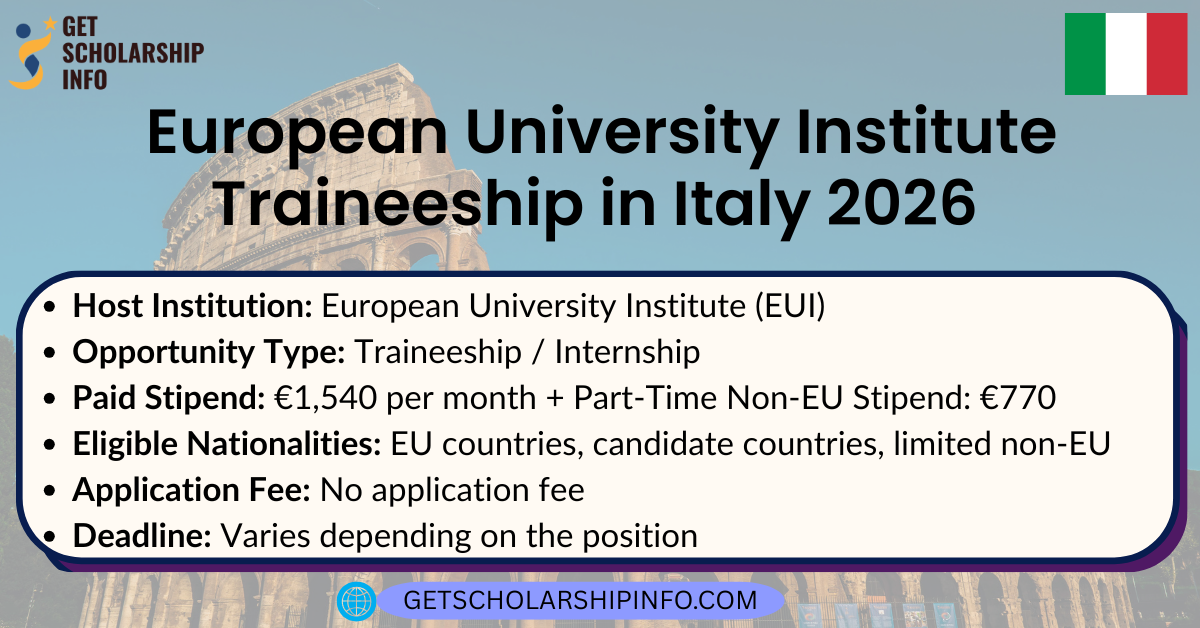
Young professionals and students eager for meaningful international experience often search for opportunities that blend real work with cultural adventure. The European University Institute (EUI) delivers exactly that through its traineeship programme based in Florence. This setup lets participants contribute to a leading research institution dedicated to social sciences and humanities while soaking up the atmosphere of one of the world’s most beautiful cities.
The EUI provides two main pathways: a paid traineeship lasting up to one year with a monthly grant, or a shorter unpaid placement of maximum three months. There is no application fee, making it accessible for talented individuals from eligible backgrounds. Placements happen across various departments, from archives and libraries to communications and administration teams.
Florence itself adds tremendous value, offering inspiration through its art, history, and lively community. Trainees typically finish the programme with stronger skills, broader networks, and fresh perspectives on European research and cooperation.
Essential Programme Information:
Host Organisation: European University Institute
Country: Italy
City: Florence
Duration Options: Up to 12 months (paid) or up to 3 months (unpaid)
Financial Support: Monthly grant of €1,540 for paid trainees (updated from January 2026)
Who It Targets: Graduates and enrolled students from qualifying countries
Language Needs: Solid English plus knowledge of another EU language
Cost to Apply: Completely free
This structure keeps the focus on learning and contribution rather than financial barriers for those who qualify.
Benefits Participants Receive and How It Shapes Their Future:
Trainees walk away with practical advantages that go well beyond a simple internship. Paid participants get a reliable monthly grant that supports living costs in Florence, plus travel expense reimbursement if they come from outside the city. Everyone benefits from health and accident insurance arranged through the institute.
The real strength lies in the professional development. Under supervisor guidance, you tackle actual projects that matter to the EUI’s work. This might involve preserving important historical documents, helping run academic events, managing digital resources, or supporting communications efforts. Such tasks build confidence using your existing knowledge while teaching new abilities in a truly international setting.
Many trainees highlight the multicultural environment as transformative. Working alongside people from different countries improves communication, adaptability, and cultural awareness, skills employers value highly. The experience often helps clarify career goals, whether that means pursuing further studies, working with EU bodies, or entering cultural heritage fields.
Living in Florence brings personal enrichment too. Trainees frequently explore museums, enjoy local cuisine, and form friendships that last years. This combination of work and life experience creates well-rounded growth that feels rewarding on multiple levels.
Understanding Eligibility Requirements:
The EUI maintains clear rules to ensure candidates can contribute effectively:
- You should be a national of an EU Member State or a candidate country with a pre-accession strategy.
- Ukrainian nationals have special eligibility under current decisions.
- A small number of spots may open to other nationalities through agreements.
- Good command of English at B2 level or higher, with useful knowledge of another EU language.
- For paid roles, you need a completed university degree (first cycle or equivalent), generally obtained within the past three years, though current students may qualify in some cases.
- For unpaid traineeships, current university enrollment is usually required, often with an agreement between your home institution and the EUI.
Diversity matters here. The programme welcomes applicants regardless of gender, ethnicity, disability, age, or other personal characteristics. Non-EU participants must sort out Italian visa and residence paperwork before arrival, as regulations require proper documentation.
These conditions help match motivated candidates with the institute’s needs while keeping standards high.
Placement Areas You Can Explore:
The EUI offers flexibility across its operations. Trainees get assigned based on their profile and current needs. Typical areas include:
- Historical Archives of the European Union
- Library and Information Services
- Information and Communication Technology
- Communications Service (events, design, marketing, multimedia)
- Academic and Research Units
- Central Administration Services
- Legal Advisory and Data Protection
Specific openings, such as audio-visual archivist or general communications roles, appear periodically. You can also submit a spontaneous application to express broader interest. This variety means candidates from history, communications, IT, administration, and related fields often find suitable matches.
Navigating the Application Journey:
Everything starts with the EUI’s online application form. Prepare your CV, a thoughtful motivation letter explaining your interest, and supporting documents like degree certificates or enrollment proof.
Some positions have set closing dates, for instance, certain archive traineeships close at the end of November for February starts. Many calls stay open longer, allowing applications throughout the year. Possible start dates fall on the first of February, April, June, September, or November.
Submit carefully and wait for feedback. The institute only contacts candidates selected for interviews. If three months pass without word, you can assume that particular application was unsuccessful but remain welcome to try again for other opportunities. Persistence and tailoring each submission improve your chances over time.
Day-to-Day Life During the Traineeship:
Florence creates an incredible daily environment. Trainees often begin work in a stimulating setting surrounded by history and fellow international staff. Tasks vary but usually involve meaningful contributions that support larger institutional goals.
Supervisors offer guidance while allowing room for initiative. You might help organize conferences, process archival materials, create content for outreach, or assist with technical projects. The collaborative culture makes learning natural and enjoyable.
Outside work hours, the city invites exploration. Weekend outings to Tuscan countryside, visits to famous landmarks, or simple café conversations with other trainees enrich the overall experience. Many describe this period as both professionally valuable and personally unforgettable.
Money Matters and Everyday Practicalities:
The €1,540 monthly grant for paid trainees covers basics like shared accommodation, meals, and local transport reasonably well in Florence. It is not intended as a high salary but provides enough stability to focus on the experience.
Unpaid trainees need alternative funding sources, such as university grants or personal savings. All participants gain from the institute’s insurance arrangements. Planning ahead for visas, housing, and initial costs helps everything run smoothly, especially for those traveling from abroad.
Standing Out When You Apply:
Write a motivation letter that feels personal and specific. Share why the EUI’s focus on European studies matters to you and how your background fits. Mention relevant coursework, volunteer work, or skills that would help in the target unit.
Research the institute beforehand. Understanding its role in European research and current priorities shows genuine interest. For interviews, prepare examples of teamwork, problem-solving, and adaptability. Even unsuccessful applications build useful experience for future tries.
Long-Term Career Impact of EUI Traineeships:
This programme carries real weight on a resume. Association with the EUI signals capability in international, research-oriented environments. The skills and networks developed often lead to further opportunities in academia, policy work, cultural institutions, or EU-related careers.
Past participants frequently note improved job prospects and clearer professional paths after completing their time in Florence. The multicultural exposure and practical achievements make candidates more competitive in today’s global job market.
Potential Challenges and Ways to Overcome Them:
Moving to a new country always involves adjustments. Non-EU trainees face extra steps with visas and permits. Language differences outside the workplace can feel tricky at first, though English works well at the EUI. Financial planning becomes important for unpaid periods.
Fortunately, the institute and Florence’s international scene provide support networks. Staying proactive, asking questions, and embracing the learning curve help turn potential difficulties into growth opportunities.
Frequently Asked Questions?:
How does the payment work for EUI traineeships?
Paid positions offer €1,540 per month. Unpaid ones rely on external support or personal funds.
Who qualifies as an eligible candidate?
Mainly nationals from EU countries and candidate nations, plus Ukrainians and some others by agreement.
Is Italian language required?
No. Strong English and knowledge of another EU language meet the needs.
Are there fixed application deadlines?
Some specific calls have deadlines, but many accept ongoing applications.
Can people from outside Europe apply?
Limited possibilities exist, subject to agreements and Italian legal requirements.
What should I include in my application?
CV, motivation letter, and evidence of education or current studies.
Does the grant include travel support?
Paid trainees from outside Florence can get reimbursement for journey costs at start and end.
What is the maximum length of a traineeship?
One year for paid roles and three months for unpaid.
Is insurance coverage arranged?
Yes, accident insurance is standard, and health insurance options are available.
Is it possible to apply without a specific vacancy?
Yes, spontaneous applications are encouraged through the online form.
Final Reflections on This Unique Opportunity:
The EUI traineeship stands apart by offering genuine professional involvement in a prestigious European setting combined with the magic of Florence. Whether you choose the paid route for financial stability or the shorter unpaid option for focused experience, the programme supports meaningful development.
For individuals drawn to history, policy, communications, research support, or international cooperation, this could mark an important step forward. The combination of challenging work, cultural discovery, and personal connections creates lasting value.
Take time to explore current openings and prepare materials that reflect your strengths and enthusiasm. With dedication and the right fit, an EUI traineeship can become a highlight of your early career and open unexpected doors for the future.

Join internships