The UBC Public Scholars Initiative stands out as one of the most thoughtful funding opportunities for doctoral students who want their research to matter beyond academic circles. This award supports PhD candidates at the University of British Columbia who are passionate about connecting their scholarly work to public benefits, community needs, and broader career development. Instead of limiting students to traditional dissertation writing, the program encourages innovative projects that blend rigorous academic standards with practical contributions to society.
Whether you’re exploring environmental solutions, cultural preservation, health equity, or creative education methods, this award provides financial backing and a supportive network. It recognizes that today’s scholars often seek ways to make their expertise useful in government, nonprofits, industry, and communities. The initiative helps bridge the gap between university research and everyday public good.
What makes this program special is its flexibility. Recipients can use the funds for research expenses, travel, professional development, or even a stipend if their existing funding doesn’t cover the proposed public-facing work. It’s not a full-ride scholarship for new students but rather meaningful extra support for those already enrolled in UBC doctoral programs. The focus remains on quality, collaboration, and long-term impact.
Key Details at a Glance:
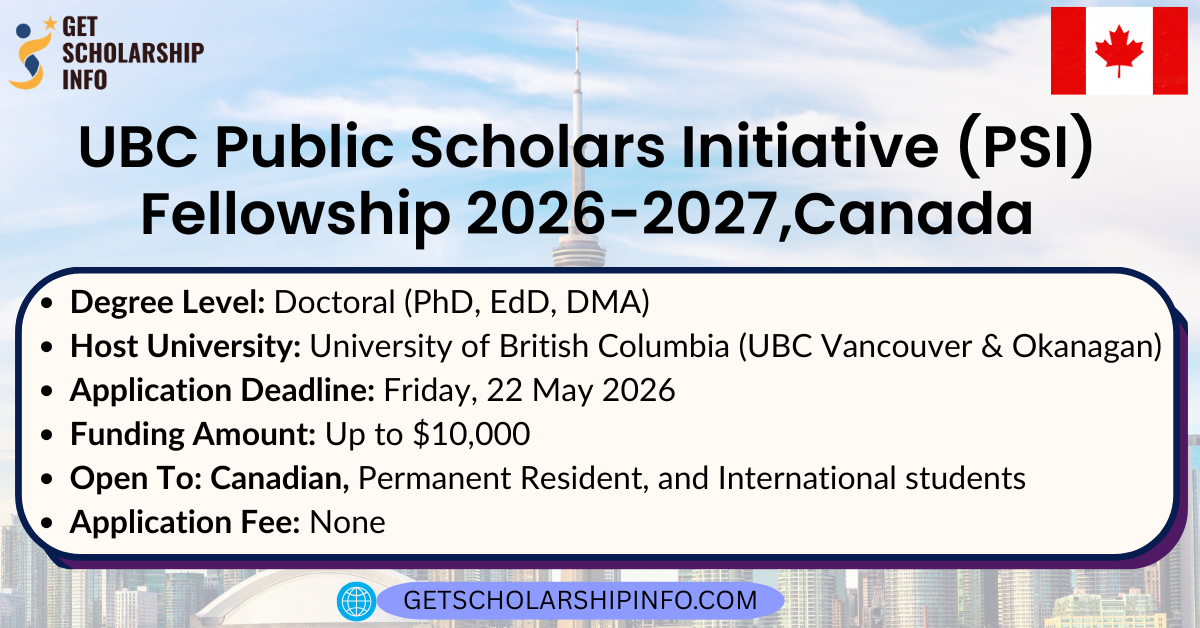
Award Name: UBC Public Scholars Award
Host Institution: University of British Columbia (Vancouver and Okanagan campuses)
Degree Level: Doctoral (PhD, EdD, DMA)
Value: Up to $10,000 per year
Renewal: Eligible for one-time renewal of up to another $10,000
Citizenship: Open to Canadian, permanent resident, and international students
Study Location: Canada
Application Fee: None
Number of Awards: Approximately 30 new awards for UBC Vancouver + 5 for UBC Okanagan each year
The program targets students in years 1-5 of their doctoral studies. Those in year 6 may apply only under exceptional circumstances with prior approval. Applications typically open in late March and close in May, with results announced in late July or early August.
Why the Public Scholars Initiative Matters Today:
Doctoral education has changed. Many PhD graduates now work outside universities in policy, media, arts, industry, and community organizations. The UBC Public Scholars Award acknowledges this reality and actively supports students who want to prepare for diverse careers while still producing excellent research.
The initiative pushes against the idea that serious scholarship must stay locked in ivory towers. Instead, it rewards work that reaches audiences beyond peer-reviewed journals. Past projects include community-based performative inquiry on Holocaust survivors, language revitalization efforts with Indigenous communities, virtual reality simulations for nursing education, and studies on immigrant women teachers’ identities.
By funding these efforts, UBC signals that public engagement strengthens rather than weakens academic rigor. Students gain practical skills, build networks, and create work that benefits society while advancing their degrees. This approach helps combat the common criticism that academic research feels disconnected from real needs.
What This Scholarship Offers: Real Benefits for Participants:
Recipients receive up to $10,000 that they can direct toward their proposed public scholarship project. This money isn’t just symbolic,it removes financial barriers that might prevent creative or collaborative work.
Participants often use the funding for:
- Research-related travel to communities or partner organizations
- Materials, equipment, or software needed for innovative projects
- Professional development workshops and training
- Stipend support when standard funding doesn’t allow time for public-facing activities
- Collaboration costs with non-academic partners
Beyond the cash, scholars join a vibrant network of like-minded doctoral students across disciplines. They attend events, share ideas, and build community. This network often becomes one of the most valuable long-term benefits.
All funded students must submit a report at the end of their funding year and present their work at the “PhDs Go Public” event. These requirements encourage reflection and dissemination, skills that prove useful in any future career. Many scholars report stronger resumes, clearer career direction, and increased confidence after participating.
The program also offers renewal funding. Students in good standing who continue making strong progress can apply for another $10,000 in a separate process. This gives meaningful multi-year support for ambitious projects.
Perhaps most importantly, participants receive institutional recognition that their non-traditional scholarly work counts toward their degree. This validation matters enormously when explaining public projects to supervisors, committees, or future employers.
Who Should Apply: Detailed Eligibility Criteria:
The award welcomes a wide range of doctoral students but maintains clear boundaries to ensure focus.
You must be:
- A UBC Vancouver doctoral student (PhD, EdD, DMA, including part-time) in years 1-5, or
- A UBC Okanagan doctoral student in years 1-5
- Registered in a UBC doctoral program as of September 1 of the award year
- Within 48 months of doctoral study as of August 31 (with limited exceptions for year 6 students)
The program values students who show strong past accomplishments and future promise. Reviewers look for breadth of interests and clear fit between the student and their proposed project.
International students are fully eligible alongside Canadian and permanent resident applicants. This inclusivity reflects UBC’s global outlook and enriches the scholar community.
All recipients must commit to participating in PSI programming, attending events, and completing required reports and questionnaires. These expectations ensure the initiative builds lasting connections rather than just distributing money.
Eligible Fields and Disciplines:
The UBC Public Scholars Award welcomes applications from virtually all academic fields. Here’s a comprehensive list of areas where previous recipients and eligible students have come from:
- Language and Literacy Education
- Resources, Environment and Sustainability
- Anthropology
- Interdisciplinary Studies
- Plant Science
- Forestry
- Nursing
- Population and Public Health
- Music (including Ethnomusicology)
- Educational Studies
- Sociology
- History
- Geography
- Psychology
- Engineering
- Computer Science
- Law
- Business and Management
- Indigenous Studies
- Health Sciences
- Fine Arts and Creative Writing
- Political Science
- Economics
- Philosophy
- Linguistics
- Environmental Science
- Agricultural Sciences
- And many more across UBC’s faculties
The initiative deliberately seeks breadth across disciplines. No single field dominates. Whether your work involves natural language processing for mining transparency, autobiographical comics exploring youth resilience, or governance work with Indigenous communities, you can apply if it connects meaningfully to public benefit.
How to Apply: Step-by-Step Guide:
Applying requires careful preparation but follows a clear process. Applications usually open around March 23 and close May 22.
Step 1: Download the forms Get the PSI Fellowship Application and Instructions from the official UBC Graduate Studies page.
Step 2: Prepare your CV Most applicants now need a Tri-agency CV (narrative style). Guidelines differ slightly depending on whether your research aligns more with CIHR, NSERC, or SSHRC. If you already have a Vanier-Banting CV, you can use that this year.
Step 3: Complete the application form Focus especially on two key sections:
- Outline of Proposed Scholarly Work (max 4000 characters, 1 page)
- Relationship of Proposal to PSI Goals (max 4000 characters, 1 page)
Be specific about your project goals, methods, and public impact.
Step 4: Combine documents Merge your completed application form and CV into one PDF. Name it using the format: LastName_FirstName_PSI
Step 5: Submit via Qualtrics Upload everything through the official submission page. Read the overview carefully before starting.
Step 6: Arrange letters of support Your supervisor must submit a mandatory letter. You can also request optional letters from collaborators. Provide letter writers with the specific Qualtrics link.
The entire process emphasizes clarity, authenticity, and genuine public engagement rather than overly academic jargon.
Crafting a Strong Application: Tips from Successful Patterns:
Strong applications clearly show how the proposed work extends beyond traditional academia. Reviewers want to see realistic goals backed by solid preparation and appropriate methods.
Focus on these elements:
- Demonstrate need for this specific funding
- Explain why traditional funding sources won’t support this particular project
- Show meaningful collaboration with non-academic partners when relevant
- Highlight potential public benefits without overpromising
- Connect your personal background and skills to the project
Use the character limits wisely. Every sentence should advance your case. Avoid vague statements about “making an impact”, describe concrete outcomes and audiences instead.
Get feedback from your supervisor and, if possible, previous PSI scholars. Fresh eyes catch unclear sections that insiders might miss.
Success Stories: Learning from Past Award Holders:
Previous recipients showcase the diversity of possible projects.
Laen Hershler explored Holocaust survivor reflections through community-based performative inquiry in Language and Literacy Education.
Severn Cullis-Suzuki works on learning the ancestral Xaayda Kil language to pass to her children—an inspiring example of personal and cultural scholarship.
Steven Bristow studies precision irrigation for BC growers facing climate change in Plant Science.
Rena Del Pieve Gobbi examines mental health disability and stigma in higher education using images and resilience narratives.
These stories reveal how the award supports deeply personal, community-connected, and practically useful research. Each scholar gained not only funding but also validation and a supportive peer network.
The Broader Impact on Doctoral Education:
Programs like the Public Scholars Initiative address important challenges in graduate education. They help reduce the isolation many PhD students feel and provide structured ways to develop transferable skills.
Participants often report improved time management, better communication abilities, and stronger professional networks. These advantages matter whether graduates pursue academic positions or careers elsewhere.
For UBC as an institution, the initiative strengthens ties with communities across British Columbia and beyond. It demonstrates the university’s commitment to public accountability and knowledge mobilization.
Common Challenges and How to Overcome Them:
Many students worry their project isn’t “public” enough. Remember that public scholarship takes many forms; policy briefs, workshops, art installations, educational resources, digital tools, and more. The key is meaningful connection to audiences outside academia.
Time management presents another hurdle. Balancing traditional dissertation work with public projects requires planning. Successful scholars often integrate the two rather than treating them as completely separate.
International students sometimes feel unsure about cultural context. Lean into your unique perspective—global viewpoints often strengthen public scholarship proposals.
Preparing for the Future: Career Benefits:
The skills and experiences gained through this award translate well to many career paths. Employers increasingly value candidates who can communicate complex ideas, collaborate across sectors, and demonstrate real-world impact.
The network of PSI scholars continues beyond the funding period. Many alumni stay connected and support newer cohorts. This community becomes a professional resource long after graduation.
PSI Renewal Funding Explained:
Scholars in good standing can apply for renewal. This separate process allows continuation of promising work into a second year. Renewal emphasizes engagement with PSI activities and progress on original goals.
Strong participation in events and network activities often influences renewal decisions positively.
FAQs About the UBC Public Scholars Award?:
Is this award open to international students? Yes. The program welcomes applications from international doctoral students at UBC on equal terms with Canadian and permanent resident applicants.
Can part-time PhD students apply? Yes, part-time doctoral students at UBC Vancouver are eligible if they meet the other criteria.
What if I’m in my 6th year of doctoral studies? Applications from year 6 students are accepted only in exceptional circumstances. You must get approval from the PSI before submitting.
Is there an application fee? No. The entire application process is free.
Can I use the funding for a stipend? Yes, if your current funding source would not otherwise allow you to pursue the proposed public scholarship activities.
How competitive is the award? Each year supports roughly 35 new scholars across both campuses. Strong alignment with PSI goals and clear public benefit significantly improve chances.
Do I need to have a non-academic partner organization? Not necessarily. While collaboration strengthens many proposals, solo projects with clear public dissemination plans can also succeed.
What happens after I receive the award? You’ll need to submit an end-of-year report, attend PSI events, present at PhDs Go Public, and complete evaluation questionnaires. These requirements support the community-building aspect of the initiative.
Can the funding be combined with other scholarships? Generally yes, but check with your graduate program and the PSI for any specific restrictions regarding your existing funding package.
When will I know if I received the award? Results are typically announced in late July or early August following the May deadline.
Final Thoughts: Is This Award Right for You?:
The UBC Public Scholars Award suits doctoral students who feel energized by connecting their research to real communities and practical outcomes. If you want support for work that might not fit neatly into traditional funding streams, this could be an excellent opportunity.
Take time to reflect on how your research could benefit broader audiences. The most successful applications come from students who authentically care about public engagement rather than those trying to fit a mold.
Consider attending one of the information sessions offered by the Graduate and Postdoctoral Studies office. Hearing directly from coordinators and past scholars can clarify expectations and spark ideas.
The program represents a forward-thinking approach to doctoral education. By supporting diverse forms of scholarship, UBC helps prepare the next generation of researchers and leaders who can thrive in complex, interconnected worlds.
Whether your passion lies in environmental stewardship, educational innovation, cultural preservation, health equity, or any other field, this award offers resources and community to help turn good ideas into meaningful action.
Start preparing your materials early. Strong applications take time to develop, especially when crafting clear descriptions of both scholarly rigor and public value. The effort invested in a thoughtful application often pays dividends even beyond the funding decision, as the process itself helps refine your research vision.
