A fully funded PhD position has opened up at Tilburg University in the Netherlands, and it sits in a corner of research that doesn’t come up often: teaching AI systems to read the physical structure of computer chips and figure out what they do. The role is based in the Department of Intelligent Systems, runs through the SHIELD project, and pulls in partners like the Netherlands Forensic Institute and the Netherlands Defence Academy. If you’ve got a background in AI, computer vision, or electrical engineering and you’re looking for a doctorate that isn’t just another language model paper, this one is worth a closer look.
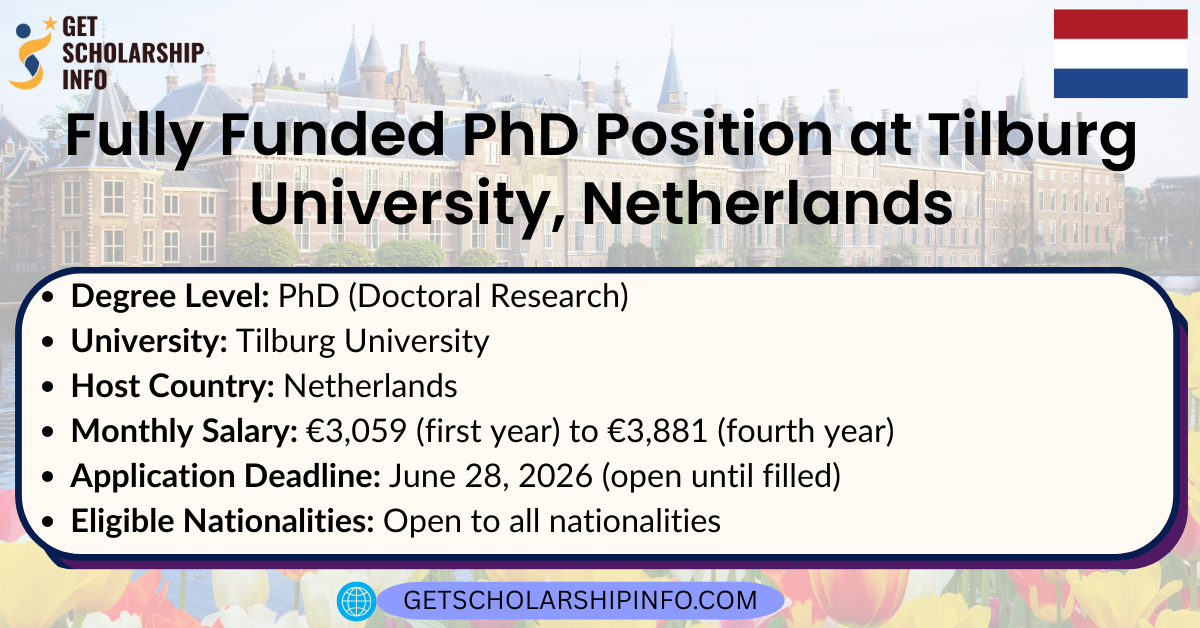
This is a salaried employment contract, not a stipend or grant, which matters because it comes with Dutch labour law protections, holiday pay, and a pension-style benefits package on top of the monthly salary. There’s no tuition to pay and no application fee anywhere in the listing. The first review deadline sits at August 31, 2026, though the position stays open past that date until someone is hired, with interviews starting in the first week of September and a target start date of October 1, 2026.
Snapshot of the Role:
- Position type: Full-time PhD researcher, 1.0 FTE, 40 hours a week
- Host institution: Tilburg University, Tilburg School of Humanities and Digital Sciences
- Country: The Netherlands
- Contract length: 12 months to start, extended to a total of 3 to 4 years after a positive first-year review
- Monthly salary: €3,059 in year one, rising to €3,881 by the final year
- Application deadline: August 31, 2026 for first review, position stays open afterward
- Interview period: First week of September 2026
- Target start date: October 1, 2026
- Application cost: None mentioned in the listing
- Nationality restrictions: None specified; international applicants are explicitly supported through housing help and tax benefits
The Actual Research, Explained Simply:
Chips are tiny, and when researchers want to know exactly what’s built inside one, they normally have to look at it under specialised microscopes and trace the wiring by hand. That process is slow and heavily manual. The SHIELD project wants to speed it up using AI, and this specific PhD role is where the computer vision and machine learning side of that puzzle lives.
The researcher hired for this role will spend their time on three connected problems. First, building deep learning tools that can look at microscope images of a chip and correctly label the tiny layers and transistors inside it. Second, designing models that take those labelled pieces and reconstruct the bigger logical blocks they form, including spotting patterns that might indicate a hidden or malicious circuit, known in the field as a Hardware Trojan. Third, testing out ways to pull memory contents and structural information back out of a chip using nothing but physically captured image data.
None of the actual chip-imaging happens by the PhD candidate working alone in isolation. The imaging data and domain expertise come through the Netherlands Forensic Institute, which brings real microscopy datasets and know-how in techniques like scanning electron microscopy and focused ion beam imaging. The Netherlands Defence Academy’s data science team also weighs in during milestone reviews, though their role stays advisory rather than directive, meaning the academic side keeps ownership of where the science goes.
What You Get Out of This Position:
It’s worth separating out what a PhD candidate actually walks away with, rather than just what tasks fill their calendar:
- A full four-year funded doctorate with a rising salary each year, not a short-term stipend that runs out
- Genuine job security through a Dutch employment contract, including holiday allowance worth 8% and an end-of-year bonus worth 8.3% annually
- A significant tax break for international hires, where 30% of salary is untaxed for the first 20 months, dropping to 20% for the next 20 months, then 10% for the final stretch
- Direct help finding housing, which matters a lot for anyone relocating to a new country for the first time
- Access to a rare mix of academic, defence, and forensic partners in one project, which is the kind of cross-sector exposure that’s hard to get in a typical university lab
- Funded participation in courses, summer schools, and conference trips, both academic and industry-facing
- A body of published, open-access research by the end of the program, useful for anyone aiming at an academic or research career afterward
- Access to strong university infrastructure, savings schemes, and sports facilities as part of the broader employee benefits package
Who Should Apply:
The listing is specific about the technical bar here, since this work sits between several disciplines at once:
- A completed master’s degree in Artificial Intelligence, Computer Science, Electrical Engineering, Computational Neuroscience, Physics, or something closely related with a strong quantitative core
- Solid Python skills and hands-on experience with deep learning frameworks such as PyTorch or TensorFlow, ideally already applied to computer vision or image analysis work
- The kind of analytical mindset that can take a messy, complex system apart, find the actual research question hiding inside it, and build a methodologically sound way to answer it
- Strong written and spoken English, since academic writing and open publication are a core part of the job, not an afterthought
There isn’t a long list of “nice to haves” padded onto this one. The listing keeps the bar tight and specific, which suggests they already know exactly what kind of researcher fits the project.
The Fields This Role Touches:
If you’re wondering whether your specific academic background lines up, here are the disciplines this position pulls together:
- Artificial Intelligence
- Computer Science
- Electrical Engineering
- Computational Neuroscience
- Physics
- Computer Vision
- Hardware Security
How the Application Actually Works:
Applying here isn’t a one-click form. You’ll need to prepare a full package before you submit anything:
- A motivation letter, capped at two pages, explaining your interest in the SHIELD project specifically and how your background fits
- A detailed CV that shows your research potential, including any publications you already have
- Official transcripts from both your bachelor’s and master’s degrees
- Your master’s thesis as a mandatory writing sample, plus any additional academic publication, technical report, or industry research project you’d like to include
- Contact information for two referees who can speak to your research ability, whether from academia or industry
Everything goes through the university’s online application system only; there’s no alternate route in. Early applications matter here because the role, while technically open until filled, has a hard first-review cutoff, and interviews begin barely a week after that date passes.
A Quick Word on Where You’d Be Living:
Tilburg University sits on a green, easily reachable campus, and the surrounding city is a manageable size compared to somewhere like Amsterdam, which tends to suit people relocating from abroad who don’t want to deal with a massive, expensive capital city right away. The university also explicitly offers accommodation assistance for employees moving from outside the Netherlands, which takes some of the usual stress out of an international relocation.
Who to Contact With Questions:
If anything about the scope of the research is unclear before you commit to putting together an application, the listing names Nevena Rankovic as the direct contact for the position, reachable through the university email listed on the original posting. It’s generally worth reaching out before submitting if you’re unsure whether your specific background is a fit, especially given how interdisciplinary this role is.
Frequently Asked Questions?:
Is this PhD position fully funded? Yes. It’s a salaried employment contract with the university, starting at €3,059 a month and rising to €3,881 by the fourth year, plus holiday allowance and an annual bonus. There’s no tuition and no fee to apply.
Can international students and researchers apply? Yes. The listing places no restriction on nationality and specifically outlines support for foreign hires, including a multi-year tax-free allowance and help finding housing near the campus.
Do I need a PhD-level background already to apply? No. A completed master’s degree in a relevant quantitative field is the requirement, not a prior doctorate. What matters more is strong Python and deep learning experience, ideally in computer vision.
What is the actual deadline to apply? The first review deadline is August 31, 2026, though the position technically remains open until filled. Interviews are expected to start in the first week of September 2026, so applying close to the deadline leaves very little buffer.
Is this position tied to defence or military work? The project collaborates with the Netherlands Defence Academy and the Netherlands Forensic Institute, but the research itself is conducted independently at Tilburg University, with academic publication as an explicit goal and the outside partners playing only an advisory role.
What documents do I need ready before I apply? A two-page motivation letter, a full CV, official bachelor’s and master’s transcripts, your master’s thesis as a required writing sample, and contact details for two referees. Everything must be submitted through the university’s online system.
Is there a fixed contract length or can it be extended? The initial contract is for one year. Following a positive first-year evaluation based on agreed research tasks, it’s extended to cover the remaining three years of the doctorate, bringing the total to four years of funded research.
