Anthropic, the company behind the Claude models, runs a four-month paid research track called the Fellows Program. It is built for people who want to move into empirical AI research, whether or not they already have a research background. Instead of asking candidates to already have a PhD or years of published papers, the program hands motivated technical people funding, mentorship, and a real project, then sees what they can build. Past cohorts have sent more than 80% of participants to a public paper submission, and roughly a quarter to half of Fellows have gone on to receive full-time offers at the company.
This particular round covers five separate workstreams, so the program is bigger than a single research topic now. A software engineer with a systems background, an economist, a security researcher who hunts bugs for fun, and a machine learning practitioner working on reinforcement learning could all apply to the same form and land in very different teams. Below is a plain breakdown of what the role actually involves, who tends to get in, and how the application works, written so you don’t have to dig through a long job page to find the numbers that matter.
The Basics You Need Before Applying:
- Applications close 11:59pm Pacific Time on July 26
- The next cohort begins November 2, though early or delayed starts can sometimes be arranged
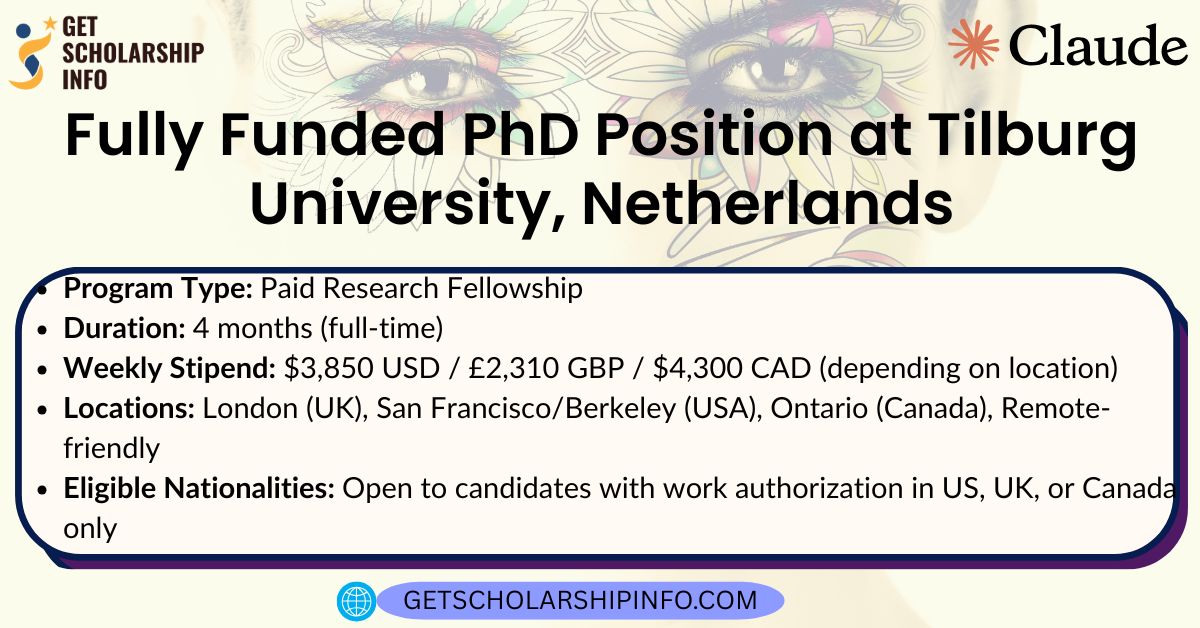
- Program length is four months, full-time, with a possible extension
- Locations are London, UK and Ontario, Canada, plus remote options across the US, UK, and Canada
- Weekly stipend is 3,850 USD, 2,310 GBP, or 4,300 CAD depending on country, plus benefits
- Compute funding of roughly $15,000 a month is provided on top of the stipend
- No visa sponsorship is offered, so applicants must already hold work authorization in the US, UK, or Canada
- There is no mention of an application fee anywhere in the official listing
Who Runs the Show and Who You’ll Work With:
Fellows aren’t left to figure things out alone. Each person goes through a matching process to land with a mentor already working inside Anthropic’s research teams. Depending on which workstream you land in, mentors range from interpretability researchers to security specialists who’ve reported real CVEs, to economists studying labor market shifts caused by AI. You’re not just given a laptop and a deadline; you’re paired with someone whose day job is already in that exact research lane.
What You Actually Walk Away With:
It helps to think about this less as “what tasks will I do” and more as “what will I have in hand at the end.” Here’s what participation actually gives you:
- A concrete public research output, usually a paper, that you can put your name on and reference in future job applications
- Direct, ongoing mentorship from researchers already working at a frontier AI lab, not a one-off call but four months of guidance
- A weekly paycheck comparable to a full-time salary, removing the need to self-fund unpaid research
- Substantial compute budget so the size of your experiments isn’t limited by your personal GPU access
- A shot at a full-time offer at Anthropic, which roughly a quarter to half of past Fellows have received
- Entry into a wider community of AI safety and security researchers, which tends to open doors well beyond the four months
- A structured way to pivot careers into empirical AI research even if your background is somewhere else entirely, like physics, economics, or general software engineering
Who Tends to Do Well Here:
The listing is refreshingly honest that not every box needs to be ticked before you apply. That said, some patterns show up across every workstream:
- A strong technical grounding in computer science, math, or physics
- Comfort writing Python at a fluent level, since this is a hard requirement across the board
- Ability to move fast on ideas and communicate what you found clearly, especially when results are messy or inconclusive
- A track record of doing something concrete already, whether that’s open-source contributions, bug bounty reports, past ML experiments, or relevant coursework
- Genuine interest in the idea that advanced AI systems need to be safe, controllable, and beneficial, since this underpins the whole program rather than being a side note
Anthropic explicitly says not to self-select out if you’re missing a qualification or two. If you’re from a background that’s historically underrepresented in tech research, they specifically encourage you to submit anyway rather than assuming you won’t measure up.
The Five Tracks You Can Choose Between:
Rather than one fixed research topic, applicants pick a preference among these workstreams, and the team considers you across all of them by default:
- AI Safety Fellows
- AI Security Fellows
- ML Systems and Performance Fellows
- Reinforcement Learning Fellows
- The Anthropic Institute Fellows, covering economics and policy
AI Safety Fellows:
This track leans into questions like keeping powerful models honest as they get smarter than the humans supervising them, stress-testing systems against adversarial situations, building “model organisms” to study how alignment can fail, digging into the internal mechanics of language models, and even studying questions around AI welfare. If you’ve got experience with large language models already, or a history of open-source contributions, this track tends to fit well.
AI Security Fellows:
This one is for people who like breaking things productively. Past projects here have included finding millions of dollars in blockchain smart contract exploits and building modular scaffolds to test how well AI systems hold up under adversarial control evaluations. If you’ve reported CVEs, collected bug bounties, done pentesting or offensive security work before, or you’re simply comfortable with unglamorous, detail-heavy technical work, this is likely your lane.
ML Systems and Performance Fellows:
This track is engineering-heavy rather than pure research. Fellows here might build a CPU simulator for accelerator workloads, add support for different hardware backends on open-source projects, or construct infrastructure that other Fellows depend on for their own experiments. If you’re the kind of person who’s comfortable with distributed systems, high-performance computing, or debugging the innards of a model training pipeline, this workstream plays to those strengths directly.
Reinforcement Learning Fellows:
Here the focus shifts toward building the training environments and tools that shape how models learn. Past and current project ideas include creating RL environments aimed at safety-related tasks, improving training data quality through better tooling, and researching how models generalize. This track rewards people who enjoy sitting at the intersection of research exploration and hands-on engineering.
The Anthropic Institute Fellows:
This is the odd one out in a good way, since it’s not purely technical. It splits into economics and policy work. Sample projects include studying how AI is reshaping labor markets, working out early warning signals for rapid AI self-improvement, and analyzing how offense and defense balance out as AI-enabled cyber and biological capabilities scale up. If your background is in economics, policy, or social science rather than engineering, this is the track built with you in mind, and prior research experience is described as a plus rather than a requirement.
How the Actual Application Process Works:
Getting in isn’t a single form and a wait. It runs through a few stages:
- An initial application, along with reference checks
- Technical assessments and interviews, which can vary a bit depending on which workstream you’re aiming for
- A final research discussion before any offer is made
The whole process is managed by Constellation, an external recruiting partner, not by Anthropic’s internal HR directly. That means once you apply, follow-up emails will come from a Constellation address rather than an @anthropic.com one, and you’ll need to complete their application form specifically, since submitting only the initial form isn’t enough to be considered. Constellation also operates the physical Berkeley workspace and provides program support specifically for Fellows on the safety and security tracks, while Fellows working on more capabilities-focused projects get support directly from Anthropic instead.
Where You’d Actually Be Working:
There are two shared physical workspaces, one in Berkeley, California, and one in London. Mentors visit these spaces and Fellows are expected to state how much time they can spend there, whether that’s full-time or part-time. That said, the program is explicitly open to remote Fellows as well, as long as they’re based in the UK, US, or Canada during the four months, since work authorization in one of those three countries is a hard requirement with no path to visa sponsorship for this particular program.
A Quick Note on Realistic Expectations:
Anthropic is upfront that a full-time job at the end isn’t guaranteed. What they do say is that strong performance during the four months has historically translated into a full-time offer for a meaningful chunk of Fellows, and for those who don’t get an offer, many have gone on to do significant work in AI safety and security elsewhere. In other words, treat this as a genuine career accelerator rather than a guaranteed pipeline to permanent employment, and you’ll have realistic expectations going in.
Frequently Asked Questions?:
Is the Anthropic Fellows Program fully funded? Yes. Fellows receive a weekly stipend along with benefits, plus separate funding of about $15,000 a month for compute and other research costs. There’s no cost to participate.
Is there an application fee? No fee is mentioned anywhere in the official posting. Applications go through Constellation’s portal at no cost to the applicant.
Who can apply to this program? Anyone with work authorization in the US, UK, or Canada who is fluent in Python and available to work full-time for four months. You do not need a prior research background, published papers, or an advanced degree to be considered.
Does Anthropic sponsor visas for this program? No. Visa sponsorship is not available for Fellows, unlike Anthropic’s full-time roles, which do offer sponsorship in many cases. You need existing work authorization in one of the three eligible countries.
Can I work remotely instead of relocating? Yes, remote participation is allowed as long as you’re located in the US, UK, or Canada during the program. Shared workspaces exist in Berkeley and London for those who want or need in-person access.
What happens after the four months end? There’s no guaranteed job at the end, but historically between a quarter and half of Fellows have received full-time offers based on their performance, and many others have gone on to meaningful roles elsewhere in AI safety and security work.
How competitive is the selection process? The program involves an application and reference check, technical assessments and interviews, and a final research discussion, so it is a multi-stage process rather than a single form review. Anthropic notes that candidates don’t need to meet every listed qualification to be worth applying.
Which workstream should I choose if I’m unsure? You don’t have to commit rigidly. The listing states that by default candidates are considered across all workstreams, so picking a preference in the application is useful but not a hard lock on where you’ll end up.
