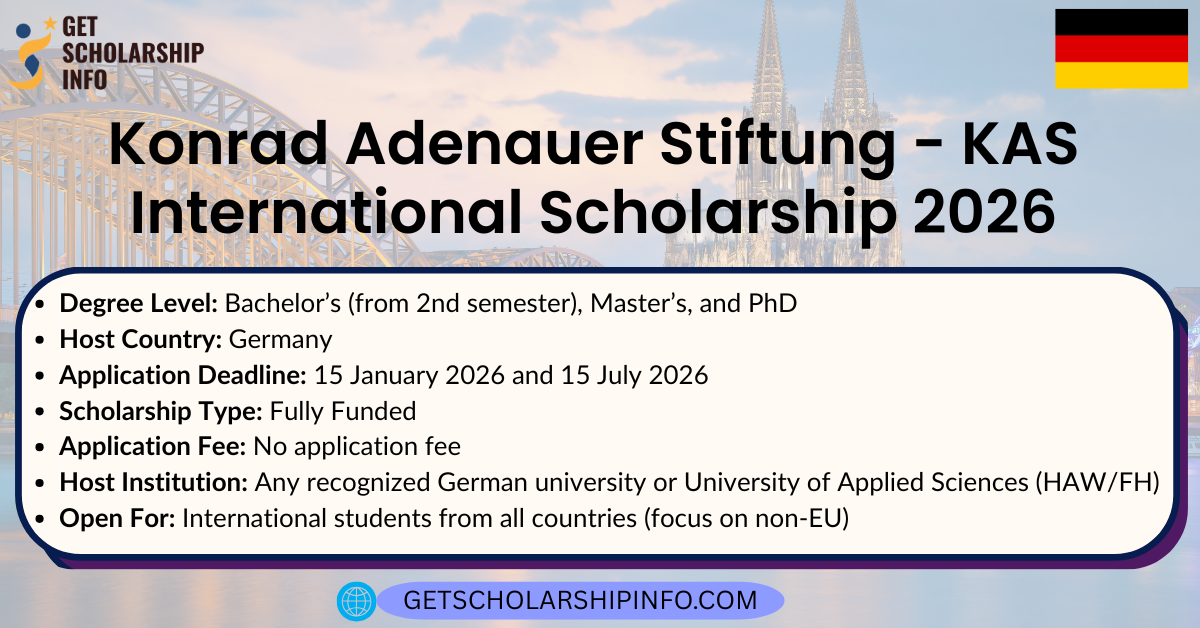
The Konrad Adenauer Stiftung, one of Germany’s largest and longest running political foundations, has awarded scholarships to international students studying in Germany since 1970. The programme funds Bachelor’s, Master’s, and PhD study, with a monthly stipend of up to €1,400 depending on level, plus additional allowances for health insurance, family support, and tuition. It is one of the more distinctive scholarships covered on this site, because academic merit alone is not enough. KAS explicitly looks for applicants who are civically engaged and personally committed to democratic values, not simply high achievers on paper.
Applications for the most recent cycle closed on 15 July 2026. KAS runs this scholarship annually with the same standard deadline each year, so this guide is written to remain useful as a standing reference rather than a single dated announcement. Check the official KAS scholarship page for the confirmed date before applying.
What the Scholarship Covers:
Funding varies by study level:
- Bachelor’s, Master’s, or postgraduate students: a monthly stipend of up to €992, for a standard funding period of two years
- PhD candidates: a monthly stipend of up to €1,400, for a standard funding period of three years
- Additional allowances for all levels: a health insurance subsidy of up to €120 per month, a family allowance of €276 per month for scholars whose spouse earns under €450 per month, a child allowance of €194 per child living in Germany, and tuition fee reimbursement of up to €1,500 per semester where applicable
This combination of stipend plus family and tuition support makes it noticeably more comprehensive than many single figure scholarships, particularly for applicants with dependents.
Why This Scholarship Is Different: Values Based Selection
Most scholarship guides treat every programme as a straightforward academic competition. KAS genuinely is not. Beyond grades and admission to a German university, KAS states plainly that it is looking for candidates who:
- Identify with the foundation’s democratic and civic values and can engage critically and respectfully with social and political topics
- Volunteer regularly, whether in politics, community work, religious organisations, or cultural initiatives
- Take initiative and are willing to play an active role in KAS’s own scholar network and local university groups, not just receive funding passively
- Intend to return to their home country after their studies and contribute to strengthening ties between that country and Germany
In practice, this means a strong KAS application needs a genuine track record of civic or community involvement alongside solid academic credentials. An applicant with excellent grades but no volunteering or civic engagement history is a noticeably weaker candidate here than they would be for a purely merit based scholarship.
Eligibility:
- Primarily open to non EU international students and doctoral candidates
- For Bachelor’s programmes, applicants must have already completed at least the second semester of study at the time of application
- For Master’s or doctoral programmes, applicants must have already completed a first course of study
- German language proficiency is generally required, typically to at least B2 level, since scholars are expected to integrate into German academic and social life during their studies
- Human and dental medicine courses leading to a state examination, along with specialist medical training, are not eligible
- Programmes shorter than the standard four semester funding period, such as some three semester LLM courses, are generally excluded
How to Apply:
- Secure admission, or a confirmed place, at a German university or KAS partner institution for your intended programme
- Prepare a formal CV that includes any social or civic engagement, not just academic and professional history
- Gather certified translations of your academic transcripts
- Arrange a signed letter of recommendation from a university professor holding a doctoral degree, dated within the last two months
- For PhD applicants, prepare a four to five page description of your doctoral thesis, written in either German or English
- Submit your application through the Campus KAS online portal before the annual deadline, typically 15 July
Applicants based in certain focus regions may also be able to apply directly through a local KAS office rather than the domestic online process. Focus regions and participating countries change from year to year, so check the current list on the official KAS site rather than assuming your country is included based on a previous year’s information.
What the KAS Scholar Network Actually Involves:
It helps to know what this support structure looks like day to day, since “non financial support” can sound vague until you see the actual pieces. KAS organizes its scholar programme around three pillars.
The first is personal mentoring. Each scholar is assigned staff contacts and university representatives who check in on academic progress and involvement in the wider programme, rather than leaving international students to navigate German university life alone.
The second is the seminar programme itself, which is genuinely large in scale. KAS runs more than 180 seminars and activities each year for its community of scholars in Germany. These cover historical, political, economic, and social topics at a national, European, and international level, and are designed as an interdisciplinary exchange with other scholars and outside experts rather than a passive lecture series. Alongside the academic content, dedicated coaching and soft skills seminars help scholars prepare for the transition from studying into professional careers. Scholars are also invited to help organize their own seminars and events rather than only attending ones set by the foundation.
The third pillar is local and regional activity through more than 140 university groups spread across Germany, giving scholars a smaller, closer knit community alongside the national programme. PhD candidates have an additional option to join one of KAS’s specialized research colleges, which focus on specific research themes and connect doctoral scholars working in related fields.
In terms of scale, KAS specifically counts more than 3,000 international alumni within its global network, part of a wider KAS scholarship community that includes over 15,000 current and former scholars across all of its programmes, both domestic and international. For an applicant weighing this scholarship against a purely financial offer elsewhere, this structured, ongoing community is arguably the more distinctive part of what KAS actually provides.
Frequently Asked Questions?
How much does the KAS scholarship pay each month?
Up to €992 per month for Bachelor’s, Master’s, or postgraduate students, and up to €1,400 per month for PhD candidates, plus additional health insurance, family, and tuition allowances where applicable.
Do I need to already have a place at a German university to apply?
Yes. Applicants need a confirmed offer or place of study at a German university or KAS partner institution before applying for the scholarship itself.
Is academic performance the only selection criterion?
No. KAS explicitly evaluates civic engagement, volunteering, and commitment to democratic values alongside academic achievement. A strong academic record alone is not considered sufficient.
Do I need to speak German to apply?
Generally yes. German language proficiency, typically at B2 level, is expected since scholars are expected to integrate into German academic and social life during their studies.
When does the KAS scholarship deadline fall each year?
The standard annual deadline is 15 July at 12:00 noon CET, submitted through the Campus KAS online portal. Some focus regions also have earlier deadlines through local KAS offices, so check both the domestic and regional timelines for your country.
Is this scholarship only for EU citizens?
No, the opposite. It is primarily aimed at non EU international students and doctoral candidates.
What does being a KAS scholar actually involve beyond the stipend?
Personal mentoring, access to more than 180 seminars and activities a year, participation in one of over 140 local university groups, and for PhD scholars, the option to join a specialized research college, all backed by a global alumni network of over 3,000 international scholars.
