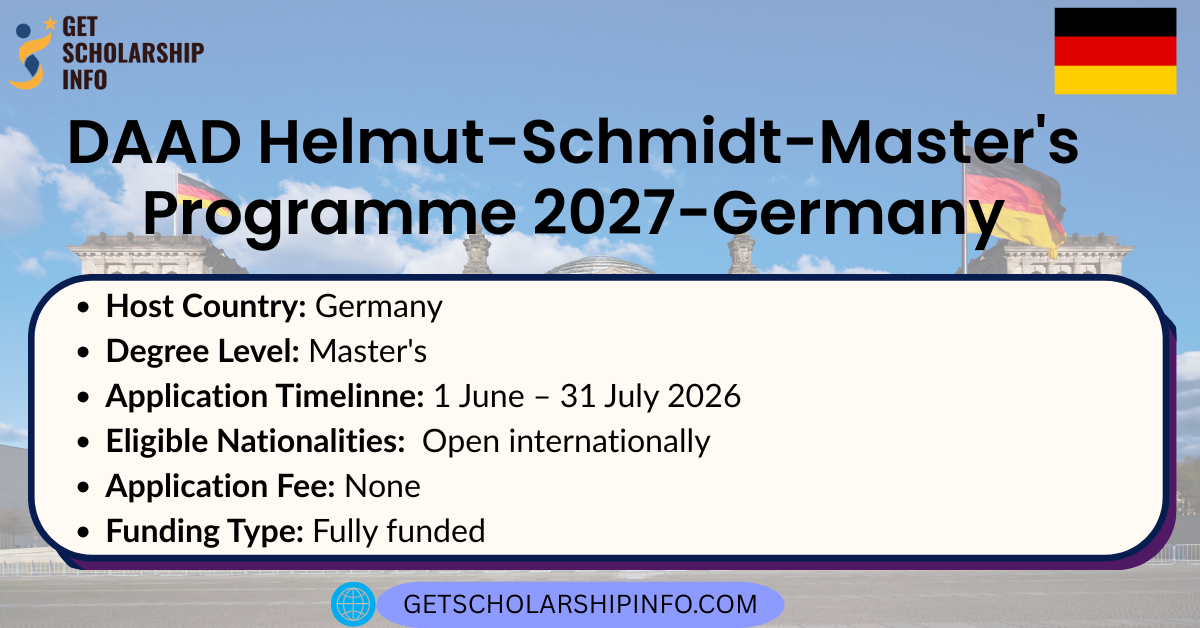
Are you a graduate from a developing or emerging country who wants to contribute to democracy, good governance, and social justice in your home region? The DAAD Helmut-Schmidt-Programme could be your gateway to a fully-funded master’s degree in Germany.
What Is the Helmut-Schmidt-Programme?:
The Helmut-Schmidt-Programme is a scholarship initiative by the German Academic Exchange Service (DAAD), funded by the German Federal Foreign Office. It supports future leaders from developing and emerging countries by offering full scholarships for selected master’s programmes at German universities.
The programme aims to:
- Prepare graduates for responsible leadership positions in their home regions
- Promote good governance, democracy, and civil society structures
- Support the social, political, and economic development of developing and emerging countries
Scholarship Value — What You Get:
This is a full scholarship. Here is everything covered:
- Monthly stipend of €992
- Health, accident, and liability insurance in Germany
- Travel allowance (lump sum) for travel between Germany and your home country
- Study and research grant of €460 per year
- Rent subsidy and family supplements (where applicable)
- Mandatory German language course in Germany for up to 4 months before studies begin
- Tuition fees fully covered (only a small semester registration fee applies)
- Networking events, workshops, and special tutoring at your host university
Special note for Social Protection (Bonn-Rhein-Sieg): During the 4th semester online phase, a reduced “sur place” rate of €500/month applies instead of the standard €992.
Who Can Apply?:
Basic Eligibility:
- Graduates from developing or emerging countries (see DAC list below)
- Hold a bachelor’s degree or equivalent in Social and Political Sciences, Law, Economics, Public Policy, or Administration
- Completed your degree with above-average grades (upper third)
- Have relevant practical experience (work, internships, volunteering, NGO/community work)
- Committed to contributing to the development of your home country or region
Residency Rules:
- You must currently live in a DAC-listed developing or emerging country
- If you have lived outside a DAC-listed country for more than 15 months by 31 July 2026, you are not eligible
- If you already live in Germany, you can still apply as long as you have been there for less than 15 months
Degree Age Requirement:
Your last university degree must have been issued on or after 1 January 2020 (not more than 6 years before the application).
Already Hold a Master’s Degree?:
You can still apply, but you must make a well-argued case explaining why you need a second postgraduate degree and how it builds on your existing qualifications.
Is There an Age Limit?:
No. There is no age limit.
The 7 Master’s Programmes You Can Apply For:
All programmes are taught in English and start in September/October 2027. You may apply to a maximum of two programmes.
1. Social Protection:
University of Applied Sciences Bonn-Rhein-Sieg (H-BRS) Duration: 4 semesters (blended learning) | Contact: msc-socialprotection@h-brs.de | Website: www.h-brs.de
- Focus: Designing, reforming, analysing, and managing social protection systems
- Structure: 1st semester on-campus → 2nd online → 3rd internship → 4th thesis (online from home/developing country)
- Academic requirements: Degree in Economics, Politics, Law, Health, Social Science, or related fields
- Professional experience: At least 5 months in a related field
- Entry exam required
2. Development and Governance:
University of Duisburg-Essen Duration: 2 semesters (1 year) | Contact: ma-devgov@uni-due.de | Website: www.ma-dev-gov.de
- Focus: Governance processes (local, national, international), development studies, peace and conflict, international relations
- Academic requirements: 4-year bachelor’s degree in Political Science, Social Science, Law, or related field
- Professional experience: Minimum 1 year full-time relevant work experience
3. Public Policy:
Willy Brandt School of Public Policy, University of Erfurt Duration: 4 semesters | Contact: admissions-mpp@uni-erfurt.de | Website: www.brandtschool.de | Apply online
- Focus: Policy analysis, leadership, social entrepreneurship, digital policy, peace and conflict, sustainable development
- Academic requirements: Above-average grades, excellent English, strong analytical skills
- Professional experience: At least 1 year of relevant experience
4. Peace and Conflict Studies (PACS):
Otto-von-Guericke University Magdeburg Duration: 4 semesters | Contact: pacs@ovgu.de | Website: www.pacs.ovgu.de
- Focus: Conflict analysis, management, peaceful approaches to conflict and violence
- Specialisations: Regional/Global Orders, Sustainable Development, Global Justice, Media and Violence
- Academic requirements: Bachelor’s degree (min. 180 ECTS) with at least 30 ECTS in Social Science; English at C1 level
- Professional experience: At least 3 months relevant work or study abroad experience
5. Management in Nonprofit-Organisations:
University of Applied Sciences Osnabrück Duration: 4 semesters | Contact: ppgg@hs-osnabrueck.de | Website: www.hs-osnabrueck.de
- Focus: Fundraising, finance, impact measurement, ethics, social innovation, development cooperation
- Academic requirements: Bachelor’s in Politics, Law, Economics, or Administration; English at B2 level
- Professional experience: At least 2 years in the non-profit sector, plus volunteer work
6. Development Studies:
University of Passau Duration: 4 semesters | Contact: information.ppgg@uni-passau.de | Website: www.uni-passau.de
- Focus: Economic and social development, field research, quantitative and qualitative methods
- Optional specialisations: Southeast Asian Studies, Economics, Sustainability
- Academic requirements: Degree in Economics, Anthropology, Sociology, Political Science, or related; 60 ECTS in social sciences; above-average grades; very good English
- Professional experience: At least 4 months relevant professional/practical experience or social/political engagement
7. Governance and Public Policy:
University of Passau Duration: 4 semesters | Contact: information.ppgg@uni-passau.de | Website: www.uni-passau.de
- Focus: Theories of government, governance structures, European integration, autocracies and democracies, policy design
- Academic requirements: Degree in Economics, Sociology, Political Science, Administrative Science, or related; 60 ECTS in social sciences; above-average grades; very good English
- Professional experience: At least 4 months relevant professional/practical experience or social/political engagement
Application Deadline:
1 June – 31 July 2026
Applications open on 1 June and must be submitted by 31 July 2026.
How to Apply — Step by Step:
- Check eligibility — Read the DAAD selection criteria in the checklist carefully.
- Choose 1 or 2 programmes — You may apply to a maximum of two from the list above.
- Fill in the DAAD Application Form — Complete it only once, listing your chosen programme(s).
- Write your Letter of Motivation — One letter for both programmes (if applying to two). Rank your choices and explain why each advances you academically and professionally.
- Prepare all required documents (see list below).
- Send your application directly to the master’s course(s) — Do NOT send it to the DAAD.
Important: Applications sent directly to the DAAD will not be forwarded and will not be returned.
Required Documents Checklist:
- Checklist (printed, ticked, signed by hand, scanned)
- Completed DAAD Application Form (typed)
- Letter of Motivation (max. 2 pages, including date of issue)
- Europass CV in reverse chronological order (with date added manually — the template does not include one); gaps of 3+ months must be explained
- University degree certificate(s) — certified translation required if not in German or English
- Full transcript of records with grading system explanation — certified translation if needed
- Proof of relevant professional experience or internships / political/community activities (on headed paper, with original or code-certified digital signature, date, and stamp)
- Proof of English language skills
- Current written reference letter (from current employer, or university lecturer if you are a student) — on headed paper, with original or code-certified signature, date, and stamp
Applicants from India and China must also submit an APS Certificate.
All documents must be in English or German.
Selection Process and Timeline:
| Stage | When |
|---|---|
| Application period | 1 June – 31 July 2026 |
| Selection committee review | October/November 2026 |
| Nominated candidates contacted by DAAD | After committee review |
| All applicants informed of results | December 2026 / January 2027 |
| Studies begin | September/October 2027 |
The selection committee includes professors from participating universities and DAAD representatives. Only nominated candidates are asked to upload documents to the DAAD portal — do not upload anything unless you receive a nomination email.
Key Selection Criteria:
- A convincing academic, professional, and personal motivation for studying in Germany
- Clear connection between your motivation and the goals of the Helmut-Schmidt-Programme
- Relevant practical experience (professional, internships, volunteering, NGO work)
- A first degree completed with above-average grades (upper third)
Frequently Asked Questions:
Can I apply if I don’t speak German? Yes. All programmes are taught in English. A mandatory German language course (up to 4 months) is included as part of the scholarship.
Can I bring my family to Germany? Yes. After the language course begins, you may apply for a partner/child allowance. However, visa decisions rest with the German embassy.
Will I pay tuition fees? No. Tuition is fully covered. Only a small semester registration fee applies.
Can I apply to more than two programmes? No. Applications to more than two institutions will be excluded from the selection process.
What if I haven’t received my degree certificate yet? You can still apply. Provide an official confirmation from your university instead.
I won’t graduate before 31 July 2026. Can I apply? No. You must have completed your degree before the application deadline.
Eligible Countries (DAC List):
Applicants must be from or currently residing in a country on the OECD DAC List of ODA Recipients. This includes countries across Africa, Asia, Latin America, the Middle East, and the Pacific. Some examples include:
Africa: Nigeria, Kenya, Ghana, Ethiopia, Tanzania, Senegal, Uganda, Cameroon, and many more
Asia: India, Pakistan, Bangladesh, Philippines, Vietnam, Indonesia, Nepal, Sri Lanka, and others
Latin America & Caribbean: Bolivia, Colombia, Ecuador, Honduras, Nicaragua, Paraguay, Peru, and others
Middle East & North Africa: Algeria, Egypt, Jordan, Morocco, Tunisia, West Bank and Gaza Strip
Europe (select): Albania, Armenia, Azerbaijan, Belarus, Bosnia and Herzegovina, Georgia, Kosovo, Moldova, Montenegro, North Macedonia, Serbia, Ukraine
For the full official list, refer to the DAC List of ODA Recipients document provided by DAAD.
Contact the Master’s Programmes Directly:
| Programme | University | |
|---|---|---|
| Social Protection | H-BRS Bonn-Rhein-Sieg | msc-socialprotection@h-brs.de |
| Development and Governance | University of Duisburg-Essen | ma-devgov@uni-due.de |
| Public Policy | University of Erfurt (Willy Brandt School) | admissions-mpp@uni-erfurt.de |
| Peace and Conflict Studies | University of Magdeburg | pacs@ovgu.de |
| Management in Nonprofit-Organisations | University of Applied Sciences Osnabrück | ppgg@hs-osnabrueck.de |
| Development Studies | University of Passau | information.ppgg@uni-passau.de |
| Governance and Public Policy | University of Passau | information.ppgg@uni-passau.de |
