Studying in Taiwan has quietly become one of the smartest moves an international student can make, and National Yang Ming Chiao Tung University (NYCU) is one of the reasons why. Formed from the merger of two of Taiwan’s most respected institutions, Yang Ming University and Chiao Tung University, NYCU now sits among the country’s top research universities, especially strong in medicine, engineering, semiconductors, and science. If you’re hunting for a scholarship that actually covers real costs instead of offering a token discount, this one deserves your attention.
This guide breaks down everything about the NYCU International Student Scholarship in plain language, so you know exactly what you’re signing up for before you spend hours on the application.
A Quick Snapshot Before We Dive In:
This scholarship is not a one-size-fits-all award. NYCU actually runs a small family of scholarships under one umbrella, including the standard International Student Scholarship, the Elite PhD Scholarship, and renewal-based awards for students already enrolled. Depending on your academic record and the funding available in your department that year, you could receive a monthly stipend, a tuition waiver, or both at once. Nothing here is guaranteed at a fixed rate for everyone, since departments and colleges adjust numbers based on their own budgets each year, but the ranges and structures below will give you a very realistic picture.
There is no mention of an application fee within the university’s own guidelines, and the scholarship is open to new applicants as well as current NYCU students who want to renew or upgrade their funding status.
Key Details at a Glance:
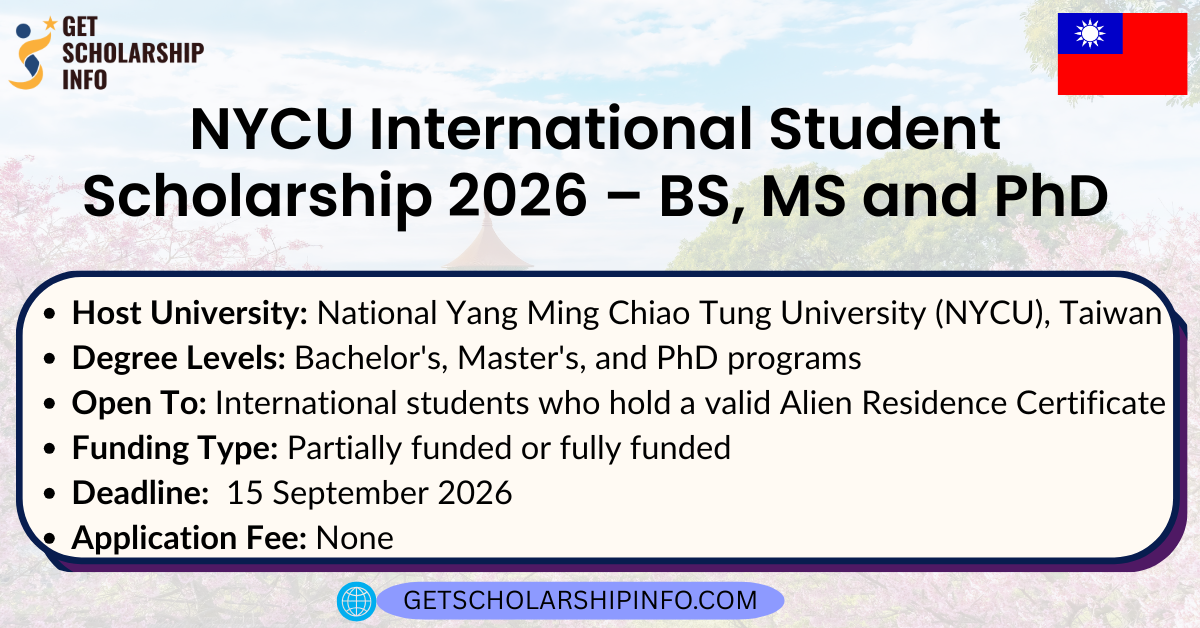
- Host University: National Yang Ming Chiao Tung University (NYCU), Taiwan
- Degree Levels: Bachelor’s, Master’s, and PhD programs
- Funding Type: Partially funded or fully funded, depending on the specific award and department budget
- Open To: International students who hold a valid Alien Residence Certificate and have not already received government scholarships or grants (with a few listed exceptions)
- Application Deadline for Current Students: Fall semester applications run from January 15 to March 15, while spring semester applications run from July 15 to September 15
- New Student Applications: Reviewed through your department and college during the general admissions cycle, separate from the renewal window above
- Application Fee: Not mentioned in the university’s guidelines
- Renewal: Possible each semester if minimum grade requirements are met
- Governing Committee: The International Scholarships and Grants Committee at NYCU makes the final call after department and college review
What Makes This Scholarship Worth Applying For:
Most people assume “scholarship” automatically means free tuition, but NYCU structures things a bit differently, and understanding this structure is exactly what helps you set realistic expectations.
Financial support comes in two separate forms, and you might receive one or both:
- A monthly stipend, funded partly by the Office of International Affairs and sometimes topped up by your college, department, or academic advisor
- A tuition scholarship, which either waives your tuition and credit fees completely, or reduces them down to the same rate that local Taiwanese students pay
For students entering the Elite PhD track specifically, the numbers are laid out clearly: a monthly stipend of NT$33,000 combined with a full waiver of tuition and credit fees for the first two years of the program. That stipend is made up of NT$25,000 from the university itself and an additional NT$8,000 that your advisor commits to matching, so your advisor’s support genuinely matters here, not just on paper.
Beyond the money, being an NYCU scholarship holder puts you inside a structured academic support system. Your advisor reviews your progress each semester, departments track your performance, and there’s a clear, documented pathway for maintaining or adjusting your award if your circumstances change. This isn’t a scholarship you win once and forget about. It’s an ongoing relationship between you, your advisor, and the university.
Who Can Apply:
Eligibility shifts slightly depending on which specific award within this scholarship family you’re going for, but here’s the general breakdown.
For brand-new students:
- You must be entering NYCU with an outstanding academic record
- You must not already be receiving another scholarship or grant from a government source
- PhD applicants pursuing the Elite PhD Scholarship can apply as new entrants or as students directly progressing into a PhD program
For current NYCU students seeking renewal or the Outstanding Existing Student Scholarship:
- You must have completed at least one full semester at NYCU already
- Graduate students need to take at least one core professional course each semester and maintain a grade point average of 3.5 or higher
- Undergraduate students need to maintain a grade point average of 3.0 or higher
- You need a conduct grade of A or above for every semester
- A recommendation letter from your academic advisor is required
General conditions that apply across the board:
- You must hold a valid Alien Residence Certificate. If that certificate was issued for work purposes, you’re not eligible
- If your residence certificate is held as a dependent, or if you hold an Alien Permanent Resident Certificate, you’ll need to sign a declaration confirming you won’t take on a paid full-time job while receiving the scholarship
- Undergraduate scholarship holders must complete at least four Mandarin language courses during their studies, while master’s and PhD holders need to complete at least two. If you’ve already studied Mandarin in Taiwan or passed a recognized national-level Mandarin test, you can submit proof to skip this requirement
Fields and Programs You Can Apply Under:
This scholarship isn’t restricted to one narrow subject area. It’s available across the university’s full academic range, which spans some of Taiwan’s most in-demand fields. Depending on your intended department, you could be applying under areas such as:
- Medicine and Biomedical Sciences
- Electrical and Computer Engineering
- Computer Science and Information Engineering
- Semiconductor and Microelectronics Engineering
- Biological Science and Technology
- Applied Science and Physics
- Photonics and Optical Engineering
- Management and Business Administration
- Humanities and Social Sciences
- Environmental and Civil Engineering
- Mechanical and Aerospace Engineering
- Biomedical Engineering
- Pharmaceutical Sciences and Public Health
Since the scholarship is administered centrally through the Office of International Affairs but reviewed at the department level, your actual chances and funding amount will depend heavily on the specific department you’re applying to and how competitive that intake is in a given year.
How the Application and Review Process Actually Works:
Unlike some scholarships where you fill out one form and wait, NYCU’s process runs through several layers, which honestly works in your favor because it means real people are evaluating your file rather than a purely automated system.
- Department-level review: Your department looks at your past academic grades, research background, or thesis progress and decides whether to recommend you.
- College-level review: Once your department signs off, your college reviews the results and ranks candidates when there’s competition for limited funding.
- Committee approval: The final list goes to the International Scholarships and Grants Committee, which confirms the award amount and duration based on that year’s budget.
Documents you’ll typically need to prepare:
- A completed application form
- Full academic year transcripts (or a single semester transcript if that’s all you have so far)
- Conduct grade documentation showing A or above
- A recommendation letter from your advisor
- A research proposal or thesis description, particularly if you’re a graduate student who has finished coursework but hasn’t accumulated grades yet
- Optional supporting documents like volunteer work certificates or public service records, which can strengthen your file even though they aren’t mandatory
New students typically go through this process alongside their admission application, while current students apply during the set renewal windows mentioned earlier in this post.
Keeping the Scholarship: What Happens After You’re Awarded:
A lot of applicants focus so heavily on getting the scholarship that they overlook what it actually takes to keep it. NYCU is fairly transparent about this, so here’s what you need to know.
- Undergraduate awardees need to maintain a semester average of at least 3.0, while graduate awardees need at least 3.5, to automatically qualify for renewal
- Your very first renewal after your initial semester works differently. Instead of a strict grade cutoff, your advisor evaluates your overall progress and can approve your continuation even if your grades sit slightly below the usual threshold
- If you fall short of the renewal grade requirement in later semesters, your advisor can still submit notes explaining your circumstances, and the Committee may approve an adjusted tuition scholarship instead of cancelling your funding outright
- Elite PhD Scholarship holders face a stricter bar, needing a semester average of 3.76 or above to continue receiving their award
Circumstances That Can End Your Scholarship Early:
It’s worth knowing the situations that lead to termination, simply so you can avoid them entirely:
- Being found responsible for misconduct or behavior the Committee considers a violation of university rules, whether on or off campus
- Being away from campus for more than 30 days for reasons unrelated to academics or research
- Graduating, being suspended, or withdrawing from your program (though if this happens after the 15th of a month, you won’t be asked to return that month’s stipend)
If you need to travel or leave campus for legitimate academic or research reasons, you’re expected to submit written approval signed by your advisor and stamped by your department to the Office of International Affairs before you go.
Maximum Funding Duration by Degree:
- Bachelor’s degree students: funding duration matches the standard length of your specific program
- Master’s degree students: up to 2 years
- PhD students: up to 5 years
- Students directly admitted into a PhD program from undergraduate or master’s study: up to 6 years
If you happen to extend your studies beyond these limits, you’re not automatically cut off from all support. Students who maintain the required grade average can still apply to pay tuition at the local student rate rather than the full international rate, provided their advisor supports the request and the Committee approves it.
A Note on Combining This With Other Funding:
You generally cannot hold this scholarship alongside another government-funded scholarship or grant at the same time, with a couple of specific exceptions built into the university’s regulations, including the NYCU Scholarship for PhD Students Attending International Conferences. If you’re already receiving funding from your home government or another organization, you can still apply for the Outstanding Existing Student Scholarship once that original funding period ends.
Frequently Asked Questions?
Is the NYCU International Student Scholarship fully funded or partially funded?
It can be either, depending on your department’s budget and your academic standing. Some awardees receive a full tuition waiver plus a monthly stipend, which functions as full funding, while others receive only a partial tuition reduction or stipend.
Is there an application fee for this scholarship?
The official university guidelines do not mention any separate application fee for the scholarship itself.
Can undergraduate students apply, or is this only for graduate students?
All three levels are covered: bachelor’s, master’s, and PhD students can all apply, though the specific requirements and stipend amounts differ by level.
Do I need to already know Mandarin to apply?
No prior Mandarin knowledge is required to apply. However, once you’re an awardee, you’ll need to complete a minimum number of Mandarin courses during your studies unless you can prove prior completion or a passing national test score.
What GPA do I need to keep the scholarship?
Undergraduates generally need to maintain a 3.0 GPA, and graduate students need 3.5, though Elite PhD Scholarship holders need a higher 3.76 average.
Can I hold this scholarship together with a scholarship from my home country’s government? Generally no, since NYCU restricts awardees from holding multiple government-funded scholarships at the same time, aside from a small number of listed exceptions.
How long can I receive this scholarship?
Up to 2 years for master’s students, up to 5 years for PhD students, up to 6 years for students directly admitted into a PhD program, and for the full standard duration of your program if you’re an undergraduate.
Who do I contact for more information?
You can reach the Office of International Affairs directly through Ms. Jessica Hsieh at scholarshipoia@nycu.edu.tw or by phone at +886-3-5712121 extension 50666.
Final Thoughts:
If you’re serious about studying in Taiwan and want a program that pairs real academic strength with genuine financial backing, NYCU’s scholarship system rewards students who stay consistent rather than students who just have a strong opening application. The renewal structure, advisor involvement, and tiered funding options mean this isn’t a scholarship you win and forget. It’s one you maintain through steady performance, and for students willing to put in that effort, the payoff, both academically and financially, is substantial.
