Early-career professionals working at the crossroads of science, technology, and international relations now have a rare chance to step into the world of science diplomacy through a fully funded programme connecting Asia and Europe. The Asia-Europe Foundation (ASEF) is running the second edition of its Training and Youth Summit on Science and Technology Diplomacy, and I want to walk you through exactly what it involves, who can join, and what you stand to gain if selected.
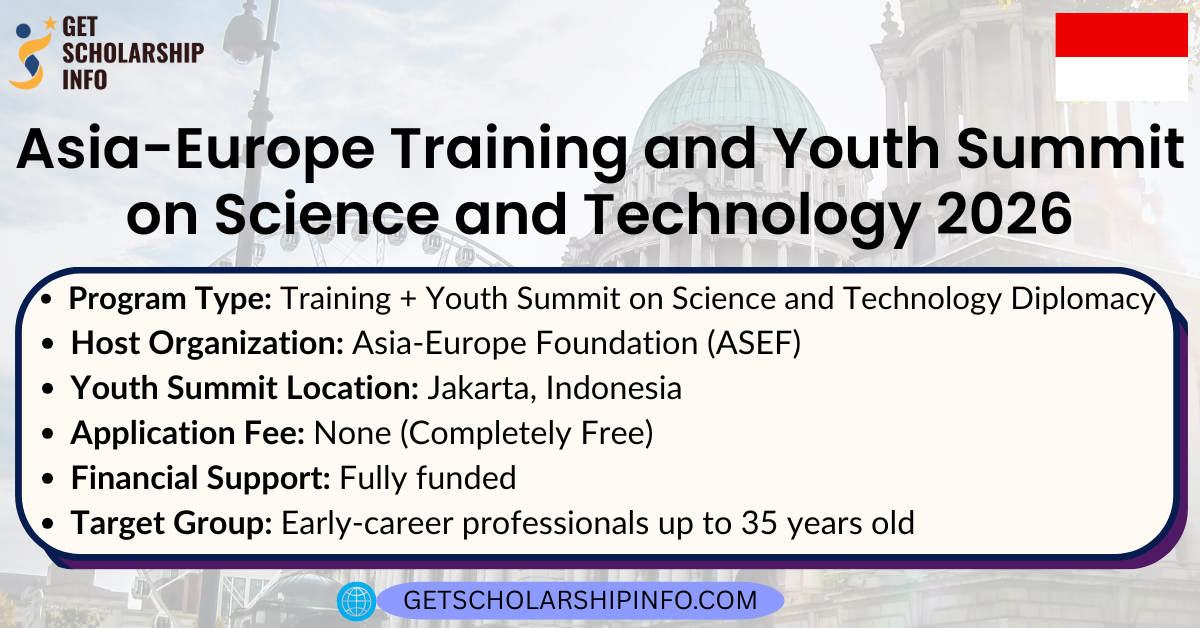
This programme is aimed at people already working in research management, international science policy, or diplomatic roles connected to science and technology. It combines an online training component with an in-person Youth Summit in Jakarta, Indonesia, and the entire experience, including travel, accommodation, and meals for those selected for the Summit, comes at no cost to participants. There is no registration fee and no participation fee at any stage. Citizens of a defined list of Asian and European countries, aged up to 35, working as research or science managers or as diplomats and government officials, are eligible to apply. This programme is not designed for undergraduate or doctoral students, so it’s specifically built for those already in professional roles.
Key Details:
Programme Name: Asia-Europe Training and Youth Summit on Science and Technology Diplomacy
Organiser: Asia-Europe Foundation (ASEF), in partnership with Indonesia’s National Research and Innovation Agency (BRIN)
Training Format: Online, running from 22 July to 8 October 2026
Youth Summit Location: Jakarta, Indonesia, from 19 to 24 October 2026
Application Deadline: 21 June 2026
Notification of Results: By 10 July 2026
Participation Fee: None. Fully funded for selected participants, including accommodation, meals, and travel subsidies for the Youth Summit
Open To: Citizens of eligible Asian and European countries, up to 35 years old
Number of Spots: Around 100 to 120 participants for the online Training, with roughly 40 selected to attend the Youth Summit in Jakarta
What This Programme Offers:
I think what makes this opportunity worth paying attention to isn’t just the training content itself, but what participants walk away with once it’s over.
- A deeper, practical understanding of Science and Technology Diplomacy and how it shapes international policy and innovation
- Direct exposure to leading experts and practitioners working in the field, giving participants insight into current trends and challenges most people never get access to
- Stronger intercultural communication skills, built through interactive workshops and real scenarios rather than theory alone
- A genuine ability to bridge cultural, personal, and professional perspectives, which becomes a career asset in any international role
- A professional network spanning both Asia and Europe, made up of peers, experts, and senior stakeholders
- The chance to co-author and present a formal Declaration on Youth Perspectives on Asia-Europe Cooperation in Science Diplomacy to senior decision-makers
- A fully covered trip to Jakarta for those selected for the Youth Summit, with accommodation, meals, and travel subsidies included
- Long-term career opportunities in science diplomacy, international collaboration, and policy work that this kind of exposure tends to open up
Who Is This Programme For:
ASEF has been fairly specific about the kind of applicant they’re looking for, and I want to break this down clearly so you can check where you stand before applying.
The programme welcomes two main applicant profiles. The first is civil society professionals, meaning research and science managers working within tertiary education institutions, research organisations, or professional bodies that deal with international science, technology, and innovation matters. The second is government professionals, meaning diplomats and government officials working specifically in international collaboration or science and technology diplomacy.
Eligibility Criteria:
Before applying, make sure you meet each of the following requirements:
- You must be a citizen of one of the eligible Asian or European countries listed by ASEF
- You must be up to 35 years old at the time of application
- You need an excellent command of English, both written and verbal, along with fluency in the official language of your country
- You must currently be working as a Research or Science Manager, or as a Diplomat or Government Official, within one of the eligible countries
- Undergraduate students and doctoral students or candidates are not eligible for this programme
- Selection also depends on your motivation to participate and any demonstrated experience you have in science and technology diplomacy
Eligible Countries:
This programme is open specifically to citizens of the following countries across Asia and Europe:
- Australia
- Bangladesh
- Brunei Darussalam
- Cambodia
- China
- India
- Indonesia
- Japan
- Kazakhstan
- Korea
- Lao PDR
- Malaysia
- Mongolia
- Myanmar
- New Zealand
- Pakistan
- Philippines
- Singapore
- Thailand
- Viet Nam
- Austria
- Belgium
- Bulgaria
- Croatia
- Cyprus
- Czech Republic
- Denmark
- Estonia
- Finland
- France
- Germany
- Greece
- Hungary
- Ireland
- Italy
- Latvia
- Lithuania
- Luxembourg
- Malta
- Netherlands
- Norway
- Poland
- Portugal
- Romania
- Slovakia
- Slovenia
- Spain
- Sweden
- Switzerland
- United Kingdom
Professional Fields Covered:
This programme is built around specific professional backgrounds rather than academic majors, so here’s a simple breakdown of the fields eligible for this programme:
- Science and Technology Diplomacy
- International Science, Technology and Innovation Policy
- Research Management (in higher education or research institutions)
- Government and Diplomatic Affairs related to science and technology
- International Relations connected to science and innovation
How the Programme Is Structured:
Understanding the two-stage structure of this programme helps explain why it’s such a substantial commitment, and also why it’s so valuable for the people who complete it.
The first stage is the Asia-Europe Training on Science and Technology Diplomacy, running online from 22 July through 8 October 2026. Around 120 young professionals join this stage, taking part in webinars and interactive workshops led by field experts. The goal here is building practical skills and forming cross-regional connections before the in-person event even begins.
The second stage is the Asia-Europe Youth Summit on Science and Technology Diplomacy, held in Jakarta, Indonesia, from 19 to 24 October 2026. Not everyone who completes the online Training moves on to this stage. Only around 40 participants are selected to attend in person. At the Summit, these delegates prepare and present a formal Declaration on Youth Perspectives on Asia-Europe Cooperation in Science Diplomacy directly to senior stakeholders during high-level sessions, giving young professionals a real voice in shaping future cooperation between the two regions.
What the Time Commitment Looks Like:
This isn’t a passive online course you can complete whenever it suits you. ASEF has laid out a fairly structured schedule that participants are expected to follow closely.
- A Welcome session on 22 July 2026 marks the official start of the Training
- A Networking session takes place on 20 August 2026
- Twelve live sessions run over six weeks, averaging around 3.5 hours per week
- Sessions are held on Tuesdays from 8:00am to 9:30am UTC and Thursdays from 8:00am to 10:00am UTC
- Participants are expected to actively engage in discussions, peer-to-peer learning, and allocated study groups throughout the Training
Those selected for the Youth Summit in Jakarta are expected to fully complete the online Training first, then travel to Indonesia and actively participate onsite for the full duration of the event.
How to Apply:
If you meet the eligibility criteria and this programme fits where you are in your career, here’s how the application process works:
- Confirm you belong to one of the two eligible applicant categories, either civil society or government
- Check that you hold citizenship of one of the eligible Asian or European countries
- Prepare to demonstrate your motivation and any relevant experience in science and technology diplomacy, since this plays a role in selection
- Submit your application before the closing date of 21 June 2026
- Watch for your results, which ASEF will communicate to all applicants by 10 July 2026
- If selected, be ready to commit to the full online Training schedule from July through October, followed by the Jakarta Summit if you’re chosen for that stage
For anyone with further questions, ASEF has made an Open Call Overview and FAQ document available, along with a recorded FAQ webinar. You can also reach the team directly at scitech@asef.org for anything specific to your situation.
Why This Matters for Early-Career Professionals:
I want to point out something that I think gets overlooked with programmes like this. It’s easy to see “training” and assume it’s just another webinar series, but this one is different because it ends with actual influence. Participants aren’t just learning about science diplomacy from the sidelines, they’re producing a formal declaration that gets presented directly to senior stakeholders. That’s a level of access most early-career professionals don’t get elsewhere, and it can meaningfully shift the direction of someone’s career in international policy or research management.
The Asia-Europe connection also matters here. So much of the current conversation around science and technology policy tends to center on either purely regional or purely Western frameworks. A programme specifically built to bridge Asian and European perspectives, and to do it through the people who will be leading these fields in the coming decades, fills a real gap.
Frequently Asked Questions?:
Is this programme free to join?
Yes. There are no registration or participation fees. Accommodation, meals, and travel subsidies are also covered for participants selected to attend the Youth Summit in Jakarta.
Can students apply for this programme?
No. This programme is not open to undergraduate students or doctoral students or candidates. It’s designed for early-career professionals already working in relevant roles.
Who is eligible to apply?
Citizens of specific Asian and European countries, up to 35 years old, currently working as Research or Science Managers in civil society, or as Diplomats or Government Officials, are eligible.
Do all participants get to attend the Jakarta Youth Summit?
No. Around 100 to 120 participants join the online Training, but only about 40 are selected to attend the in-person Youth Summit in Jakarta.
What happens during the online Training?
Participants join webinars and interactive workshops led by experts, covering 12 live sessions over six weeks, along with a Welcome session and a Networking session.
What is the Declaration presented at the Youth Summit?
It’s a formal Declaration on Youth Perspectives on Asia-Europe Cooperation in Science Diplomacy, prepared and presented by youth delegates to senior stakeholders during the Summit.
When will applicants know if they were selected?
All applicants will be informed of the results by 10 July 2026.
Who organises this programme?
It’s organised by the Asia-Europe Foundation (ASEF), hosted in partnership with Indonesia’s National Research and Innovation Agency (BRIN) for the Jakarta Summit.
Final Thoughts:
If you’re an early-career professional working somewhere in the space between science, technology, and international policy, this programme offers something genuinely rare: real access to senior stakeholders, a fully funded international experience, and a platform to actually influence how Asia and Europe collaborate on science diplomacy going forward. Between the structured online Training and the high-level Youth Summit in Jakarta, this is the kind of experience that tends to open doors well beyond the programme itself. If your background fits the eligibility criteria, I’d encourage you to prepare a strong application well ahead of the deadline.
