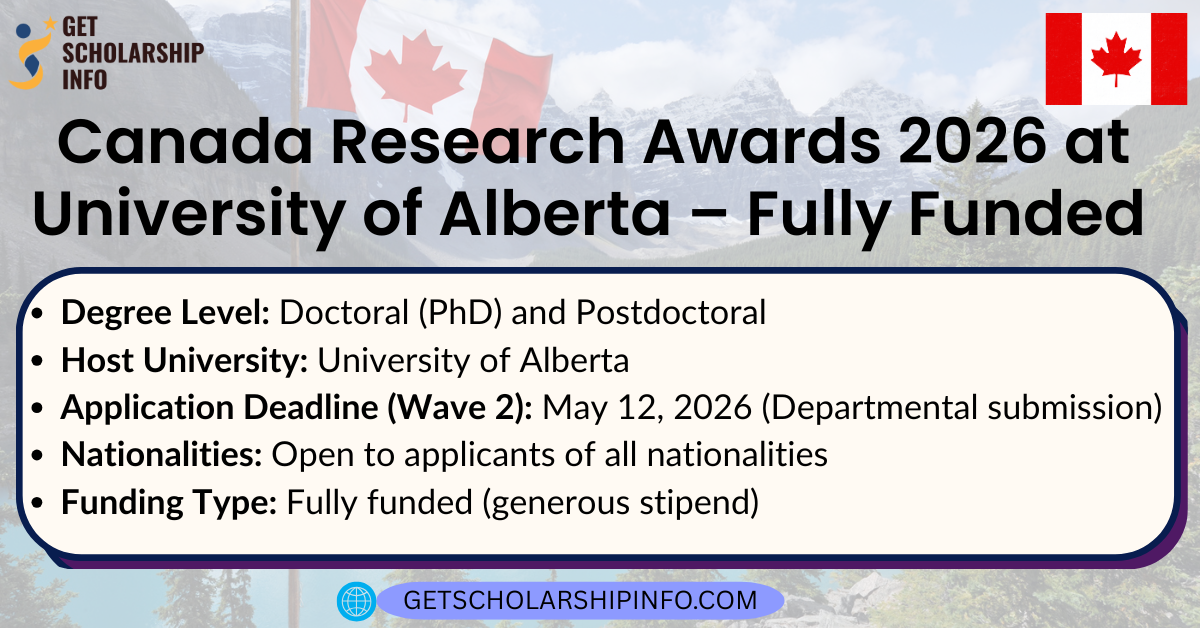
Figuring out how graduate funding actually works at a Canadian university can feel like reading a different language, especially when one page links to five other pages and none of them agree on what’s actually due when. The University of Alberta’s Faculty of Graduate & Postdoctoral Studies, usually just called GPS, runs one of the larger funding portfolios in the country for master’s, doctoral, and postdoctoral researchers. Each year, GPS puts roughly $29 million CAD directly into the hands of graduate students and postdoctoral scholars, spread across federal grants, provincial scholarships, and awards funded by private donors.
This isn’t a single scholarship with one deadline and one amount. It’s closer to an entire ecosystem of funding, and the goal of this guide is to break that ecosystem down into something you can actually use , what’s available, who qualifies, what it’s worth, and how the application process works from start to finish.
Who Runs This and Where the Money Comes From:
The Faculty of Graduate & Postdoctoral Studies administers awards through what’s called the GSMS Awards Portal, a centralized system where students search for, apply to, and manage their funding. Money flows in from three main directions:
- The Tri-Council agencies (NSERC, SSHRC, and CIHR), which are federal research funding bodies covering natural sciences and engineering, social sciences and humanities, and health research respectively
- Provincial sources, primarily Alberta Innovates and the Government of Alberta through programs like the Alberta Graduate Excellence Scholarship
- Private endowments and donor funds, the largest of which is the Killam Trusts, a $400 million endowment supporting scholarly work across Canada, with more than $60 million of that having gone to the University of Alberta specifically
Beyond these three streams, GPS also manages over 500 separate department-level awards, each funded individually by donors and tied to specific faculties or programs.
Snapshot: What You Need to Know Before Digging In:
- Institution: University of Alberta, Faculty of Graduate & Postdoctoral Studies (GPS)
- Location: Edmonton, Alberta, Canada
- Degree levels covered: Master’s, doctoral, and postdoctoral researchers
- Total annual funding administered: Approximately $29 million CAD
- Open to international applicants: Yes, many awards are open to both domestic and international students, though some particularly Tri-Council awards are restricted to Canadian citizens and permanent residents
- Application fee: None. Applying through the GSMS portal does not cost anything
- Application method: Through the GSMS Awards Portal using your CCID and password
- Minimum guaranteed PhD funding: $100,000 CAD over four years, with at least $25,000 CAD guaranteed in the first year alone
What Graduate Students and Postdocs Actually Receive:
It helps to separate the money itself from what that money actually buys you as a researcher, because the value goes beyond the dollar figure on an award letter.
- Doctoral students starting or currently enrolled at the University of Alberta receive a guaranteed funding floor, meaning you know your minimum income for four years before you even begin your first term, which removes a huge amount of financial uncertainty
- Postdoctoral fellows through programs like CIHR and NSERC can receive up to $70,000 CAD per year for two years, giving early-career researchers enough runway to build an independent research profile before entering the job market
- Killam recipients don’t just get a paycheque , they join a laureate network considered among the most prestigious research communities in Canada, which carries weight well beyond the funding period itself
- Travel award recipients get direct support to present their research at conferences, meaning your work gets seen by the wider academic community instead of staying inside a single department
- Entrance and recruitment scholarship holders get recognition that often strengthens future funding applications, since being selected for one competitive award tends to make you a stronger candidate for the next one
- Indigenous graduate researchers have access to a dedicated research award designed specifically to support their scholarship, rather than having to compete solely within general funding pools
- Mentoring award winners gain formal institutional recognition for supervision work that’s often invisible in typical academic evaluation, which matters a great deal for tenure and promotion cases later on
Eligibility: What Actually Determines Whether You Qualify:
Because this covers dozens of separate awards rather than one program, eligibility isn’t a single checklist , it shifts depending on the specific award. That said, a few patterns hold across most of them:
- You generally need to be registered, or about to be registered, as a full-time graduate student or postdoctoral scholar at the University of Alberta
- Federal Tri-Council awards (NSERC, SSHRC, CIHR) usually require Canadian citizenship or permanent residency, which rules out most international applicants for those specific streams
- Provincial and university-funded awards, including the Alberta Graduate Excellence Scholarship, are frequently open to international students as well as domestic ones
- Academic standing matters heavily , most competitive scholarships expect a strong GPA and a demonstrated record of research productivity or potential
- Some awards, like the Indo-Pacific Scholarship/Fellowship, are tied to specific regional or thematic priorities rather than being open to every applicant
- Department-specific awards often carry additional criteria set by individual faculties, such as being enrolled in a particular program or working under a specific supervisor
- Postdoctoral fellowships typically require you to be within a certain number of years of completing your PhD, so timing your application matters as much as your qualifications
Because eligibility varies this much between awards, the smartest move is always to check the individual award’s memo before assuming you either qualify or don’t.
Fields and Disciplines Covered:
One of the more useful things about this funding portfolio is how wide it stretches. Unlike a scholarship tied to a single subject, GPS funding spans essentially every faculty at the University of Alberta. Based on how these awards are structured, applicants from the following areas are all represented:
- Engineering and applied sciences
- Natural and physical sciences
- Health sciences and medicine
- Social sciences
- Humanities and languages
- Business and economics
- Law
- Education
- Agricultural, life, and environmental sciences
- Native Studies and Indigenous scholarship
- Arts, design, and creative disciplines
- Interdisciplinary and grand-challenge focused research
If your program exists at the University of Alberta, there’s a very good chance there’s at least one award category open to you, even if it’s a department-specific one rather than one of the flagship named scholarships.
Major Awards Worth Knowing, With Their Current Deadlines:
Rather than treating every award the same, here are some of the standout opportunities currently on the calendar, along with what’s due when:
- Alberta Innovates Graduate Student Scholarship (AI GSS): Master’s funding valued at $26,000, with a GPS deadline of July 23, 2026
- Indo-Pacific Scholarship/Fellowship: $13,200 CAD for graduate students and $11,200 CAD for postdoctoral scholars, due August 4, 2026
- University of Alberta Graduate Recruitment Scholarship and Graduate Student Award (Winter 2027 start): A variable amount, with applications due November 12, 2026
- CIHR Postdoctoral Fellowships (CPRA): $70,000 per year for two years, with a university deadline of September 9, 2026 and a ResearchNet deadline of September 16, 2026
- NSERC Postdoctoral Research Award (CPRA): $70,000 per year for two years, due October 17, 2026
- SSHRC Postdoctoral Research Award (CPRA): $70,000 per year for two years, due September 10, 2026
- LevMax-Health 2026 Spring Tri-Agency Competition: Amount varies by project, deadline August 28, 2026
- NSERC Indigenous Student Ambassadors (NISA): Up to $5,000, accepted on an ongoing basis rather than a fixed deadline
Since award values and deadlines are confirmed directly by the funding agencies and can shift, it’s worth double-checking the official GPS deadlines page before finalizing any application timeline.
How the Application Process Actually Works:
Applying isn’t a single form , it’s more of a sequence, and skipping a step tends to cause the most common mistakes.
- Start with the GPS Scholarships and Awards webpage. This is where you’ll find out which awards are even open through the portal, since only a limited selection is available there directly
- Read the Scholarships and Awards Manual (SAM). This document governs eligibility definitions, registration status requirements, and what happens if your program status changes mid-award
- Log into the GSMS Awards Portal using your CCID and password. From here you can search for awards, submit applications, view your submitted documents, and track offers
- Watch for notifications. Offers typically arrive both as an email to your university account and as an intray message inside the GSMS portal itself
- Respond to offers promptly. There are specific guides for accepting, renewing, deferring, or interrupting an award, and missing these steps can affect your funding continuity
- For externally sponsored awards, if the funder requires “sponsor approval,” your academic supervisor needs to route the application through the Research Services Office institutional approval chain — plan for this at least ten business days before the actual deadline, since it isn’t instant
NSERC Information Sessions Worth Attending:
If you’re considering an NSERC doctoral or postdoctoral application, GPS runs live Q&A sessions over Microsoft Teams specifically to walk through program details. These are offered in both English and French across several dates in late August and early September 2026. Before joining, you’re expected to have already read the relevant program description so the session time goes toward answering your specific questions rather than covering material available in writing.
A Few Things to Double-Check Before You Apply:
- Award amounts listed anywhere, including this guide, are estimates and should be confirmed on the official funding agency’s website before you rely on them
- GPS administers many of these awards directly, but for externally funded programs, GPS is not responsible for managing the competition itself , the sponsoring agency’s website is the final authority
- If you hit a technical issue inside the GSMS portal, that’s handled by IST, not GPS directly, so route those tickets accordingly
Frequently Asked Questions?:
Is there a fee to apply for University of Alberta graduate awards?
No. Applying through the GSMS Awards Portal is free for all award categories.
Can international students apply for these scholarships?
Many can, particularly provincial and university-funded awards like the Alberta Graduate Excellence Scholarship. However, federal Tri-Council awards generally require Canadian citizenship or permanent residency.
What is the minimum guaranteed funding for PhD students?
Current and incoming doctoral students are guaranteed at least $100,000 CAD across their first four years, with a minimum of $25,000 CAD guaranteed in year one.
Do I need to be in a specific field to qualify for funding?
No. Awards span nearly every faculty at the University of Alberta, from engineering and health sciences to humanities, law, and Indigenous scholarship. Eligibility depends more on the specific award than on your discipline.
How do I actually submit an application?
Through the GSMS Awards Portal, using your CCID and password. Most award instructions and required documents are listed directly within the portal listing for each competition.
Are postdoctoral fellows eligible for the same awards as graduate students?
Some awards are shared across both groups, like the Indo-Pacific Scholarship/Fellowship, while others, such as CIHR, NSERC, and SSHRC postdoctoral awards, are specifically designed for postdoctoral researchers only.
What happens if my program status changes while I hold an award?
The Scholarships and Awards Manual outlines how changes in registration status, including interruptions or deferrals, affect an existing award. It’s worth reviewing this before any change to your enrolment status.
Where can I find the most accurate, up-to-date deadlines?
The GPS “Awards Deadlines at a Glance” page is updated regularly and should always be treated as the most current source, since amounts and dates for external awards can change.
