Germany’s DAAD has built a scholarship around a simple idea: research that starts in the Global South shouldn’t have to stop there. The GROW programme , short for Global Research Opportunities for the South , pays for scholars from Sub-Saharan Africa, Latin America and Asia to spend time in Germany, work with a host institution, and carry that experience back home. There’s no tuition to chase and no single academic field it’s locked into. What matters is that your work connects to a real development challenge and that you’re based at a university or research institute in an eligible country.
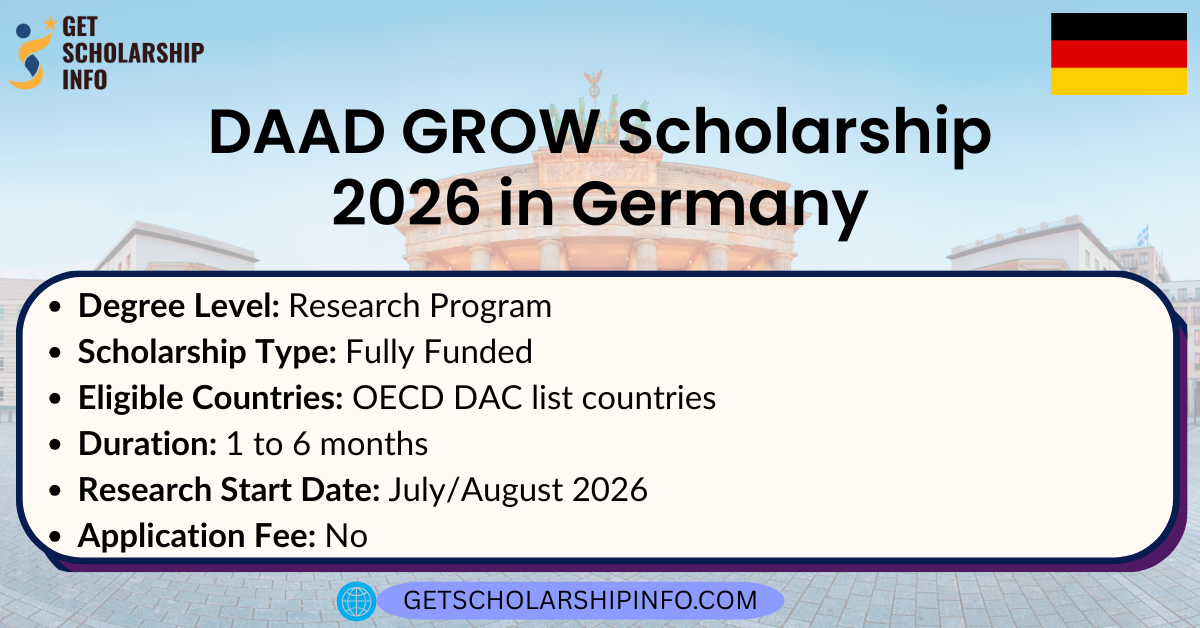
This is not a degree scholarship. Nobody is flying to Germany for a Bachelor’s or a Master’s under this call. Instead, GROW pays for two very different kinds of trips: a short visit to set up a research partnership, or a longer stay to actually carry out a project. Funding is fully covered, monthly stipend, insurance contributions, and a travel allowance , and there’s no application fee involved anywhere in the process. Eligibility runs from doctoral candidates all the way up to full professors, provided you’re not already based in Germany and not doing your entire doctorate at a German institution.
The 2026 intake closed its application window on 30 April 2026, so if you’re reading this after that date, treat everything below as preparation for the next call rather than something to submit today. DAAD tends to reopen programmes like this on a yearly rhythm, and the requirements rarely shift much from one cycle to the next, so there’s real value in getting your documents ready now.
A Quick Snapshot Before You Read Further:
Some readers just want the bones of it before committing to the full article. Here they are.
- Who runs it: German Academic Exchange Service (DAAD), with money coming from Germany’s Federal Ministry for Economic Cooperation and Development (BMZ)
- Destination: Germany, a public university or a recognised non-university research institution
- Funding type: Fully funded, covering stipend, insurance, and travel
- Degree level: Not degree-seeking. Open to doctoral candidates, postdocs, lecturers, assistant professors, and full professors
- Where applicants must come from: Countries on the OECD DAC list, with priority given to Sub-Saharan Africa and additional room for Latin America and Asia
- Trip length: Either 1–2 months (cooperation visits) or 2–6 months (research stays)
- Application fee: None
- Latest call deadline: 30 April 2026 (closed)
- Funded period must end by: 31 January 2027, no exceptions and no extensions
What Makes This Scholarship Different From a Typical Study Grant:
Most scholarship blogs describe benefits as a list of activities, you’ll travel here, you’ll attend that. GROW is better understood through what you actually walk away with, because the programme was designed around outcomes rather than logistics.
- A monthly stipend that scales with your career stage: 1,400 euros for doctoral candidates and postdoctoral researchers, 2,000 euros for assistant professors and lecturers, and 2,150 euros for full professors
- Contributions toward health, accident, and personal liability insurance while you’re in Germany, so you’re not left covering emergency costs out of pocket
- A travel allowance to help offset the cost of getting to Germany and back
- Deeper technical and methodological skills gained by working inside a German research environment, not just observing one
- A functioning international network, the kind built through actual collaboration with a German supervisor, not a one-off conference handshake
- Greater visibility for your work in international research circles, which tends to open doors for future funding and publishing
- A pathway back into your home institution with something concrete to contribute: new methods, new contacts, and often the groundwork for future joint proposals
- For applicants with a disability or chronic illness, a case-by-case subsidy for additional costs tied to completing the project in Germany
None of this is packaged as a free trip. It’s built to strengthen your standing as a researcher after you’ve gone home, which is really the entire point of the programme.
Who Actually Qualifies:
Eligibility here is less about your degree and more about where you’re standing right now in your academic career, and where you’re based.
- Doctoral candidates currently enrolled and working on a thesis
- Postdoctoral researchers, defined specifically as those who completed their PhD no more than four years before the application deadline
- University lecturers and teaching staff
- Assistant professors
- Established, senior academics and full professors
- Applicants must be employed at a university or a research institute at the time of applying
- Applicants must come from a country on the OECD DAC list , the programme leans heavily toward Sub-Saharan Africa, while also accepting applicants from Latin America and Asia
- Women, applicants from disadvantaged regions, and socioeconomically disadvantaged individuals are specifically encouraged to apply
A few things rule you out immediately. You can’t apply if you’re already physically in Germany at the point of application, and you can’t apply if your entire doctoral or postdoctoral research is being carried out at a German institution already. This programme is meant to bring people to Germany, not fund people who are already there.
The Two Tracks Under GROW ; And Why the Difference Matters:
This is where GROW splits from most research scholarships, because it doesn’t offer one format. It offers two, and picking the wrong one for your situation will cost you time.
Programme Line 1 ; Preparatory and Cooperation Visits. Think of this as the relationship-building track. It funds a short stay of 1 to 2 months, meant for scholars who haven’t yet locked in a joint project with a German host but want to get there. You’d use this time to meet potential collaborators, sketch out a joint publication, or draft a proposal for third-party funding together. It’s not meant for finishing research, it’s meant for starting the right kind of partnership.
Programme Line 2 ; Research Stays. This is the longer, deeper track: 2 to 6 months, built for scholars who already have a research question and a plan for answering it. You’ll work independently but in coordination with a host academic supervisor in Germany, carrying out a project with clear development relevance. Crucially, your application needs a transfer concept, a real plan for how the results get applied back home once you leave.
Both tracks share the same hard rule: funding cannot be split across multiple visits, and time spent in countries other than Germany doesn’t count toward the funded period. One country, one continuous stretch of time, that’s how DAAD wants it structured. Travel specifically for attending or presenting at conferences also isn’t covered under either line, so don’t build your budget around that.
The Research Themes GROW Cares About:
There’s no fixed subject list here, GROW isn’t tied to engineering, or medicine, or economics specifically. What it does require is a clear link between your research and at least one UN Sustainable Development Goal. In practice, that opens the door to almost any academic field, as long as you can show why it matters for development. The themes that come up most often in the programme’s own framing are:
- Health and public health systems
- Education and skills development
- Climate change and environmental research
- Governance and public policy
- Social inclusion and equity
- Innovation systems and technology transfer
If your work touches any of these, directly or at an angle, you’re already in reasonable territory. The selection committee is really asking one question underneath all of this: will this research make a measurable difference somewhere, once it’s finished?
How the Selection Committee Actually Judges Applications:
DAAD uses an independent panel of subject specialists for this, and the criteria differ slightly depending on which programme line you’re applying under.
For Preparatory and Cooperation Visits, reviewers look at your academic track record as shown in your CV, how strong and development-relevant your proposal is, whether the German host institution you’ve chosen actually makes sense for your project, how much prior contact or coordination you’ve already done with that host, and how realistic your timeline is. They also weigh how likely the partnership is to survive beyond the funded visit, and whether it contributes to real capacity-building back home.
For Research Stays, the bar includes your academic grades if you’re a doctoral candidate or postdoc, your publication and presentation history, the originality and relevance of your research proposal, and how clearly you’ve thought through the transfer concept, meaning, specifically, how the results get used once you’re back. Doctoral applicants also need to show how the funded stay fits into their broader thesis timeline. Beyond the paperwork, the committee also considers your motivation and your track record of activity outside pure academic work, alongside equal-opportunity factors you’re invited to describe directly in the application form.
Getting Your Application Together:
The process runs entirely through the DAAD’s online portal, and a few practical points are worth knowing before you start.
- Applications are submitted digitally through the DAAD portal, there’s no paper route
- The portal typically closes at midnight Central European Time on the deadline day, so submitting a day or two early avoids any last-minute technical issues
- Incomplete applications aren’t reviewed, and it’s entirely on the applicant to make sure every required document is uploaded
- You’ll generally need a CV, a research proposal or letter of motivation depending on the programme line, evidence of contact with a German host institution, and academic records
- If you’re applying under Research Stays, your transfer concept needs to be spelled out clearly, vague statements about “sharing knowledge” won’t carry much weight with reviewers
- Documents submitted stay with DAAD and are processed under EU and German data protection rules
One detail that trips a lot of applicants up: DAAD explicitly allows the use of AI tools while preparing your application, but only if you disclose it. If part of your motivation letter or proposal was drafted with AI assistance, you’re expected to state that clearly in your documents, note which tool you used, and still sign a declaration confirming the application reflects your own work and adheres to good academic practice. Skipping that disclosure isn’t a small oversight, it goes against the programme’s own stated rules.
If the 2026 Deadline Has Already Passed:
The application window for this cycle closed on 30 April 2026. If you’re reading this now, there’s nothing to submit this round, but that doesn’t mean the opportunity is gone. DAAD scholarship programmes like GROW tend to reopen annually, usually with the same eligibility structure and similar funding terms. The smartest move at this stage is preparation, not waiting:
- Start identifying a potential host supervisor or institution in Germany now, before the next call opens, this is often the slowest part of the process
- Draft your research proposal or motivation letter early, so you’re not writing it under deadline pressure
- Check the DAAD scholarship database periodically for the next GROW announcement, since exact dates shift slightly year to year
- If your project fits Programme Line 1, start the groundwork conversations with a German researcher now, since that relationship-building is literally what the funding is meant to support later
Frequently Asked Questions?:
Is there an application fee for GROW?
No. DAAD does not charge applicants a fee to apply for this or any of its standard scholarship programmes.
Can I apply if I already live in Germany?
No. You’re not eligible if you’re already in Germany at the time you apply, or if your entire doctoral or postdoctoral research is being conducted at a German institution.
How long does the funding last?
It depends on which track you apply under. Preparatory and Cooperation Visits run 1 to 2 months. Research Stays run 2 to 6 months. Either way, the entire funded period must fall within a single, uninterrupted block of time.
Does GROW cover travel to attend a conference?
No. Travel specifically for attending or presenting at a conference is excluded from funding under both programme lines.
What’s the difference between a postdoctoral researcher and an assistant professor for this scholarship’s purposes?
DAAD defines a postdoctoral researcher here as someone who completed their PhD no more than four years before the application deadline. Assistant professors and lecturers fall into a separate stipend bracket at 2,000 euros a month, compared to 1,400 euros for doctoral candidates and postdocs.
Can the funding period be extended past January 2027?
No. All funded activity under this call must be completed by 31 January 2027, and DAAD has stated clearly that neither funding nor the stay itself can be extended beyond that date.
Is GROW open to every academic subject?
There’s no fixed subject list. What matters is that your research connects to at least one UN Sustainable Development Goal and has a genuine, arguable link to development outcomes in your home region.
Do I need a host supervisor lined up before I apply?
It helps significantly, especially for Research Stays, where the selection committee specifically checks for prior contact and coordination with your chosen host. For Preparatory and Cooperation Visits, some flexibility exists since the visit itself is meant to help you establish that contact.

I would love to do masters in microbiology in your country
We are just Non-Profit Organisation who helps with finding scholarships for students.
You can find all the available Masters scholarship in the MS category.