Algorithms now decide what most people read. Every scroll through a news app, every recommended headline, every “you might also like” suggestion is shaped by systems built to predict what will hold your attention. University College Dublin has opened a fully funded PhD scholarship built entirely around understanding that phenomenon , how personalised algorithms shape what we know about the world, and what gets left out.
This is a four-year, fully funded doctoral position based at UCD’s School of Information and Communication Studies, and it sits inside one of the more urgent conversations happening in media and technology research right now: filter bubbles, algorithmic bias, and the slow narrowing of what people see when they open a news app. If you’ve been looking for a PhD scholarship that blends computer science, journalism, and social science into one research project, this is worth a close read.
Key Details:
Here’s the essential information at a glance:
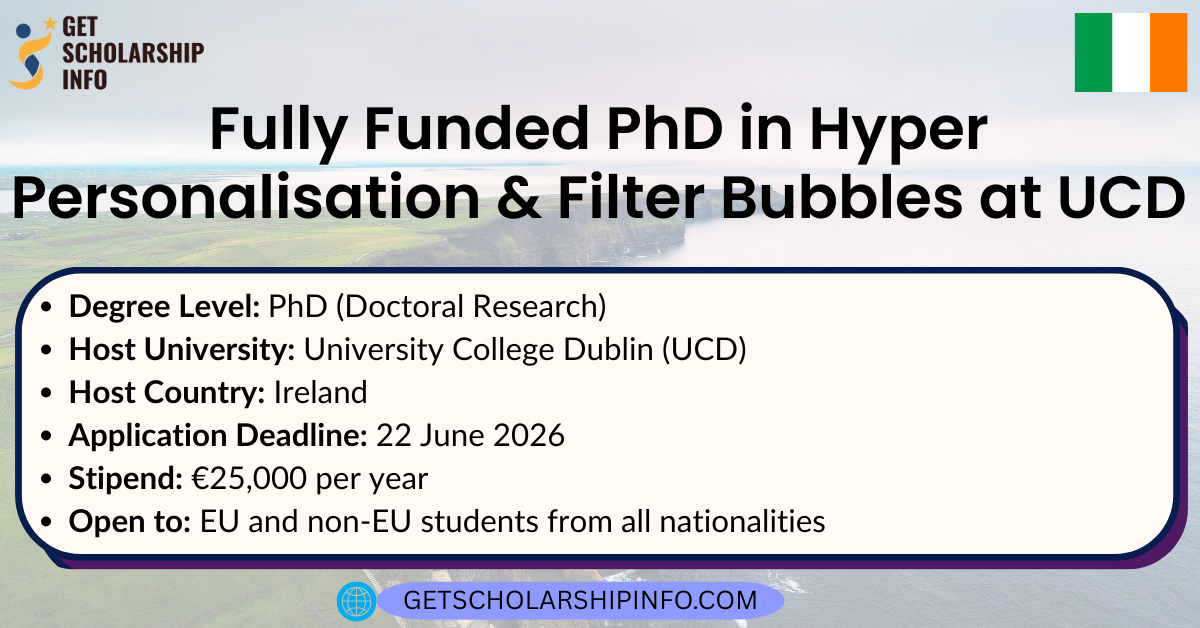
- Degree Level: PhD (Doctoral)
- Host University: University College Dublin (UCD)
- Host School: School of Information and Communication Studies (ICS)
- Host Country: Ireland
- Funding Type: Fully funded
- Position Type: Full-time, 100% commitment, in-person
- Starting Date: 31st August 2026
- Open to All Nationalities: Yes, both EU and non-EU applicants are equally eligible
- Supervisors: Assistant Prof Brendan Spillane and Assoc Prof Marguerite Barry
- Duration: 4 years
This scholarship is part of a much bigger initiative too. The successful candidate doesn’t just join UCD , they become part of a national research centre for Data Science and AI, funded by Research Ireland, which brings together PhD students across multiple institutions and disciplines. That means the value here goes beyond the individual project; it comes with an entire training ecosystem built around it.
What This Scholarship Offers:
Funding packages for PhD positions vary a lot from one university to the next, and this one is unusually generous in how it breaks things down. Here’s what a successful candidate actually receives:
- An annual stipend of €25,000, paid every year for the full four years of the program
- €5,750 per year specifically allocated toward tuition fees
- €4,500 set aside for conference travel, so scholars can present their research internationally
- €3,000 for equipment needed to carry out the research
- €5,000 for materials required throughout the project
- Access to a centrally held training fund that covers mandatory research centre training sessions
- Membership in a national cohort-based PhD training programme, which includes transferable skills workshops, hackathons, and spin-out sprints
- Structured teaching and tutoring experience gained during the program
- The opportunity for an academic research visit to an internationally recognised partner institution
- Exposure to industry and public service partners through enrichment activities and training placements
- A built-in professional network spanning academia, industry, and government, developed through the cohort structure
What makes this stand out isn’t just the money, though €25,000 a year is a solid stipend by PhD standards. It’s the layered support system , the mix of individual research funding plus cohort training plus career development , that gives scholars a genuinely well-rounded four years rather than just a paycheck and a thesis deadline.
Eligibility Criteria:
Before you consider applying, take a close look at whether you meet these requirements:
- A strong Master’s degree, 2:1 classification or above (or the equivalent GPA), in a relevant field
- Background in Computer Science, Information Science, Media and Communications, Journalism, Political Science, Psychology, International Relations, or a closely related subject
- Strong written English, with C1 or C2 level proficiency under the Common European Framework of Reference for Languages recommended
- Ability to demonstrate strong organisational skills and experience
- A methodical, analytical mindset with genuine attention to detail
- Willingness to learn new research methods, tools, and technologies as the project demands
- Comfort working independently while also contributing to a wider research group and centre
Both EU and non-EU students are treated equally under this scholarship, so nationality is not a barrier here. What matters most to the selection panel is your academic background, your research readiness, and your genuine interest in the intersection of technology, media, and society.
Programs Available:
Because this position sits within a national interdisciplinary centre, eligible academic backgrounds span a wide range of fields. Applicants coming from any of the following areas are considered:
- Computer Science
- Information Science
- Media and Communications
- Journalism
- Political Science
- Psychology
- International Relations
- Data Science
- Human-Computer Interaction
- Social Science
- Arts and Humanities
- Engineering
- Health Sciences
- Life Science and Environment
- Mathematics and Statistics
- Law
- Business
- Education
This breadth exists because the research itself is genuinely interdisciplinary. Understanding filter bubbles and algorithmic personalisation isn’t a problem that computer scientists can solve alone, nor one that communications researchers can fully untangle without technical grounding. UCD is deliberately building a cohort that pulls from all these areas at once.
What the Research Actually Involves:
It’s worth spending a moment on what this PhD will actually look like day to day, because it’s more varied than a typical single-method doctoral project.
The research centres on how algorithmic recommendation systems shape news consumption ; specifically, how personalised feeds create filter bubbles that narrow what people are exposed to, reinforce existing biases, and potentially erode the diversity of information people rely on to form opinions. The successful candidate will look closely at how editorial decision-making interacts with algorithmic curation, and whether personalisation systems are strengthening or undermining traditional journalistic values like balance and pluralism.
The approach is mixed-methods, which means the work won’t be confined to one type of analysis. Computational methods will be used to study personalised news feeds across different platforms, looking for patterns in content similarity and ideological clustering. Alongside that, experimental studies will measure how personalisation affects people’s attitudes and memory of news content. Interviews and discourse analysis will round things out, capturing how everyday readers, journalists, and editors actually perceive bias, trust, and credibility inside these personalised systems.
For someone who enjoys combining data-driven research with qualitative depth, this project offers a genuinely rich four years of work.
Responsibilities of the Successful Candidate:
Beyond the research itself, scholars taking on this position will have a set of academic and institutional responsibilities to fulfill throughout the program:
- Writing and successfully defending a PhD thesis on the topic of hyper-personalisation and filter bubbles
- Producing research outputs and academic papers in collaboration with supervisors
- Attending and presenting at academic conferences to share findings
- Participating in seminars, workshops, and events hosted by ICS and UCD
- Completing 30 ECTS credits as part of UCD’s structured PhD pathway
- Engaging in teaching and tutoring duties during the studentship
- Submitting regular progress reports to ICS, UCD, and the national research centre
- Contributing actively to the intellectual and research culture within the school and university
This isn’t a scholarship where you disappear into a lab for four years and resurface with a thesis. It’s built around visibility, collaboration, and consistent engagement with a wider academic community.
How to Apply:
The application process here happens in stages, so it’s important to understand the sequence before diving in.
- First, candidates must apply through the national centre for Data Science and AI, funded by Research Ireland, in order to join the cohort of UCD-based students
- Applications for this were expected to open in late May 2026 and close on 22nd June 2026
- Shortlisted candidates are then invited to interview, provisionally scheduled for late June or early July
- Successful candidates from that stage are then asked to submit a formal application directly to UCD
- Due to high application volume, only candidates selected for interview will receive a response
- For specific questions about the position, candidates can reach out directly to Dr. Brendan Spillane or the ICS admissions contact listed on the official UCD page
Given the layered nature of this process, anyone interested in this line of research should keep an eye on UCD’s ICS vacancies page for future rounds, since national centre cohort applications tend to follow a similar structure year to year.
Why This Scholarship Is Worth Considering:
For anyone genuinely interested in the ethics and mechanics of algorithmic media, this scholarship offers something fairly rare: a fully funded, four-year runway to study one of the defining issues in how information reaches the public today. It’s not a narrow technical project, and it’s not a purely theoretical one either. It sits right at the intersection, with real funding, real mentorship, and a built-in national research community behind it.
The combination of strong financial support, structured training, and access to both academic and industry partners makes this a genuinely competitive option for graduates from computer science, communications, or social science backgrounds who want their doctoral work to matter beyond the walls of a university library.
Frequently Asked Questions?:
Is this PhD scholarship fully funded?
Yes. It includes a €25,000 annual stipend, tuition contribution, conference travel funding, equipment costs, and materials support, spread across four years.
Can international students apply?
Yes. Both EU and non-EU applicants are equally eligible for this studentship.
What academic background do I need?
A strong Master’s degree (2:1 or above, or equivalent) in Computer Science, Information Science, Media and Communications, Journalism, Political Science, Psychology, International Relations, or a related field.
Where is the program based?
At University College Dublin’s School of Information and Communication Studies, with the position being full-time and in-person.
How long does the PhD take?
The scholarship is structured as a four-year, fully funded doctoral program.
Do I need to apply directly to UCD?
Not initially. Candidates first apply through the national Data Science and AI centre funded by Research Ireland, and only successful interviewees are asked to submit a direct application to UCD afterward.
What level of English is required?
A strong written command of English is required, with C1 or C2 level proficiency recommended.
Will I need to teach during the PhD?
Yes. The role includes teaching and tutoring responsibilities alongside the research work.
Who can I contact for more information?
Prospective applicants can reach out to Dr. Brendan Spillane at UCD’s School of Information and Communication Studies for further details on the position.
