
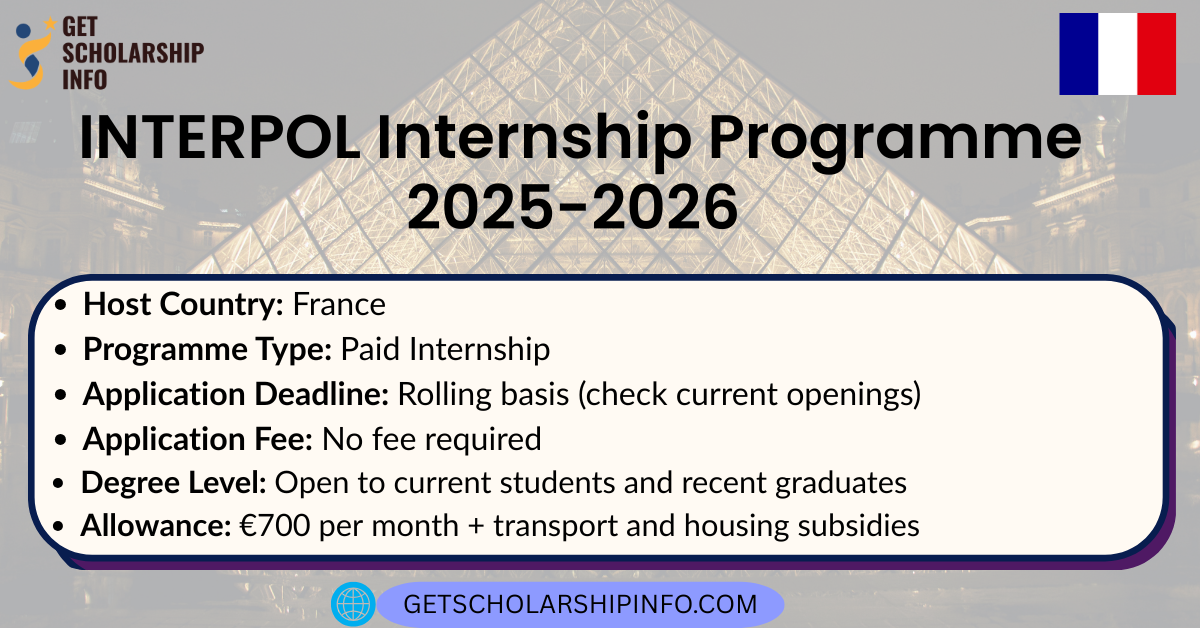
Applications are now open for the INTERPOL Internship Programme, giving students and recent graduates a rare chance to work inside one of the most recognized international organizations on the planet. Whether your interest lies in fighting cybercrime, human trafficking, financial fraud, or you come from a background in communications, HR, or strategic planning , INTERPOL has internship openings across both policing and support services.
The programme is based primarily in Lyon, France, runs between 6 to 11 months, and comes with a monthly allowance of EUR 700, plus transport and housing subsidies for eligible interns. There is no application fee. Nationals of any INTERPOL member country who are currently enrolled in , or recently graduated from , a recognized university can apply. This is a partially supported opportunity, not fully funded, as travel, insurance, and accommodation costs remain the intern’s responsibility.
Key Details:
- Programme Type: Internship (Policing & Support Services)
- Host Organization: INTERPOL (International Criminal Police Organization)
- Duty Station: Lyon, France (Headquarters) , select positions at other duty stations
- Duration: Minimum 6 months – Maximum 11 months
- Monthly Allowance: EUR 700 (prorated by days worked)
- Transport Subsidy: EUR 30 per month
- Housing Subsidy: EUR 170 per month (for eligible interns)
- Open To: Nationals of INTERPOL member countries
- Application Fee: None
- Funding Type: Partially Funded
- Language Requirement: English (fluency required)
- Application Platform: INTERPOL Recruitment Hub
What This Internship Actually Gives You:
Let’s be honest , most internships put you in a corner making coffee. INTERPOL is different, and here’s what you actually walk away with.
Real Exposure to International Law Enforcement:
You get placed inside a working unit of one of the world’s most operationally active international organizations. Depending on your placement, you could be contributing to real work in areas like counter-terrorism, cybercrime investigation support, border management, or financial crime analysis. That kind of exposure simply does not exist at the average workplace.
A Monthly Living Allowance:
Interns receive EUR 700 per month, calculated based on the number of days worked. On top of that, there’s a EUR 30 monthly transport subsidy to help cover commuting costs. Eligible interns also receive a EUR 170 monthly housing subsidy, which goes some way toward offsetting the cost of living in Lyon.
Access to INTERPOL’s Health Insurance:
Interns are required to hold personal health insurance for the duration of the internship. However, they have the option to request enrolment in INTERPOL’s own organizational health coverage at no extra cost. This is a significant benefit that many internship programmes simply do not offer.
A Name on Your CV That Opens Doors:
There are organizations that look impressive on paper. Then there’s INTERPOL. For anyone building a career in international relations, criminal justice, law, public policy, data analysis, or communications — having INTERPOL on your resume is a genuine differentiator. Recruiters, graduate programmes, and government agencies recognize it immediately.
Understanding of How Global Police Cooperation Works:
INTERPOL connects 196 member countries. The scale of coordination happening inside that organization daily — across languages, legal systems, and governments — is extraordinary. As an intern, you sit inside that system. That understanding of multilateral cooperation is something no textbook teaches.
Professional Network in an International Environment:
Working in a multinational setting, surrounded by professionals from law enforcement, legal, communications, technology, and policy backgrounds from around the world, gives you a network that is genuinely international from day one.
Who Can Apply — Eligibility Criteria:
INTERPOL has set clear criteria for internship applicants. Before you put together your application, go through each of these points carefully.
- You must be currently enrolled in a post-secondary accredited academic institution, or you must have graduated within the past one year from the date you submit your application.
- You must be a national of one of INTERPOL’s 196 member countries.
- You must have reached the legal age of majority in your country of nationality.
- You must be fluent in English , this is non-negotiable as it is the working language of the programme.
- You must meet any additional requirements listed in the specific vacancy you are applying for, as these vary by role and department.
One important thing to note: graduating does not disqualify you. As long as you graduated within the last 12 months at the time of application, you are still eligible. So if you finished your degree recently and haven’t locked in your next step, this is a window worth using.
Security Clearance and Background Requirements:
Because INTERPOL handles sensitive law enforcement data and international security matters, the vetting process is serious. This is not unusual , it is simply the nature of the organization.
Before your selection is confirmed, a confidentiality vetting inquiry will be carried out. If you are selected, you will need to provide a certificate of non-criminal records from your country of nationality. If you have lived in any other country for more than 12 consecutive months during the past five years, you’ll need to provide that certificate from those countries as well.
This process takes time, so be prepared for it. Plan accordingly if you are applying close to a deadline.
Fields and Areas Available:
INTERPOL internships span a wide range of professional and academic disciplines. The specific openings depend on the hiring needs of each department at the time, but the areas that typically appear across both policing and support services include:
- Criminal Intelligence Analysis
- Cybercrime and Digital Forensics
- Counter-Terrorism
- Human Trafficking and Migrant Smuggling
- Financial Crimes and Anti-Corruption
- Border Management and Travel Document Security
- Drug Trafficking and Organized Crime
- Communications and Public Affairs
- Human Resources
- Strategic Planning and Organizational Development
- Legal Affairs and Compliance
- Information Technology and Data Management
- Research and Policy Analysis
- Translation and Linguistics
- Project Management and Coordination
- Forensic Science Support
Not all of these will be open at the same time. You should check the INTERPOL Recruitment Hub regularly for current listings and apply for the one that best matches your academic background and professional interests.
Where Will You Be Based?:
The vast majority of INTERPOL internships are based at the General Secretariat Headquarters in Lyon, France. Lyon is France’s third-largest city , well-connected by rail to Paris and Geneva, with a strong international community and a reasonable cost of living by Western European standards.
A smaller number of internship positions are available at other INTERPOL duty stations. These are listed individually on the vacancy notice, so always check where the role is located before applying.
If you are accepted, you will be responsible for arranging your own travel to the duty station, obtaining the appropriate visa, and securing your accommodation. INTERPOL will provide the documentation you need to support your visa application, but the process and the cost belong to you.
What the Application Looks Like:
Step 1 — Check Current Openings:
Go to the INTERPOL Recruitment Hub and browse internship listings. Each vacancy notice includes the location, duration, required background, and any specific eligibility requirements for that role.
Step 2 — Prepare Your Cover Letter:
Your cover letter is important here , INTERPOL asks for it to cover three specific things:
- Your motivation for joining the INTERPOL internship programme
- Your interest in the specific role you’re applying for, and what you bring to it
- What you expect to gain from this internship
Keep it honest and specific. Generic letters don’t work well for roles where the organization values precision and clarity. Write it as if you’re explaining your reasoning to a senior official , because, in a way, you are.
Step 3 — Submit Through the Recruitment Hub:
All applications must go through the Recruitment Hub platform. No email applications or direct submissions are accepted. Make sure your CV, cover letter, and any required documents are uploaded before the vacancy deadline.
Step 4 — Vetting and Confirmation:
If shortlisted, you will go through the confidentiality vetting process described above. This includes submitting criminal record certificates. Once vetting clears and your selection is confirmed, you’ll receive further guidance on visa documentation and onboarding.
Costs You Need to Plan For:
This is not a fully funded programme, and being clear-eyed about that from the start saves confusion later.
The following costs are your responsibility as an intern:
- Travel to and from Lyon (or your duty station)
- Accommodation throughout the internship
- Daily living expenses
- Visa application fees
- Personal health insurance (unless you enrol in INTERPOL’s scheme)
- Any costs related to the recruitment process itself
The monthly allowance of EUR 700, the EUR 30 transport subsidy, and the EUR 170 housing subsidy (where eligible) will offset some of this. But you should do the math for your specific situation before applying. Lyon’s cost of living is manageable by French city standards, but it is still a major European city.
Confidentiality Obligations:
One condition that is taken seriously at INTERPOL is confidentiality. As an intern, you will likely be exposed to unpublished operational information, internal processes, or sensitive data. You are required to keep all of that strictly confidential , not just during your internship, but after it ends.
You cannot publish documents, articles, social media posts, or any other content based on information you accessed during your placement without explicit authorization. This is standard for law enforcement organizations, but it is worth being aware of upfront, especially if you were planning to write about your experience in detail during or after the internship.
A Few Things Worth Knowing Before You Apply:
Apply early. Internship slots fill up, and vetting takes time. If you wait until the deadline to submit, you may find that the process moves faster than expected on their end, or that positions are already at capacity.
Be specific in your cover letter. INTERPOL operates with a lot of structure. A cover letter that speaks directly to the specific role , using the language of that department and demonstrating you’ve read the vacancy properly , will always perform better than a general one.
Know your timeline. The internship runs between 6 and 11 months. That’s a significant chunk of time. Before applying, be honest with yourself about whether you can commit to the full duration of the role you’re applying for.
Check membership. Your country needs to be an INTERPOL member country. With 196 members, it almost certainly is , but it’s worth confirming if you have any doubt.
How to Apply:
- Visit the official INTERPOL Recruitment Hub: https://209400.jobs2web.com/
- Search for current internship vacancies
- Select the role that matches your background and interest
- Prepare your CV and a tailored cover letter addressing motivation, fit, and expectations
- Submit your full application through the platform before the vacancy deadline
- If selected, cooperate with the vetting process and provide required documentation
There is no application fee at any stage of this process.
Final Thoughts:
The INTERPOL Internship Programme is one of those opportunities that genuinely stands apart from standard work experience. It places you inside a functioning international institution dealing with real, serious, global challenges , not a simulation of one. The financial support is modest, and the costs involved require planning. But for someone building a career in law enforcement, international affairs, policy, technology, or organizational management, what you gain in experience, credibility, and professional perspective is hard to match anywhere else.
If this fits where you’re headed, the Recruitment Hub is your starting point. Check it regularly, because openings appear and close on their own schedule throughout the year.
