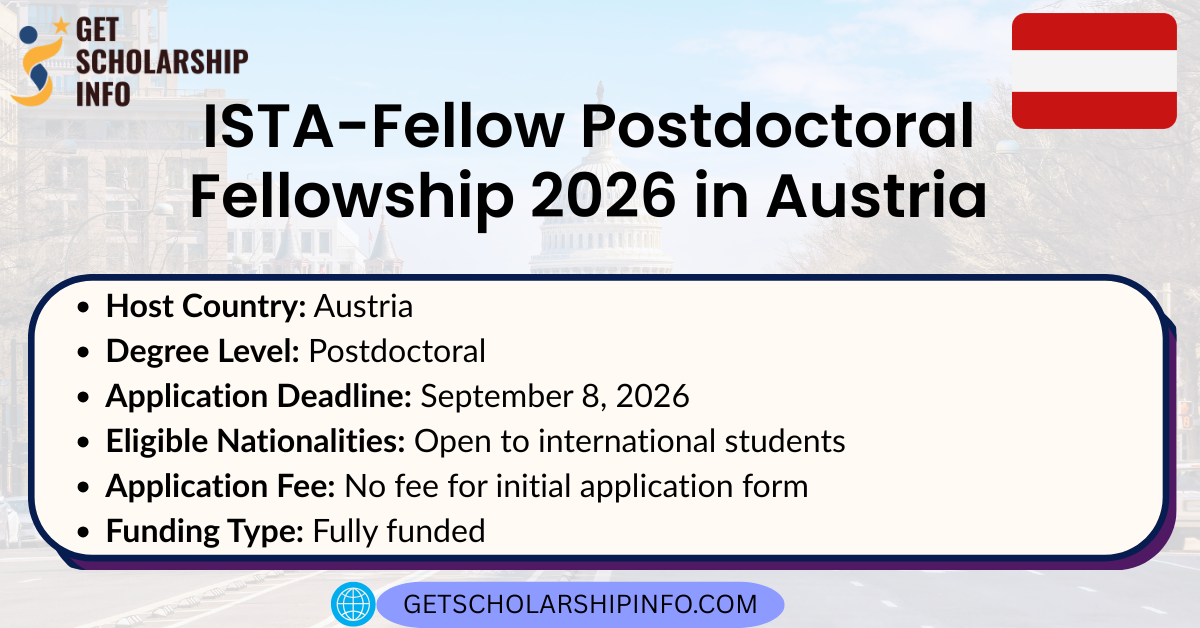
Applications are now open for the ISTA-Fellow Postdoctoral Fellowship, a fully funded two-year research program offered by the Institute of Science and Technology Austria (ISTA). This fellowship is open to talented postdoctoral researchers from any country who have completed, or are about to complete, a PhD in natural sciences, mathematics, computer science, or a closely related field. There is no application fee, and successful candidates receive a generous salary along with full social security coverage, making this one of the better-paying postdoc opportunities in Europe right now. The deadline to apply is September 8, 2026, and selected fellows will begin their research between December 2026 and June 2027.
What makes this program stand out is the freedom it gives to researchers. Instead of being assigned a fixed project, fellows get to propose their own research idea and work on it inside one of ISTA’s research groups, with a senior professor guiding them along the way. If you’re someone who has spent years following someone else’s research plan during your PhD, this is your chance to actually run your own show, while still having institutional backing and mentorship.
Below, we’ve broken down everything you need to know about this scholarship, from who can apply to how the whole process works, so you don’t have to dig through a long PDF guide to figure it out.
Key Details:
- Degree Level: Postdoctoral (you must already have a PhD or be close to finishing one)
- Host Country: Austria
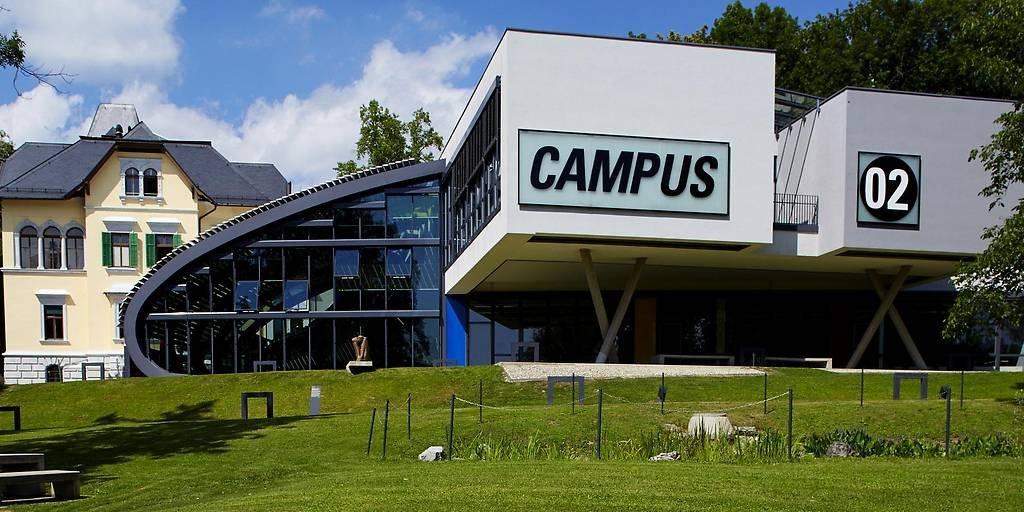
- Host Institution: Institute of Science and Technology Austria (ISTA)
- Application Deadline: September 8, 2026, 14:00 CEST
- Fellowship Duration: 2 years, full-time
- Funding Type: Fully funded
- Number of Fellowships: Up to 10 positions available
- Open For: All nationalities, no restrictions
- Application Fee: None
- Fellowship Start Date: Between December 15, 2026 and June 15, 2027
What This Scholarship Offers:
When people hear “fully funded,” they usually picture just tuition or a basic stipend. This program goes quite a bit further than that, so here’s what you actually walk away with as an ISTA-Fellow.
- You get a real salary, not a stipend. The minimum gross pay is 73,500 EUR per year, and it comes with full social security coverage, so you’re treated like an actual employee rather than a guest researcher.
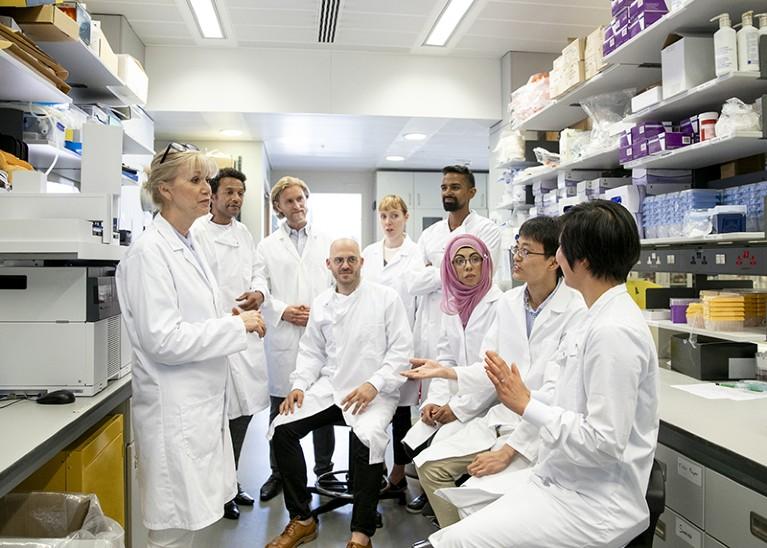
- You gain direct access to some of the best research equipment in Europe, including electron microscopy, nanofabrication labs, and NMR facilities, without having to compete for limited slots like in many other institutions.
- You receive close, hands-on mentorship because ISTA deliberately keeps its research groups small, with no more than 15 people per group. This means your supervisor will actually know your work and be available to guide you.
- You don’t have to worry about finding a place to live the moment you land in Austria, since on-campus housing is available while you search for something more permanent.
- If you’re moving with a young child, ISTA also offers on-site daycare starting from 3 months of age, which is honestly rare for a research institution to provide.
- You get help with the entire visa process through ISTA’s International Office, so the paperwork side of moving to a new country becomes a lot less stressful.
- You can pick up German language skills for free through courses offered right on campus, which makes day-to-day life in Austria much easier even though English is the institute’s working language.
- You gain the freedom to design your own research project instead of being handed someone else’s, which is a big deal if you’ve been wanting to explore your own scientific ideas for a while.
Eligibility Criteria:
Before you start preparing documents, it’s worth checking whether you actually qualify. Here’s what ISTA expects from applicants.
- You must hold a PhD or equivalent degree by the application deadline, or you must be reasonably close to finishing one before the fellowship begins, no later than June 15, 2027.
- If you haven’t formally graduated yet, that’s fine for now, but ISTA will not issue your final contract until you submit proof of your PhD defense or your diploma.
- You cannot apply if you were already working at ISTA before September 1, 2026, since the program is meant for researchers coming in from outside.
- Your proposed research area must fall within one of ISTA’s existing research fields, and it needs to genuinely match the expertise of the supervisor you choose. Picking a supervisor whose work doesn’t align with your proposal can get your application rejected as out of scope, so this part matters more than people usually expect.
- You’ll need three referees who can speak to your academic work, typically former professors or senior scientists you’ve collaborated with. At least two of their reference letters must arrive before the deadline, or your application will be considered incomplete.
Programs Available:
ISTA accepts applications across a wide range of scientific disciplines. Here are the fields you can apply under:
- Biology
- Neuroscience
- Mathematics
- Data and Computer Science
- Physics
- Chemistry
- Earth Science
It’s worth noting that Astronomy is not included here, since ISTA runs a separate fellowship specifically for that field called the Sirius Fellowship.
How To Apply:
The application process itself is fairly straightforward once you know the steps, but it does require some advance planning, especially around contacting your supervisor and lining up referees early.
- Start by reading through the official Guide for Applicants carefully, since it spells out formatting rules and document requirements you’ll need to follow exactly.
- Create an account on ISTA’s application portal at apply.ista.ac.at.
- Check your email and verify your account using the link they send you.
- Reach out to your chosen host supervisor before you submit anything. ISTA is clear that you need to confirm with them that your proposed project actually fits their group’s work.
- Fill in your personal details, PhD education history, and current professional affiliation inside the online form.
- Upload your required documents, which include a research proposal, your CV with a publication list, a one-page summary of your top achievements, and a completed ethics self-assessment form.
- Add your three referees into the system and click the option to notify them, so they receive instructions on submitting their letters directly.
- Double check that everything follows the formatting rules (A4 page size, Times New Roman or Arial font, at least 11pt size, and 2cm margins), since documents that don’t meet these standards risk being marked ineligible.
- Submit your completed application before September 8, 2026, at 14:00 CEST.
Once submitted, you don’t need to just sit and wait quietly. You can log back into the portal anytime to check whether your referees have uploaded their letters yet, and send them a gentle reminder if needed.
Selection Process
After the deadline passes, here’s what happens to your application before you hear back.
- Every applicant is notified of the outcome within four months of the deadline, whether that means acceptance, a reserve list spot, or rejection.
- ISTA’s program management team first checks every application to confirm it meets the basic eligibility requirements.
- Applications that pass this initial check are then sent to the Selection Committee and faculty reviewers for evaluation.
- Reviewers assess the quality, originality, and feasibility of your research proposal.
- They also look at how qualified you are as a researcher, based on your CV, your achievements summary, and your reference letters.
- Your scientific match with the host group is evaluated too, meaning how well your project fits with your chosen supervisor’s expertise.
- Final decisions are made during a Selection Committee meeting where all reviewed applications are discussed and ranked.
Final Thoughts:
If you’re a postdoc researcher looking for a position that actually pays well, gives you research freedom, and supports you with things like housing and visa help, the ISTA-Fellow program is worth the effort of applying. The competition will likely be tough given only 10 spots are available, but the structure of the program rewards applicants who put real thought into matching their proposal with the right supervisor, rather than just sending out generic applications. Start early, talk to your potential supervisor well before the deadline, and make sure your referees know you need their letters in time.
For more details or specific questions, you can reach out directly,

I am Dr. M Sahlolbei, holding a PhD in Molecular Medicine with over 12 years of experience in advanced cellular and molecular workflows, particularly in CAR T-cell therapy and laboratory quality systems. Securing a fully funded postdoc opportunity like the ISTA-Fellow program is a profound milestone for any researcher aiming to drive high-impact therapeutic discoveries. Navigating such prestigious European fellowships can be challenging, and having comprehensive breakdowns like this is incredibly valuable for the global scientific community. Thank you for sharing these carefully researched details.
Thank you so much, Dr. Sahlolbei , your kind words truly mean a lot to us. It is always deeply encouraging when distinguished researchers like yourself find our work valuable. With your impressive background in CAR T-cell therapy and over 12 years of experience, you would be a remarkable addition to ISTA’s research community. We sincerely hope this opportunity opens a wonderful new chapter in your research journey. Best of luck with your application, and please do share this with fellow researchers who may benefit!