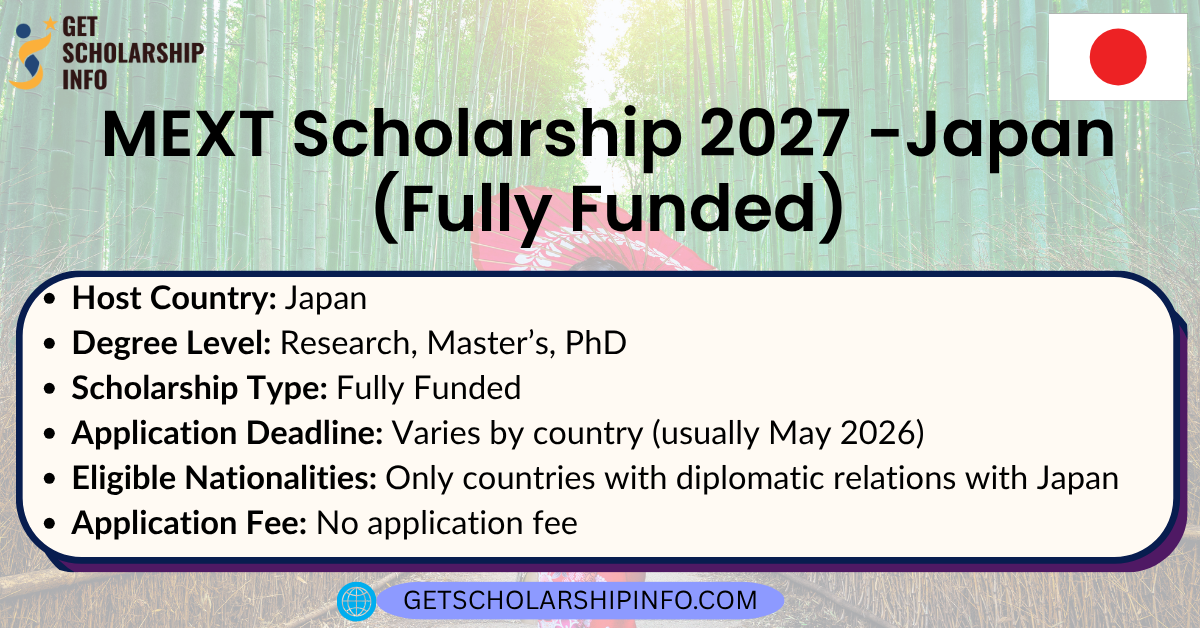
Japan’s Ministry of Education, Culture, Sports, Science and Technology runs one of the longest-standing government scholarships in the world, and the Research Students category is where most graduate applicants end up. It’s not a short exchange or a summer programme, it’s a route into a full master’s or doctoral degree at a Japanese national university, with tuition, a monthly stipend, and flights all covered by the Japanese government from the moment you land.
This particular intake covers arrival in Japan in either April 2027 or the September/October 2027 term. It’s run through Japanese embassies and consulates rather than a single online portal, which means the exact deadline depends entirely on which country you’re applying from. Recruitment for this round opened around mid-April 2026, and the first screening stage, conducted directly by each embassy, runs from roughly early May through late July 2026. If you’re only finding this now, in the middle or toward the end of that window, most embassy deadlines for direct submission have likely already closed, so the guidance below is written to help you plan properly for the next intake rather than rush a late application. There’s no fee anywhere in this process, and it’s open to applicants from any country that holds diplomatic relations with Japan.
At a Glance:
- Offered by: Japan’s Ministry of Education, Culture, Sports, Science and Technology (MEXT)
- Category: Research Students (leading toward a master’s or doctoral degree)
- Host country: Japan
- Degree level: Graduate study, master’s course, doctoral course, or professional graduate course
- Nationality requirement: Applicants must hold citizenship of a country with diplomatic relations with Japan; Japanese nationals are not eligible
- Age requirement: Generally born on or after April 2, 1992
- Funding type: Fully funded, tuition, monthly stipend, and airfare all covered
- Application fee: None
- Recruitment window: Around mid-April to May 2026, through Japanese embassies and consulates (deadlines vary by country)
- Application route: Submitted directly to the Japanese embassy or consulate in your country of nationality, not to MEXT in Japan
The Money and Benefits Behind This Scholarship:
What makes this scholarship stand out isn’t a single headline figure, it’s how comprehensive the coverage is across the entire time you’re in Japan.
- A monthly allowance of 143,000 yen during preparatory Japanese-language education or while enrolled as a non-regular student
- A monthly allowance of 144,000 yen once enrolled as a regular student in a master’s or professional degree course
- A monthly allowance of 145,000 yen once enrolled as a regular student in a doctoral course
- An additional regional allowance of 2,000 to 3,000 yen per month for grantees placed in specially designated areas of Japan
- Full waiver of entrance examination, matriculation, and tuition fees at your accepting university
- A funded economy-class flight from the international airport nearest your residence to Japan, arranged and issued directly by MEXT
- A funded return flight to your home country once you complete your course, provided you finish within the designated scholarship period
- The possibility of an extended scholarship period if you progress from a non-regular student status into a full degree course, or from a master’s into a doctoral programme, subject to passing the relevant entrance exam
Beyond the direct payments, you also gain something less tangible but arguably just as valuable: a fully immersive research placement inside a Japanese university, with your academic advisor and accepting institution shaping the direction of your work for the length of your degree.
Are You Eligible:
This scholarship checks more boxes than most, so it’s worth going through the requirements carefully rather than assuming you qualify.
Nationality:
- You must hold citizenship of a country that maintains diplomatic relations with Japan
- Applicants holding Japanese nationality at the time of application are not eligible
- Dual nationals holding Japanese citizenship can still apply, but only if they commit to relinquishing their Japanese nationality before arriving in Japan as a student
Age:
- Applicants must generally have been born on or after April 2, 1992
- Exceptions exist only where MEXT determines the applicant genuinely couldn’t apply earlier due to circumstances like military service or war-related disruption to their education — personal financial or family circumstances do not qualify for an exception
Academic background:
- For a master’s course or the first phase of a doctoral course, you generally need 16 years of prior school education, or a bachelor’s degree (or equivalent) from a programme with a standard length of three years or more
- For the second phase of a doctoral course, you generally need an overseas master’s or professional degree, or at least two years of recognised research experience judged equivalent to a master’s level
- For doctoral study in medicine, dentistry, veterinary science, or select pharmaceutical fields, requirements are higher — typically 18 years of school education or a bachelor’s-equivalent degree from a five-year or longer programme, since these paths follow a different academic structure in Japan
Other conditions:
- You need to be willing to learn Japanese and show genuine interest in understanding Japanese culture and society
- You must submit a health certificate, completed by a physician, confirming no condition that would prevent you from studying in Japan
- You must commit to one of two arrival windows — April 2027 or the September/October 2027 term — and this choice generally cannot be changed once submitted
- You’ll need to obtain a new Student visa before travelling to Japan, even if you already hold another type of residence status there
A number of situations automatically rule an applicant out, including active military service, holding another MEXT scholarship application at the same time, already being enrolled as a privately-financed student in Japan under certain conditions, or having no genuine intention of completing a degree in Japan. If any of these apply to your situation, it’s worth reading the full eligibility conditions in the official guidelines before applying.
Subjects You Can Apply Under:
There isn’t a fixed list of approved majors here. Instead, MEXT expects your chosen field of study in Japan to match, or closely relate to, whatever you studied at university. In broad terms, that opens the door to graduate study across:
- Humanities and social sciences
- Natural sciences
- Engineering and applied technology
- Agriculture and environmental sciences
- Economics and business studies
- Law and public policy
- Education
- Medicine, dentistry, and veterinary science (with additional academic requirements)
- Pharmaceutical sciences
A few things fall outside the scope of this programme entirely. Traditional Japanese performing arts, such as Kabuki or classical Japanese dance, aren’t covered, and neither are subjects built around hands-on technical training at factories or companies. It’s also worth knowing that if you’re pursuing medicine, dentistry, or welfare-related study, you won’t be permitted to take part in clinical training or procedures like surgery until you separately obtain the relevant license from Japan’s Ministry of Health, Labor and Welfare.
Individual Japanese embassies can also narrow the list of accepted fields further for applicants in their specific country, so it’s worth checking directly with your local embassy once you’ve identified a general field of interest.
Documents You’ll Need:
The paperwork here is heavier than most scholarships, largely because it needs to satisfy both the embassy’s initial screening and, later, a Japanese university’s admission process.
- Completed Application Form for the 2027 intake, with a correctly sized recent photograph attached
- Placement Preference Application Form, listing up to three universities you’d like to attend
- Field of Study and Research Plan, describing your academic background and your intended research direction in Japan
- Academic transcripts covering every year of university study completed so far
- Certificate of graduation, or a certificate of prospective graduation if you haven’t finished yet
- A recommendation letter from your university’s president, dean, or your academic advisor
- A medical certificate completed and signed by a physician
- Abstracts of any theses you’ve written, if applicable
- Certificates of Japanese or English language proficiency, if you hold any, issued within the last two years
- A recommendation letter from your current employer, if you’re employed
- Samples of artistic or musical work, only if you’re applying to major in fine arts or music
Everything needs to be in Japanese or English, and if your original documents are in another language, a translation must be attached. It’s also worth noting that none of these documents get returned once submitted, so keep your own copies before sending anything to the embassy.
The Application Journey:
Unlike most scholarships that run through a single centralized system, MEXT works through a layered process involving your local embassy, MEXT itself, and eventually the Japanese university you hope to attend.
- Submit your full application directly to the Japanese embassy or consulate in your country of nationality — never to MEXT in Japan directly
- Sit the First Screening, which includes a review of your documents, written language tests in both Japanese and English, and an interview conducted by the embassy
- If you pass the First Screening, contact your preferred Japanese universities yourself to request a Letter of Provisional Acceptance, generally starting after results are announced and continuing until around September 1, 2026
- Submit your finalized Placement Preference Application Form to the embassy once you know which universities have responded, listing up to three institutions in order of preference
- Wait for MEXT’s Second Screening, where your placement at a specific university is finalized based on the acceptances you’ve secured
- Receive your final results and university placement through the Japanese embassy, generally between January and March 2027
A Letter of Provisional Acceptance genuinely shapes your outcome here, applicants without one are at real risk of being rejected at the Second Screening stage, so this middle step deserves as much attention as the initial application itself.
Timeline for This Round:
- Around mid-April 2026 — Call for applications opens through Japanese embassies and consulates worldwide
- Early May to late July 2026 — First Screening conducted by individual embassies (exact dates vary by country)
- By September 1, 2026 — Applicants who passed the First Screening contact universities to request provisional acceptance
- Mid-September to early October 2026 — Final Placement Preference Application Form submitted to the embassy
- From November 2026 — MEXT conducts the Second Screening and finalizes university placement
- January to March 2027 — Final results and university placement announced through the embassy
If This Window Has Already Closed for You:
Given how the timeline runs, many embassy deadlines for this particular intake will have already passed by the time this reaches some readers, since individual countries set their own cut-off dates within that April-to-May submission period. That doesn’t mean the opportunity is gone for good, MEXT runs this Research Students programme every year, generally following a very similar structure and timeline.
- Start monitoring your national Japanese embassy’s website now for the next intake announcement, since exact opening dates shift slightly by country
- Use the coming months to strengthen your Field of Study and Research Plan, since this document carries significant weight in your placement outcome
- Begin studying Japanese now if you haven’t already, even basic proficiency strengthens your interview performance and your later placement options
- Identify potential Japanese universities and even specific academic advisors whose research aligns with your interests, so you’re not starting that research from zero next year
- Reach out to a current or former professor early about writing your recommendation letter, since a strong, specific letter takes real time to prepare properly
Frequently Asked Questions?:
Is the MEXT Scholarship really fully funded?
Yes. It covers your tuition, entrance and matriculation fees, a monthly living allowance, and airfare to and from Japan, with no cost to apply.
Can I apply directly to MEXT in Japan?
No. Applications must go through the Japanese embassy or consulate in your country of nationality. MEXT does not accept documents sent directly from applicants.
Is there an age limit for this scholarship?
Yes, applicants generally need to have been born on or after April 2, 1992. Limited exceptions exist for applicants whose education was disrupted by war or military service obligations.
Do I need to already speak Japanese to apply?
No, but you do need to show a genuine willingness to learn it. Applicants who require language preparation typically receive six months of Japanese-language education after arriving in Japan.
What happens if I don’t get a Letter of Provisional Acceptance from any university?
You can still submit a Placement Preference Application Form, but without a letter of provisional acceptance, your chances at the Second Screening are significantly reduced, and your arrival would be restricted to the October term.
Can I hold another scholarship at the same time as this one?
Generally, no. Applicants planning to receive another scholarship or fellowship from the Japanese government or a related organization after the payment period starts are not eligible for the MEXT Scholarship.
How many universities can I apply to under this scholarship?
You can list up to three preferred universities on your Placement Preference Application Form, though you may only request Letters of Provisional Acceptance from a maximum of two at any given time.
Is this scholarship only for recent graduates?
No. It’s open to applicants pursuing master’s or doctoral study, including those with existing research experience, as long as they meet the relevant academic background condition for their intended course.
Stay Updated:
Join our platforms to get the latest scholarships:
We share daily updates on fully funded and partially funded scholarships worldwide
