
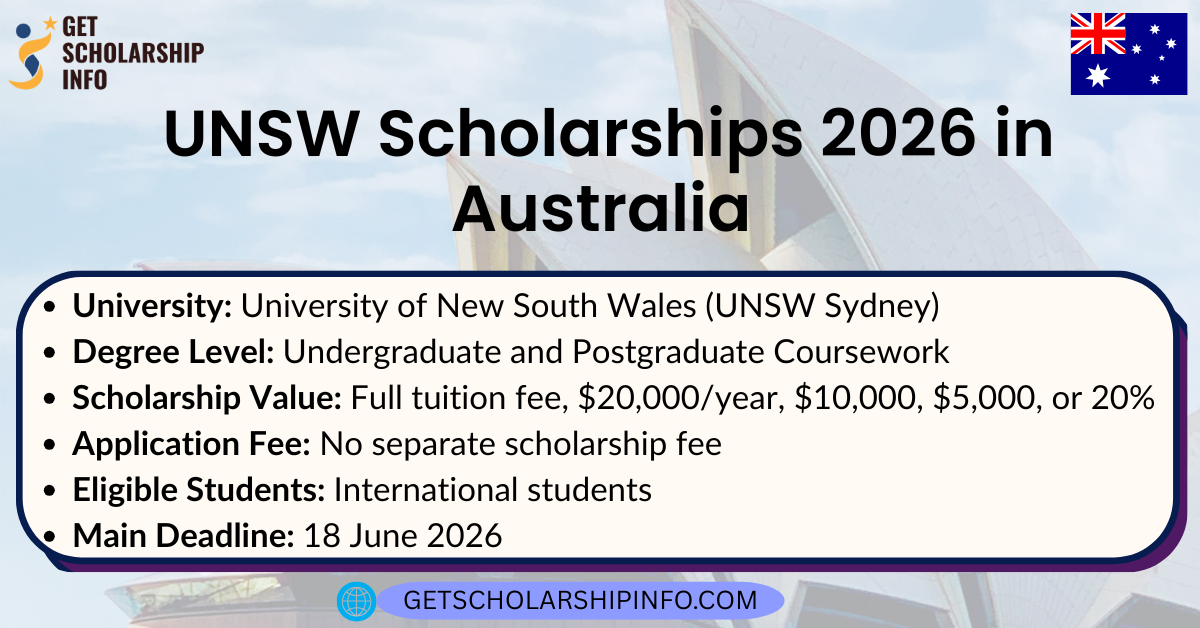
Let’s be honest ; scrolling through university scholarship pages usually feels like reading a legal contract written by someone who’s never had to pay tuition themselves. Confusing tables, vague eligibility rules, half the links broken. So here’s the plain-English version of what’s going on with UNSW Sydney’s 2026 scholarship round for international students, because there’s genuinely a lot on the table this year, and it would be a shame if good candidates missed out just because the fine print was too dense to bother reading.
The University of New South Wales, better known simply as UNSW, sits comfortably among Australia’s top-ranked universities, and every year it puts aside a decent chunk of funding specifically to bring international talent onto campus. For 2026 (and in some cases students starting in 2027), that funding pool covers everything from full-ride tuition scholarships worth tens of thousands of dollars, down to smaller but still meaningful awards and automatic fee discounts that basically everyone qualifies for without lifting a finger. Whether you’re eyeing a law degree, an engineering program, or something in business, there’s likely something here worth your time.
So What’s Actually on Offer?
Before diving into specifics, it helps to understand that UNSW isn’t offering “one scholarship” , it’s running a whole ecosystem of them, stacked across different value tiers and different application processes. Some you have to actively apply for. Others just… happen, automatically, once you’ve been accepted. That distinction matters more than people realize, because it changes how much effort you need to put in and when.
Broadly, here’s the landscape:
At the very top, there’s the International Scientia Coursework Scholarship. This one’s the crown jewel , it covers your full tuition fee outright, or alternatively hands you $20,000 a year toward your costs. If you’re the kind of student with a strong transcript and a track record of achievement outside the classroom too (leadership roles, research experience, whatever makes your application stand out from the pile), this is worth chasing hard.
Just below that, you’ve got a tier of solid, high-value partial scholarships tied to specific schools within UNSW. The Law & Justice International Award, for instance, gives $10,000 for your first year if you’re heading into a law degree. Business students have their own version too , the International Pathways Award, worth $15,000 for the first year, which is honestly a pretty generous starting cushion for anyone coming from overseas and trying to budget out their first twelve months.
Then there’s a broader tier of general partial scholarships , smaller in dollar value but still nothing to sneeze at. The UNSW Business School International Scholarship offers $5,000 spread across your whole program rather than just year one. Australia’s Global University Award and the UNSW College Award both sit around $10,000 for a single year. These tend to have slightly less brutal competition than the flagship scholarships, so if your profile is strong but maybe not “top 1%” strong, these are realistic targets.
For postgraduate law specifically, there’s a dedicated Master of Laws Scholarship worth $20,000 for one year , a nice one if that’s the direction you’re headed.
And then, almost as an afterthought but honestly one of the best parts of this whole scheme, there’s the UNSW International Student Award. This one gives a flat 20% reduction on your tuition fees for the entire length of your program, and here’s the kicker , it’s automatic. You don’t apply for it separately. If you get an offer of admission and you meet the criteria, it’s just… applied. No extra forms, no essay, no waiting to hear back a second time. For students who don’t have the bandwidth to write five separate scholarship applications on top of everything else going on in their lives, that automatic 20% is quietly one of the more valuable things UNSW is offering this year.
There’s also the Articulation Scholarship, worth $5,000 annually, aimed at students coming through particular pathway or articulation routes into UNSW , worth checking if that applies to your situation.
Who Can Actually Apply?
Here’s where things narrow a bit. This isn’t a “everyone on Earth is eligible” situation , UNSW specifies that applicants need to come from an eligible country, and while the list itself isn’t reproduced here, it’s worth checking directly with UNSW’s official scholarships page before you get your hopes up about a specific award.
Beyond that nationality requirement, the basic eligibility checklist looks like this:
- You need to actually be an international student (not a domestic Australian student or permanent resident)
- You need to hold, or be in the process of securing, an offer of admission into a full-time undergraduate or postgraduate coursework program at UNSW
- Your academic record and English language proficiency need to meet the university’s standard entry requirements , scholarships don’t lower the bar for getting in, they just help once you’re already qualified
- You generally can’t already be a current UNSW student, though the university does note there are some exceptions to that rule, so it’s not an absolute dealbreaker in every case
One thing worth flagging clearly: not every degree at UNSW qualifies. If you’re looking at UNSW Online, UNSW Canberra, or the AGSM (their business school for postgraduate management programs), you’ll want to double-check eligibility, because these are specifically called out as exclusions for at least some of the scholarship categories. It’s a small detail, but the kind of thing that trips people up after they’ve already spent hours on an application.
Also, and this is important ,meeting the eligibility criteria doesn’t automatically mean you’ll be selected. Some of these scholarships, especially the flagship ones, are genuinely competitive. UNSW makes this explicit: ticking the boxes gets you in the room, but it doesn’t guarantee a seat.
The Deadline You Actually Need to Circle:
For the 2026 intake (Term 3), the main deadline sitting on the calendar is 18 June 2026. That’s the date to build your entire plan around. Late applications, per UNSW’s own guidance, are not accepted , no grace period, no “email us and we’ll sort it out.” If you’re serious about any of the scholarships that require a separate application, treat that June date as immovable and work backward from there.
Given that some scholarships need supporting documents beyond the standard paperwork , think portfolios, references, statements about your achievements , it’s worth starting the process weeks, not days, before that deadline. Competitive scholarship committees can usually tell the difference between an application someone put real thought into and one that was thrown together the night before it was due.
Documents You’ll Need on Hand:
Nothing here is unusual if you’ve ever applied to a university abroad before, but it’s still worth having a checklist so nothing slips through the cracks:
- Academic transcripts from your current or most recently completed institution
- A copy of your passport, since this is fundamentally an international application
- Your admission offer letter from UNSW , you generally need this in hand before applying for most scholarships, since the award is layered on top of an actual accepted place, not a hypothetical one
- English language certification, if your prior education wasn’t conducted in English or if UNSW otherwise requires proof (IELTS, TOEFL, or similar, depending on what the specific program calls for)
- Supporting documents for achievements, if you’re going after one of the more competitive, merit-based scholarships , this could mean anything from certificates of extracurricular involvement to evidence of research work or leadership positions
Not every scholarship needs all five. The automatic 20% tuition reduction, for example, doesn’t require you to submit a separate stack of achievement certificates , it’s baked into your admission. But if you’re chasing the Scientia Scholarship or one of the school-specific awards, expect to put together a fuller package.
The Actual Steps, In Order:
If you strip away the marketing language, applying for a UNSW scholarship as an international student basically comes down to five moves:
First, decide on your program. This sounds obvious, but it matters ; some scholarships are tied to specific schools (Law, Business) and won’t apply if you’re studying something else entirely.
Second, submit your application for admission through UNSW’s official portal. This is the foundation everything else sits on top of, so it needs to happen before anything scholarship-related can move forward.
Third, wait for and receive your offer letter. Some scholarships specifically require this document as part of the application, so there’s a natural sequencing here , admission first, scholarship applications second.
Fourth, apply separately for any scholarship that requires its own application. Not all of them do remember, the International Student Award is automatic , but for the higher-value ones like the Scientia Scholarship or the school-specific awards, you’ll need to submit a dedicated application alongside your supporting documents.
Fifth, submit everything before 18 June 2026. Don’t leave this to the last 48 hours if you can help it.
For anything automatic, there’s genuinely nothing extra to do beyond securing your offer of admission. It’s one of the rare cases in the world of scholarships where doing less work is a legitimate, sanctioned strategy.
A Few Things People Tend to Overlook:
A handful of details in UNSW’s scholarship structure are easy to miss on a first read, but they can meaningfully change your strategy:
Some scholarships can be combined, some can’t. UNSW is upfront that not all awards stack together, so if you’re hoping to apply for multiple scholarships at once, it’s worth checking the specific combination rules rather than assuming you can layer a $10,000 award on top of a $20,000 one and pocket the difference.
Program-specific scholarships exist for a reason. If you’re going into Business, Law, or Engineering, don’t just apply for the general awards, check whether your specific school has its own dedicated scholarship, since those often carry higher values and are, in a sense, less crowded because fewer people even think to look for them.
“Eligible country” is doing a lot of work in that eligibility list. Since not every nationality qualifies for every award, it’s worth confirming your specific situation directly with UNSW rather than assuming based on general international student policy elsewhere.
The automatic award is easy to underestimate. A 20% reduction across an entire degree, which, for a multi-year program, can genuinely add up to tens of thousands of dollars over time, sometimes gets overlooked because it doesn’t have the flashy “$20,000 scholarship” headline attached to it. Don’t sleep on it.
Final Word:
If you’re an international student weighing up where to study in Australia in 2026, UNSW’s scholarship lineup is worth taking seriously, not because it’s flashy or unusually generous compared to global norms, but because it’s structured in a way that actually rewards students at multiple levels, not just the handful who can win the single biggest award. Whether you end up with a full-tuition Scientia Scholarship or simply benefit from the automatic 20% reduction that comes bundled with your offer letter, there’s a real, tangible reduction in what you’ll end up paying.
The main thing now is timing. Get your program choice sorted, get your admission application in early enough that you’re not racing the clock, and treat 18 June 2026 as a hard stop rather than a soft suggestion. Scholarship committees, at UNSW or anywhere else, tend to notice the difference between a rushed application and one where the person actually cared enough to get the details right.
As always, treat this as a starting point rather than the final word, scholarship terms, values, and eligibility lists can shift, so it’s worth cross-checking everything directly against UNSW’s official scholarships page before you commit time to any single application.
Good luck, and here’s hoping you land somewhere on that list of awards.
Stay Updated:
Join our platforms to get the latest scholarships:
We share daily updates on fully funded and partially funded scholarships worldwide
