
Some fellowships ask you to study the past. This one asks you to help explain what’s happening right now. The Wang Gungwu Visiting Fellows Programme, run by the ISEAS, Yusof Ishak Institute in Singapore, is built around the kind of research that shapes how governments, journalists, and policy analysts across the region actually understand the shifting balance of power between the US and China, and everything that ripple effect means for Southeast Asia. If your research sits anywhere near that space, this fellowship offers a rare mix of funding, publishing platforms, and genuine policy relevance.
Here’s a full look at what the programme involves, who it’s built for, and how to put together a strong application before the 2027 intake closes.
Honouring a Name That Shaped the Institute:
Before getting into the practical details, it’s worth understanding where this fellowship comes from. It’s named after Professor Wang Gungwu, who served as Chairman of the Board of Trustees at ISEAS for an impressive 17 years. The fellowship exists as a way of carrying his legacy forward, specifically by nurturing a new generation of scholars and policy makers who want to dig into how the tension and cooperation between major world powers is actively reshaping Southeast Asia.
Fast Facts Before You Read Further:
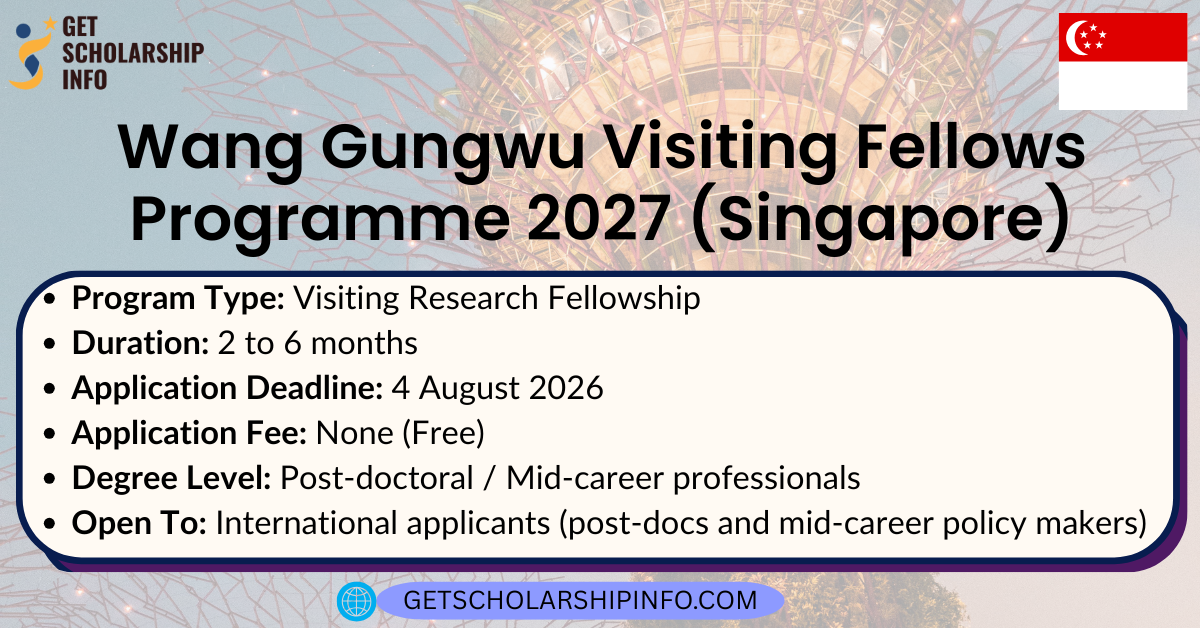
- Programme Name: Wang Gungwu Visiting Fellows Programme (WGWVF)
- Host Institution: ISEAS ; Yusof Ishak Institute, Singapore
- Fellowship Length: A minimum of two months, up to a maximum of six months, subject to ISEAS approval
- Residency Requirement: Fellows are expected to be physically based in Singapore, in residence at ISEAS, for the full duration of their fellowship
- Application Deadline: Friday, 28 August 2026
- Eligible Applicants: Post-doctoral researchers and mid-career policy makers, including those without a PhD if their professional experience justifies it
- Application Fee: Not mentioned, so there’s no cost involved in applying
- Application Method: Online submission via FormSG, with two reference letters required separately by email
What You Actually Receive as a Fellow:
It helps to look past the research activity itself and focus on what a fellow personally gains from the experience.
- A fixed monthly stipend that already includes a housing subsidy, removing the need to separately budget for accommodation costs in Singapore
- Round-trip economy airfare between your home country and Singapore, fully covered
- A dedicated office space at ISEAS, along with computer equipment and IT services to support your research
- Full access to the ISEAS Library and other institute facilities relevant to your work
- The rare opportunity to personally meet Professor Wang Gungwu during your fellowship, where scheduling allows
- A guaranteed publishing platform through ISEAS Perspective and ISEAS Fulcrum, both well-regarded outlets for Southeast Asian policy analysis
- A speaking opportunity through an in-house seminar, where you present your research findings directly to ISEAS researchers and staff
- Long-term membership in a network of regional scholars, with the door left open to keep contributing to ISEAS even after your fellowship formally ends
Put together, this isn’t just funded research time. It’s a structured entry point into one of the region’s most visible policy research communities, with your work reaching an audience well beyond a typical academic journal.
The Research Priorities Guiding This Cycle:
ISEAS isn’t looking for research on any Southeast Asia-related topic. The fellowship is intentionally focused on the intersection of major-power relations and their effects on the region, spanning international politics and security, regional economics, and digital technology. The specific priority areas for this cycle are:
- Developments in US-China relations and their impact on Southeast Asia
- Asia Pacific security issues, such as tensions in the South China Sea or the state of China-ASEAN relations
- Progress and prospects of global and regional economic cooperation initiatives, including efforts like the Belt and Road Initiative and the Regional Comprehensive Economic Partnership
- The rise of China and its impact on Southeast Asian communities
- The use of digital media and technology by countries seeking to advance their interests and shape public perception across Southeast Asian countries
If your current research or policy work touches on any of these themes, this fellowship is built with your kind of project in mind.
Who ISEAS Is Actually Looking For:
Eligibility here is intentionally broader than a typical academic fellowship, since it’s designed to bring in both scholars and practitioners.
- Post-doctoral researchers with relevant expertise in the fellowship’s priority research areas
- Mid-career policy makers, even those who don’t hold a PhD or equivalent degree, provided their CV or resume clearly demonstrates a strong level of professional experience and genuine research interest in the field
This dual pathway matters. ISEAS isn’t only interested in traditional academics, someone working inside a ministry, think tank, or international organisation with hands-on policy experience is just as strong a candidate here as someone coming straight from a postdoctoral research post.
What’s Expected of You Once You’re Selected:
Being awarded the fellowship comes with clear responsibilities, and understanding them ahead of time helps you plan your fellowship period properly.
- Contribute written research output to ISEAS Perspective and ISEAS Fulcrum publications, specifically within your area of research
- Deliver an in-house seminar presenting your research findings to the ISEAS community during your fellowship
- Remain in residence at ISEAS in Singapore for the entire approved duration of your fellowship, rather than conducting the work remotely
- Continue engaging as part of the broader ISEAS scholar network after your fellowship concludes, if you choose to stay involved
Learning From Those Who’ve Done It Before:
One of the more reassuring things about this fellowship is that it has a real, visible track record. Past Wang Gungwu Visiting Fellows have gone on to hold positions across some of the world’s most recognised universities and policy institutions, and their project topics give a genuinely useful sense of what ISEAS values in an application.
Recent and past fellows have researched topics such as China’s Belt and Road Initiative and land dynamics in Southeast Asia, the impact of US-China economic decoupling on global supply chains, Indonesia’s positioning as an Indo-Pacific maritime power, and the effects of US-China clean energy competition on the region. Others have focused specifically on China’s official rhetoric during periods of crisis escalation, the historical relationship between maritime China and Southeast Asia, and the practical impact of trade liberalisation with China on poverty and wages in Indonesia.
Fellows have come from institutions including the University of Cambridge, University of British Columbia, Harvard University, Cornell University, the University of North Carolina at Chapel Hill, and government bodies such as Indonesia’s Ministry of National Development Planning, alongside research centres based in China, Cambodia, and the Philippines. This range shows just how broadly ISEAS interprets its research priorities, welcoming scholars and policy practitioners from a genuinely international mix of backgrounds.
How the Application Process Actually Works:
Getting your application together involves a few distinct steps, so it’s worth mapping these out early rather than leaving them until close to the deadline.
- Review the fellowship’s priority research areas and confirm your proposed project genuinely aligns with one or more of them
- Prepare your supporting documents, including a CV or resume that clearly demonstrates your research background or relevant professional experience
- Complete your application and upload all required supporting documents through the official FormSG application link
- Arrange for two referees to submit Letters of Recommendation directly by email to development@iseas.edu.sg
- Make sure your referees use the correct subject line format: “Application for ISEAS Wang Gungwu Visiting Fellows Programme 2027 ; [Reference Letter for First Name and Last Name]”
- Submit everything no later than Friday, 28 August 2026
- Wait to be contacted directly if you’re shortlisted for an interview, since ISEAS only reaches out to applicants who progress to that stage
A Few Practical Things Worth Knowing:
Because this fellowship requires full residency in Singapore, it’s worth thinking through the practical side of relocating for two to six months before you apply. The housing subsidy built into your monthly stipend is designed to ease this transition, and having your flights covered removes one of the bigger financial barriers to taking up an international fellowship. Still, it’s sensible to think ahead about visa requirements and how the fellowship period fits around your current academic or professional commitments before submitting your application.
Why This Fellowship Carries Real Weight:
A lot of visiting fellowships offer funding and little else. What sets this one apart is the guaranteed publishing platform through ISEAS Perspective and Fulcrum, both outlets with genuine readership among policy analysts, diplomats, and regional experts. Add to that a direct seminar audience of ISEAS researchers, potential access to Professor Wang Gungwu himself, and a long-term regional research network that stays open after your fellowship ends, and it becomes clear this programme is built for researchers who want their work to actually influence real policy conversations, not just sit in an academic archive.
Frequently Asked Questions?:
Is the Wang Gungwu Visiting Fellows Programme fully funded?
Yes. Fellows receive a fixed monthly stipend that includes a housing subsidy, along with round-trip economy airfare between their home country and Singapore.
Who is eligible to apply?
Post-doctoral researchers and mid-career policy makers, including those without a PhD, provided their professional experience and research interest are clearly reflected in their CV or resume.
Is there an application fee?
No application fee is mentioned in the official programme details.
How long does the fellowship last?
Between two and six months, depending on ISEAS approval, with fellows required to be physically based in Singapore for the entire duration.
What research topics does this fellowship focus on?
Priority areas include US-China relations, Asia Pacific security issues, regional economic cooperation initiatives, the rise of China’s impact on Southeast Asia, and the use of digital media and technology to shape regional perceptions.
Do I need a PhD to apply?
Not necessarily. Mid-career policy makers without a PhD or equivalent degree are welcome, provided their experience and research background are clearly demonstrated.
What is the application deadline?
All applications must be received no later than Friday, 28 August 2026.
How do I submit my application?
Applications, along with all supporting documents, must be submitted through the official FormSG application link, with two Letters of Recommendation sent separately by email from your referees.
What am I expected to produce during the fellowship?
Fellows are required to contribute publications to ISEAS Perspective and ISEAS Fulcrum, and to deliver an in-house seminar presenting their research findings.
Will I be notified if my application isn’t shortlisted?
ISEAS states they will contact you only if you’re shortlisted for an interview, so applicants should expect to hear back specifically in that case.
Before You Submit Your Application:
Given how clearly ISEAS has defined its research priorities, the strongest applications tend to come from candidates who connect their proposed project directly and specifically to one of the five listed themes, rather than presenting a broader Southeast Asia research interest and hoping it fits. Take the time to line up your referees early, since their letters need to be submitted separately and on time, and make sure your CV genuinely reflects the depth of experience ISEAS is looking for, whether that comes from academic research or hands-on policy work.
