Singapore’s National Library Board is once again opening its doors to researchers, historians, and independent scholars who want hands-on access to some of the region’s rarest archival material. The Lee Kong Chian Research Fellowship isn’t your typical scholarship built around lectures and coursework , it’s a residency, one where you spend six months buried in centuries-old manuscripts, colonial-era records, and community archives that most people never get to touch. If your work sits anywhere near Singapore or Southeast Asian history, this is worth your full attention.
Here’s everything broken down clearly, so you know exactly what’s on offer, whether you qualify, and what’s expected of you if you’re selected.
What This Fellowship Actually Involves:
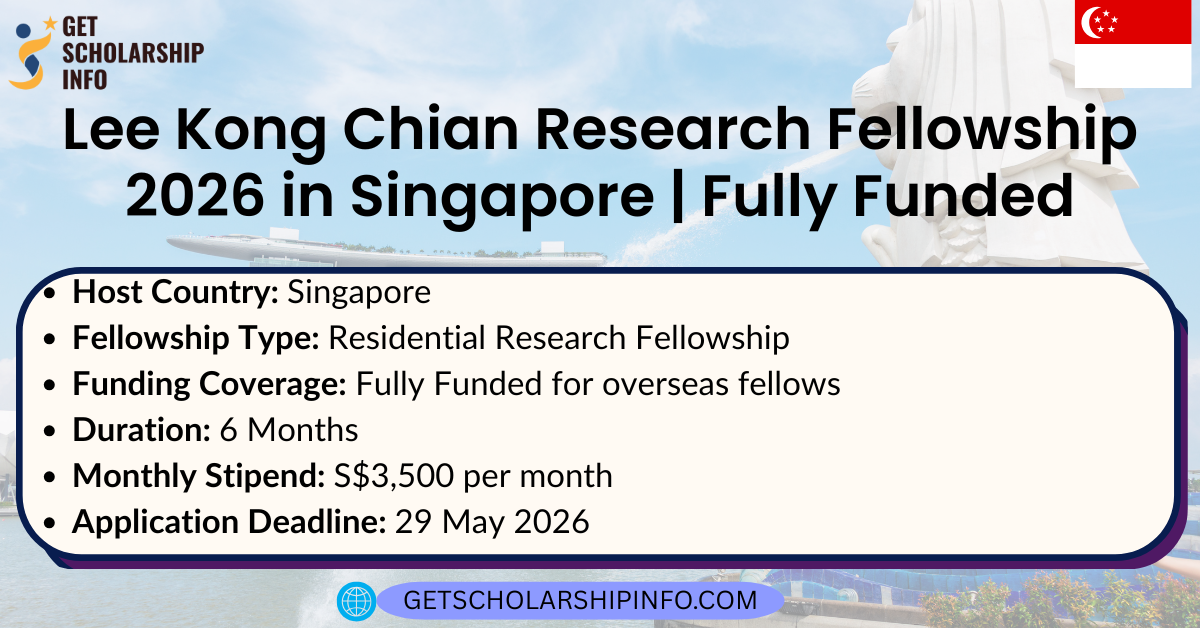
This is a fully funded, six-month residential fellowship hosted at the Lee Kong Chian Reference Library in central Singapore. Rather than funding general study, it’s designed specifically to support deep research into the library’s historical holdings and the collections at the National Archives of Singapore , materials that stretch back to the 1500s alongside more contemporary archives. You’re expected to live in Singapore for the duration and dedicate the bulk of your time to research drawn directly from these collections. There’s no tuition fee involved because this isn’t a degree program; it’s a paid research residency covering your living costs, and for those coming from abroad, a good deal more.
The Essentials You Need to Know First:
- Fellowship Type: Residential research fellowship, not a degree-based scholarship
- Host Institution: National Library Board, Singapore, based at the Lee Kong Chian Reference Library
- Duration: Six months, full-time residency required
- Location Requirement: Fellows must remain in Singapore and spend at least 75 percent of their working time physically at the Library
- Application Deadline: 29 May 2026
- Nationality: Open to both local Singaporean applicants and overseas candidates
- Eligible Applicant Types: Curators, historians, academics, independent researchers, and those pursuing doctoral, postdoctoral, or advanced research
- Application Fee: None indicated , applications are submitted free of charge by email or post
- Notification Timeline: Results are shared within three months of the closing date
Financial Support and Everything Included:
Money matters, and this fellowship is refreshingly generous compared to many research grants. Every awarded Fellow receives a monthly stipend of S$3,500 for the full six months, meant to cover daily living costs, local transport, and even photocopying expenses while working through the archives.
If you’re coming from outside Singapore, the support goes further:
- A one-time relocation allowance of S$1,500 to help with the move
- Reimbursement of a return economy class air ticket, up to S$1,500
- A monthly accommodation allowance of up to S$3,500, provided on a reimbursement basis
On top of the money, every Fellow , local or overseas gets practical research support that’s often harder to come by than funding itself:
- A dedicated research space inside the Lee Kong Chian Reference Library, complete with a computer and internet access
- Full access to the library’s historical and contemporary collections
- A direct introduction to library staff who can point you toward the right materials and resources for your specific research area
In short, you’re not just being handed a stipend and left to figure things out. You’re placed inside the institution, with people and infrastructure built around helping your research actually succeed.
Who Should Apply:
Eligibility here is less about ticking boxes and more about demonstrating real research credentials. The fellowship is open to:
- Local applicants based in Singapore
- Foreign applicants from anywhere in the world
- Curators with a track record in their field
- Historians and academics with established research achievements
- Independent researchers who can show equivalent scholarly credentials
- Doctoral candidates, postdoctoral researchers, or those undertaking advanced research
What matters most is a demonstrated ability to carry out original research using the library and archive collections, along with the potential to take that research further. Referee input, academic transcripts, and prior research experience all factor into how applications are judged.
Research Areas Given Priority in 2026:
The National Library Board has flagged specific themes it wants to see more work on this year. If your research interests overlap with any of these, your application likely carries extra weight:
- Critical study of Singapore’s contemporary literature or theatre from the 1950s onward
- Comparative research on early Singapore and Malaya viewed through both Western and Asian scholarly lenses
- Arts and culture in Singapore and Malaya from the early 1900s through to independence, including visual, performing, or literary arts within specific ethnic or under-represented communities
- Research using World War II donor collections, such as materials from Toshio Egawa and Lim Shao Bin
- Social history of Singapore and Malaya before independence
- Architectural history of Singapore, including how architecture is remembered in culture and literature or experienced through lived design
- History of the Straits Settlements , Penang, Malacca, and Singapore between 1826 and 1946
- Asian cultural heritage explored through the Asian Children’s Literature Collection
- Chinese community history through clan association records, including materials from Singapore Hokkien Huay Kuan, Chin Kang Huay Kuan, and Kim Mui Hoey Kuan
What You’re Signing Up For as a Fellow:
This isn’t a passive grant where you disappear for six months and resurface with a paper. The fellowship comes with clear obligations, and understanding them upfront will help you decide if the commitment fits your schedule and goals.
- Remain physically based in Singapore, spending at least 75 percent of your working hours at the Library throughout the fellowship
- Deliver one public presentation to library staff and a separate one open to the general public, both centred on your fellowship research
- Produce a resource guide , essentially an annotated bibliography that highlights the most valuable sources on your topic and explains their significance
- Submit both a 3,000-word paper and a 6,000-word paper based on your findings, due within three months of your fellowship ending, each including 6 to 8 images and kept light on footnotes
- Grant the National Library Board first right of publication for your research, including permission to repackage the content into different formats
- Submit a written reflection on your fellowship experience within one month of completion
- Offer feedback to the library on any gaps you noticed in the collections, helping strengthen their future research capacity
- Provide a copy of any published work stemming from the fellowship, with proper acknowledgement of the National Library Board’s support
One point worth flagging clearly: if any of these obligations aren’t met, you risk forfeiting your stipend and other reimbursed expenses. The final stipend instalment is only released once obligations are confirmed complete.
How Applications Are Evaluated:
Selection isn’t random, and understanding the criteria can help you shape a stronger proposal. Reviewers look at:
- Whether the proposed research is genuinely original
- Whether it makes direct use of the library’s or archives’ collections
- Whether the scope realistically fits within a six-month window
- The applicant’s demonstrated competency, based on referees, transcripts, and past research achievements
- How clearly the application shows understanding of the proposed topic
A strong proposal isn’t just about picking an interesting subject , it’s about proving you already understand the materials well enough to make efficient use of six months on the ground.
Steps for Overseas Candidates After Being Awarded:
If you’re an overseas applicant and you’re successful, there’s a practical checklist that follows the good news, since relocating to another country for six months involves more than packing a suitcase:
- Sign your official fellowship agreement
- Apply for the appropriate work pass, with assistance from the National Library Board
- Book your flight to Singapore
- Arrange accommodation ahead of arrival
- Wait for your work pass to be issued
- Open a local bank account
- Set up a telecommunications and internet plan
- Make arrangements for getting to and from the Library
The Library provides further detailed guidance on each of these once the award is confirmed, so you’re not navigating relocation logistics entirely on your own.
Submitting Your Application:
The process itself is straightforward, though attention to detail matters here since incomplete submissions are automatically disqualified.
- Complete the official application form in full
- Send it either by email to LKCRF@nlb.gov.sg or by post
- If mailing, address it to: The Administrator, Lee Kong Chian Research Fellowship, National Library Headquarters, National Library Board, 100 Victoria Street, #14-01, Singapore 188064
- Submit before the deadline of 29 May 2026
- Double-check that every required document is included, since late or incomplete applications are not accepted under any circumstances
- Expect notification of the outcome within three months of the closing date
If anything about the process is unclear, reaching out directly to LKCRF@nlb.gov.sg before you submit is far safer than guessing and risking a rejected application.
Why This Fellowship Stands Out:
Plenty of research grants hand you money and leave the rest to you. This one is different because it embeds you inside an institution that actively wants your research to succeed , through dedicated workspace, direct staff introductions, and access to materials that simply aren’t available anywhere else in the world. Past Fellows have gone on to publish meaningful work built entirely around collections most researchers only hear about secondhand. If you’ve been circling a research question about Singapore or Southeast Asian history and haven’t had access to the right primary sources, this fellowship removes that barrier completely.
Frequently Asked Questions?:
Is the Lee Kong Chian Research Fellowship fully funded?
Yes. Fellows receive a monthly stipend for six months, and overseas Fellows additionally receive a relocation allowance, accommodation allowance, and reimbursed airfare, along with full access to research space and materials at no cost.
Can researchers from outside Singapore apply?
Yes. The fellowship is explicitly open to both local and foreign applicants, provided they have the relevant scholarly or research credentials.
Is there an application fee?
No application fee is mentioned. Applications are submitted free of charge by email or mail.
Do I need a PhD to apply?
Not necessarily. While doctoral and postdoctoral researchers are encouraged to apply, curators, historians, academics, and independent researchers with established achievements in their field are equally welcome.
How much money will I receive during the fellowship?
A stipend of S$3,500 is paid monthly for six months. Overseas Fellows also receive a S$1,500 relocation allowance, up to S$1,500 in reimbursed airfare, and up to S$3,500 per month toward accommodation.
Do I have to live in Singapore during the fellowship?
Yes. Fellows are required to stay in Singapore and spend at least 75 percent of their working time at the Library for the full six-month period.
What happens if I don’t complete the required obligations?
Failing to meet obligations such as submitting your papers, resource guide, or presentations can result in forfeiting your stipend and any other reimbursed expenses.
What is the application deadline?
Applications must be submitted by 29 May 2026. Late or incomplete applications will not be accepted under any circumstances.
Who owns the rights to research published from this fellowship?
The National Library Board holds first right of publication and may repackage the research into different formats, both digital and physical.
Before You Apply:
If you’re serious about applying, start by mapping your research interests against the priority areas listed for 2026 and be ready to show, clearly and specifically, how your project would make real use of the library’s and archives’ collections within a six-month timeframe. A well-prepared, focused proposal stands a far better chance than a broad or loosely defined one , and given the depth of support on offer here, it’s an opportunity worth putting real effort into.

my name is ramdani I hope to be accepted for this scholarship