
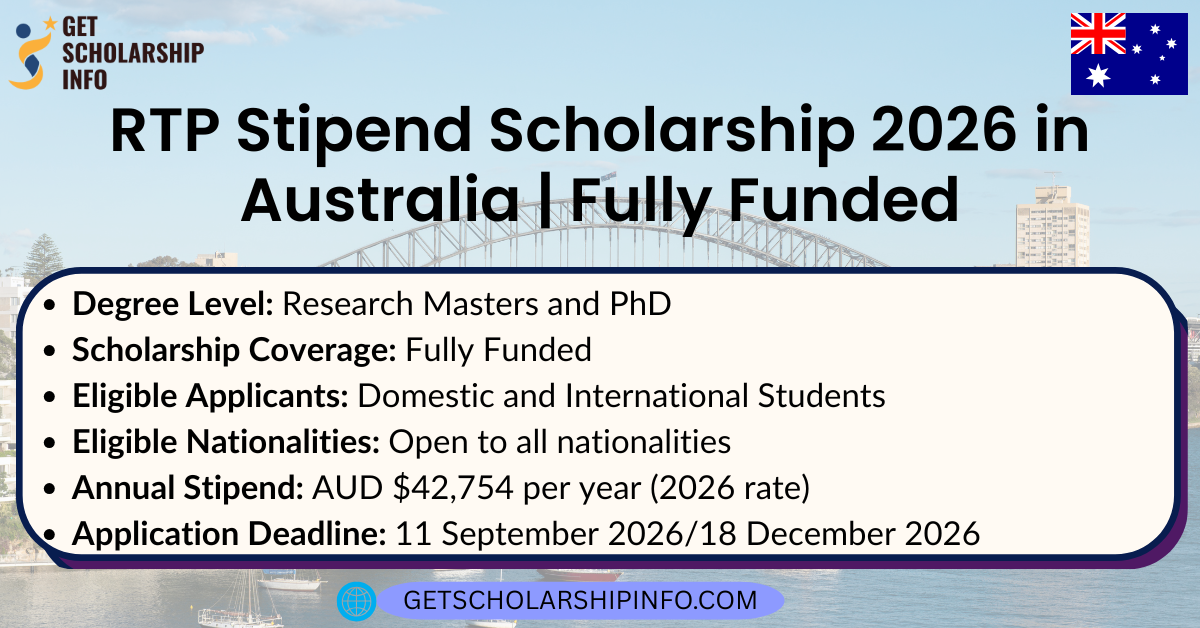
Not every research scholarship comes from a single university with one closing date and one application form. Some run at a national level, funded by government but delivered differently at every institution that offers them. The Research Training Program, commonly shortened to RTP, is exactly that kind of scheme , and if you’re planning a research doctorate or research master’s in Australia, understanding how it actually works matters just as much as knowing it exists.
This guide walks through what the RTP covers, who can access it, how the money is worked out, and where you actually need to go to apply, since unlike most scholarships , you won’t find a single “apply here” button for this one.
Understanding the RTP Before You Apply Anywhere:
The RTP is funded by the Australian Government and channelled through eligible higher education providers, referred to as HEPs, to support both domestic and overseas students undertaking research doctorates and research master’s degrees. Rather than the government reviewing individual student applications, each participating university receives block funding and then runs its own internal process for deciding who receives support. This means the RTP isn’t one scholarship , it’s a funding pool that shapes many university-specific scholarships across the country.
Since 1 January 2017, the RTP has replaced three older schemes: the Australian Postgraduate Award, the International Postgraduate Research Scholarship, and the Research Training Scheme. If you’ve come across any of those names while researching Australian postgraduate funding, know that they’ve all been consolidated into what is now the RTP.
The Basics You Should Know Upfront:
- Funding Source: Australian Government, distributed through eligible higher education providers
- Degree Levels Covered: Research doctorate (PhD) and research master’s degrees
- Eligible Applicants: Both domestic and overseas HDR students
- Application Route: Not centralised, applications go directly through your chosen higher education provider, not through the Department of Education
- Application Fee: Not specified by the Department, since each HEP manages its own process and terms
- Support Duration: 3 to 4 years full-time for a research doctorate, or 6 to 8 years part-time; up to 2 years full-time for a research master’s, or up to 4 years part-time
- Number of Scholarships: Not fixed nationally, since availability depends entirely on each HEP’s allocation and internal decisions
What Students Can Actually Receive Through the RTP:
The scheme isn’t limited to one type of payment. Depending on what a HEP chooses to offer, a student can be supported through one or more of the following:
- A tuition fees offset, which reduces or fully removes the cost of course fees
- A stipend to help cover general day-to-day living costs while studying
- Allowances that go toward the ancillary costs that come with doing a higher degree by research
Beyond the direct financial support, being part of the RTP also connects students to a program specifically designed to build employable research skills , not just for academic careers, but for roles across the wider labour market. There’s also a built-in emphasis on linking students with industry, meaning the benefits extend beyond a paycheck and into real career-building opportunities through structured collaboration between universities and research end-users.
How Long the Funding Actually Lasts:
Length of support depends on both your degree type and your study load:
- Full-time research doctorate students can receive support for a minimum of 3 years, extendable up to 4 years at the HEP’s discretion
- Part-time research doctorate students can receive support for 6 up to 8 years
- Full-time research master’s students can be supported for up to 2 years
- Part-time research master’s students can be supported for up to 4 years
A few conditions affect how this period is calculated. Paid recreation leave or approved personal leave won’t extend your support period. On the other hand, an approved scholarship suspension, or approved paid personal leave, paid parental leave, paid partner leave, or paid family and domestic violence leave, will extend it. In other words, the system is built to protect students going through genuine life circumstances without penalising their funding timeline.
Who Is Eligible for RTP Support:
Eligibility is broader than many people assume, since this isn’t restricted to one nationality or one type of institution.
- Both domestic and overseas students undertaking a higher degree by research at an eligible HEP can be considered
- Students can be enrolled in either a research doctorate or a research master’s program
- Students may apply to more than one eligible higher education provider if they choose, rather than being limited to a single institution
- Final eligibility, selection, and award decisions rest entirely with the individual HEP, not with the Department of Education
Because each university runs its own process, two students with similar academic backgrounds might face different requirements simply because they’ve applied to different institutions.
Areas of Research Supported:
Unlike scholarships tied to a specific subject or department, the RTP isn’t limited to one field of study. It applies broadly across research disciplines at eligible institutions, since the program exists to fund research training generally rather than to promote one academic area over another. In practical terms, the categories of support available under the scheme break down as follows:
- Research Doctorate Programs (PhD level research training)
- Research Master’s Programs (postgraduate research training below doctoral level)
Within either category, your actual research topic can span virtually any discipline your chosen HEP offers as an accredited higher degree by research, provided that institution has agreed to support it through its own RTP allocation.
Current Stipend Rates Worth Knowing:
If you’re weighing up how much financial support you might receive, it helps to look at how the base and maximum stipend rates have moved over recent years. These rates are indexed annually and typically announced by 1 October each year, taking effect from 1 January.
- 2026: Full-time base stipend rate of $34,315, with a full-time maximum stipend rate of $53,608
- 2025: Full-time base stipend rate of $33,511, with a full-time maximum stipend rate of $52,352
- 2024: Full-time base stipend rate of $32,192, with a full-time maximum stipend rate of $50,291
Since HEPs have discretion in how they structure individual scholarships within these bands, the exact amount you’re offered will depend on the institution and the specific scholarship they attach to your RTP funding.
The Industry Internship Boost:
One feature that sets the RTP apart from a standard stipend scheme is its industry internship weighting, introduced through the 2021–22 Budget. The goal here is straightforward: get research doctorate students working alongside real industry partners before they finish their degree, strengthening the bridge between academic research and practical, non-academic careers.
For students who complete an eligible internship, HEPs receive an additional funding weighting of 2.0 within the broader RTP allocation formula. While this weighting benefits the institution’s funding rather than paying the student directly, it creates a strong incentive for universities to actively support and organise these placements for their research doctorate candidates.
To count as an eligible internship, several conditions need to be met:
- The internship must run for at least 3 months
- It must involve a minimum of 60 full-time equivalent days of engagement
- It needs to be formally agreed in writing between the student, the HEP, and the research end-user
- For full-time students, the written agreement must be made within 18 months of starting the course
- For part-time students, that window extends to 36 months
- The research end-user involved must be recognised as an eligible research end-user at the time the agreement is signed
If a student has an approved suspension within their first 18 months of enrolment, or their support period is extended, the timeframe for arranging the internship agreement is extended accordingly too.
Giving Credit Where the Funding Is Due:
If you’re supported by an RTP scholarship and you go on to publish research, present findings, or produce academic material connected to your project, there’s a formal expectation around acknowledging that support. The RTP now carries its own digital object identifier, and from 3 December 2025, the Higher Education Support (Commonwealth Scholarships) Guidelines 2025 require that Commonwealth funding be properly acknowledged.
The recommended acknowledgment wording looks like this: “This research was supported by the Commonwealth through an Australian Government Research Training Program Scholarship,” followed by the DOI reference. Students who already maintain an ORCID researcher profile are also required to include the RTP DOI there. If you don’t already have an ORCID profile, there’s no obligation to create one just for this purpose , but if you do have one, updating it is expected.
If Something Goes Wrong During Your Studies:
Life during a research degree isn’t always smooth, and the RTP framework acknowledges this. If a scholarship-supported student runs into issues with their higher education provider, there’s a dedicated grievance pathway available, outlined through the HDR grievance factsheet. This exists specifically to give RTP scholarship recipients, and HDR students more broadly, a clear route for raising and resolving concerns with their institution rather than having no formal avenue to turn to.
Getting Your Application Started:
This is the part that trips people up most, because there’s no national portal to submit through. Since funding is distributed to HEPs rather than directly to students, here’s how the process actually works:
- Identify the higher education provider or providers where you’d like to study
- Contact your chosen HEP directly to find out their specific RTP scholarship application process
- Review each HEP’s individual eligibility requirements and selection criteria, since these can differ from one institution to the next
- Submit your application according to that HEP’s own deadlines and documentation requirements
- Feel free to apply to more than one HEP at the same time if you’re weighing up multiple options
- Reach out to RBGrants@education.gov.au if you need clarification on the broader RTP scheme itself, rather than institution-specific queries
Because RTP scholarship applications cannot be submitted through the Department of Education, going straight to your target university’s research office or graduate school is the only real starting point.
Where to Look for More Detail:
For anyone wanting to dig deeper into the fine print, several official resources are available:
- RTP Frequently Asked Questions for students, particularly useful for questions around applications, eligibility, and scholarship structure
- RTP Frequently Asked Questions for administrators, more relevant if you’re working alongside a supervisor or research office
- RTP industry internship weighting FAQs, for anyone specifically exploring the internship pathway
- Direct email enquiries through RBGrants@education.gov.au for anything not covered elsewhere
Frequently Asked Questions?:
Is the RTP scholarship fully funded?
It can be, depending on what your higher education provider offers. Support may include a tuition fees offset, a living stipend, and allowances for ancillary study costs, either individually or combined.
Can international students receive RTP funding?
Yes. The scheme explicitly supports both domestic and overseas students undertaking a research doctorate or research master’s at an eligible Australian institution.
Where do I actually apply for an RTP scholarship?
Directly through your chosen higher education provider. Applications cannot be made through the Department of Education, since funding is distributed to institutions rather than allocated to individual students centrally.
Is there an application fee?
This isn’t specified at the national level, since each higher education provider manages its own application process and terms. It’s worth confirming directly with your chosen institution.
How much is the RTP stipend worth?
For 2026, the full-time base stipend rate is $34,315, with a full-time maximum stipend rate of $53,608. These figures are indexed and adjusted annually.
How long can I receive RTP support for?
Full-time doctoral students can be supported for 3 to 4 years, part-time doctoral students for 6 to 8 years, full-time master’s students for up to 2 years, and part-time master’s students for up to 4 years.
Can I apply to more than one university for RTP funding?
Yes. Prospective students are free to apply to more than one eligible higher education provider at the same time.
What is the industry internship weighting?
It’s an additional funding incentive for higher education providers when a research doctorate student completes an eligible industry internship of at least 3 months and 60 full-time equivalent days, formally agreed upon within set timeframes.
Do I need to acknowledge RTP funding in my published research?
Yes. Since December 2025, Commonwealth funding must be formally acknowledged using the RTP’s official wording and DOI, and it should also be added to your ORCID profile if you already maintain one.
Final Word Before You Reach Out to a University:
Because the RTP works through individual institutions rather than one central application system, your best move is to shortlist the universities offering research programs in your field and contact their graduate research offices directly. Ask about current stipend structures, internship pathways, and internal deadlines, since these details shift from one HEP to another even though the underlying government funding scheme stays the same.

My name is Ramdani, I am very happy to get this scholarship
Congratulations, Ramdani! Wishing you great success in your journey ahead. 😊