Somewhere between an artist’s studio and a chemistry lab, a quiet revolution is happening in how creative practitioners think about the materials they use. Fossil-based polymers, toxic resins, and materials nobody can safely recycle are slowly being replaced by biobased alternatives , and the Jan van Eyck Academie in Maastricht has built an entire fellowship programme around supporting the people doing that work. If you’re a designer, artist, or material researcher trying to push sustainable practice forward, this opportunity deserves a proper look.
Two fully funded research positions are available under the Academie’s Future Materials programme, each lasting eleven months and offering a private studio, direct access to specialized labs, and a stipend that lets fellows focus entirely on their work rather than juggling side jobs to make ends meet. One position is reserved for fashion and textile research; the other is open to broader material innovation across arts and design.
Key Details:
Here’s a quick overview before we get into specifics:
- Fellowship Type: Material Research Fellowship (two positions available)
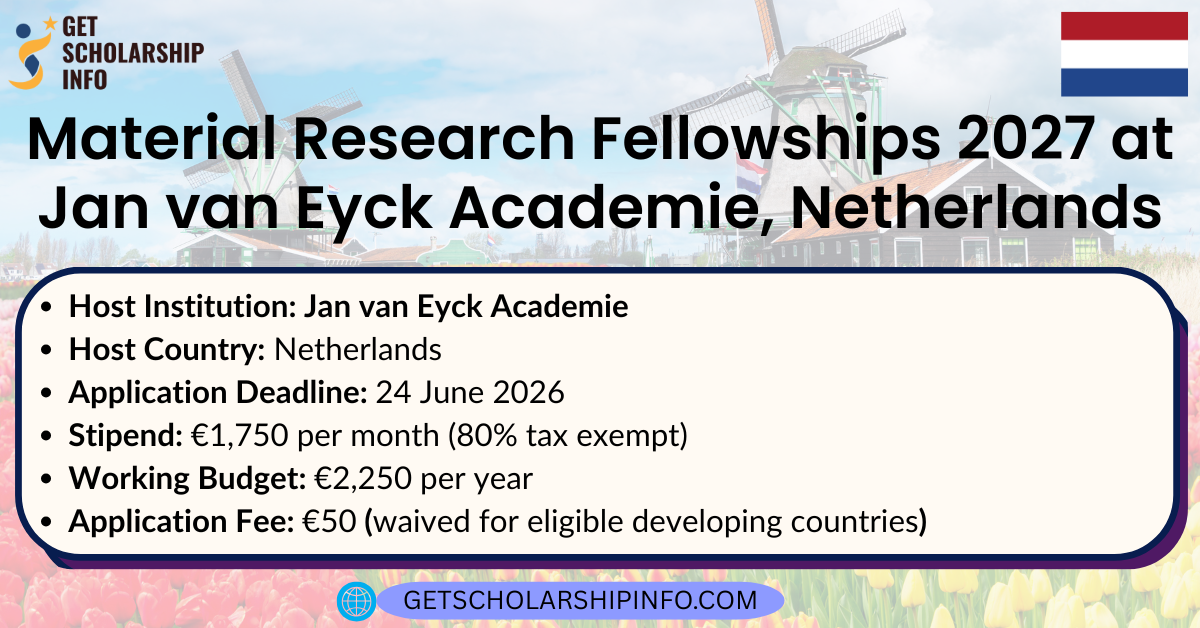
- Host Institution: Jan van Eyck Academie, Maastricht, Netherlands
- Host Country: Netherlands
- Programme: Future Materials, part of Future Threads (co-funded by the European Union)
- Fellowship Duration: 11 months
- Residency Period: 15 January to 15 December 2027
- Application Deadline: 24 June 2026
- Final Selection Announced: Mid-September 2026
- Open to All Nationalities: Yes, international applicants are welcome, though prior Jan van Eyck alumni and certain Rijksakademie or De Ateliers alumni are excluded
- Application Fee: €50, excluding VAT, waived for applicants from Least Developed Countries, Low Income Countries, and Lower Middle Income Countries on the DAC list
- Funding Type: Fully funded, including monthly stipend, working budget, studio, and accommodation
This isn’t a scholarship for classroom study. It’s a working residency built for people who already have a research project in motion and want the space, funding, and expert network to take it further.
What This Fellowship Offers:
The support package here is genuinely comprehensive, covering both the financial and practical sides of what it takes to do serious material research for nearly a year. Selected fellows gain:
- A monthly stipend of €1,750, with 80 percent of it exempt from income tax
- An annual working budget of €2,250 to support materials, testing, and project costs
- A private studio apartment provided as accommodation, which fellows are required to accept
- Full exemption from the academy’s annual enrollment fee
- Direct access to the Jan van Eyck Labs, including the Future Materials Lab, Material Matters, Food, Printing & Publishing, Photography & Audiovisual, and the Library
- Collaboration opportunities with Textile Innovation Maastricht for the Fashion & Textile fellow, or CHILL at Brightlands Chemelot Campus for the Future Materials fellow
- Membership in a working community of roughly 35 artists, designers, curators, and writers, offering daily exchange and peer learning
- Access to the extended Future Threads network, which connects research institutes, schools, companies, and start-ups working on circular and biobased materials across the Maastricht region
- The chance to present finished work at the Jan van Eyck Open Studios 2027
- Inclusion of the completed project in the Future Materials Bank, giving the work lasting visibility beyond the residency itself
What stands out here isn’t just the money, though a tax-advantaged stipend paired with a working budget and free studio housing is a strong package for a research residency. It’s the ecosystem around it. Fellows aren’t working in isolation , they’re plugged into a regional network of labs, companies, and institutions that are all actively pursuing the same circular transition, which means the research produced during these eleven months has a real chance of extending beyond the residency itself.
Eligibility Criteria:
Before applying, check that you meet the following conditions:
- You must have an existing research project already underway in sustainable or biobased materials
- Your project should be relevant to either fashion and textiles, or broader material innovation in arts and design
- You are not eligible if you are a Jan van Eyck Academie alumnus
- You are not eligible if you were previously enrolled as a full-time participant at Rijksakademie or De Ateliers, two other Dutch post-academy institutions
- You must be willing to reside in Maastricht or within a 10km radius for the full duration of the fellowship
- You must be prepared to accept the private studio apartment offered as part of the fellowship, rather than arranging your own housing
- All application materials must be submitted in English
There’s no strict requirement around nationality or academic background here. What matters most is the maturity and direction of your existing project, since these fellowships are designed to deepen work that’s already in progress rather than fund something starting from scratch.
Programmes Available:
Unlike degree-based scholarships, this fellowship isn’t organized around academic majors. Instead, it’s structured around two specific research tracks. The fields eligible for these fellowships are:
- Fashion and Textile Design
- Material Science and Innovation
- Sustainable and Biobased Design
- Arts and Design Research
- Circular Material Practices
Applicants coming from design backgrounds, material science, sustainable fashion, or interdisciplinary creative research are all well positioned to apply, as long as their existing project fits one of the two specific tracks on offer.
Understanding the Two Fellowship Tracks:
Since there are two distinct positions available, it’s worth breaking down what separates them.
The Fashion & Textile Material Fellowship is built for someone already researching sustainable, biobased approaches to fashion or textile materials. The expectation is that the project won’t just look at material innovation in isolation, but will take a systemic view, considering the environmental, cultural, social, and economic dimensions that come with shifting fashion toward more sustainable systems. This fellow will work closely with Textile Innovation Maastricht, gaining access to specialized textile facilities and expertise alongside the academy’s own resources.
The Future Materials Fellowship, on the other hand, has a broader scope. It’s meant to support a project centered on a biobased material or process that could serve as a genuine alternative to toxic or difficult-to-recycle materials commonly used across arts and design, things like epoxy resins, fossil-based polymers, plaster, inks, and pigments. As with the textile track, the project needs systemic depth, factoring in the social and cultural economies tied to a fair and just material transition. This fellow will collaborate with CHILL at Brightlands Chemelot Campus, working alongside other regional partners focused on biobased research.
Both tracks share the same underlying goal: pushing sustainable materials research out of the theoretical and into practices that can genuinely scale.
How to Apply:
The application process is entirely online and requires careful attention to formatting, since incomplete or poorly structured submissions are unlikely to make it through review. Here’s what’s required:
- A single combined PDF, no larger than 10 MB, submitted through the appropriate online registration form
- A motivational letter, maximum 500 words
- A project proposal, maximum 500 words
- Documentation of previous work, no more than 15 pages, with one to two images per page, and nothing older than five years
- A curriculum vitae, no more than two pages
- All materials must be written in English
- Applicants must select the correct form depending on which fellowship they’re applying for, as each track has its own distinct application form
- Any hyperlinks included in the portfolio must be functional and valid, and any required passwords for platforms like Vimeo or YouTube must be clearly provided
- Videos hosted on Vimeo should be rated appropriately for review access
Once the online form is completed, applicants are redirected to PayPal to pay the €50 application fee. If you don’t have a PayPal account and are unable to create one, the academy asks that you reach out directly to their applications team for an alternative. Applicants based in and coming from countries on the DAC list of Least Developed, Low Income, or Lower Middle Income Countries and Territories can have this fee waived entirely.
Selection Timeline:
Given the tight window between application and residency start, it helps to understand exactly how the process unfolds:
- Applications close on 24 June 2026
- Final selection of the two candidates is expected mid-September 2026
- The fellowship period runs from 15 January to 15 December 2027
This means successful applicants have several months between being selected and actually beginning their residency, which offers useful time to prepare, relocate, and plan the early stages of the research work ahead.
Why This Fellowship Is Worth Applying For:
Material research fellowships that combine real funding with lab access, housing, and a built-in professional network are genuinely rare. Most residencies offer one or two of these elements; this one offers all of them together, plus a clear pathway for the finished research to live on through the Future Materials Bank and public presentation at Open Studios.
For practitioners working at the intersection of design and sustainability, the ability to spend eleven months focused entirely on an existing project, without financial strain and with direct access to specialized facilities like Textile Innovation Maastricht or CHILL at Brightlands Chemelot Campus, is the kind of support that can genuinely shift a research project from promising to publication-ready.
Frequently Asked Questions?:
Is this fellowship fully funded?
Yes. Fellows receive a monthly stipend, an annual working budget, free studio accommodation, and exemption from enrollment fees.
How much is the monthly stipend?
€1,750 per month, with 80 percent of it exempt from income tax.
Is there an application fee?
Yes, €50 excluding VAT, though this is waived for applicants from Least Developed Countries, Low Income Countries, and Lower Middle Income Countries listed on the DAC list.
Can international applicants apply?
Yes, though former Jan van Eyck Academie alumni and certain former full-time participants at Rijksakademie or De Ateliers are not eligible.
Do I need to already have a project underway?
Yes. These fellowships are designed to support and deepen an existing research project rather than fund a completely new idea from scratch.
Where will I need to live during the fellowship?
Fellows are required to reside in Maastricht or within a 10km radius, and must accept the private studio apartment provided as part of the fellowship.
What language should application materials be in?
All materials must be submitted in English.
How long does the fellowship last?
Eleven months, running from 15 January to 15 December 2027.
What happens to the research after the fellowship ends?
Completed projects are presented at the Jan van Eyck Open Studios 2027 and included in the Future Materials Bank for continued visibility.
