
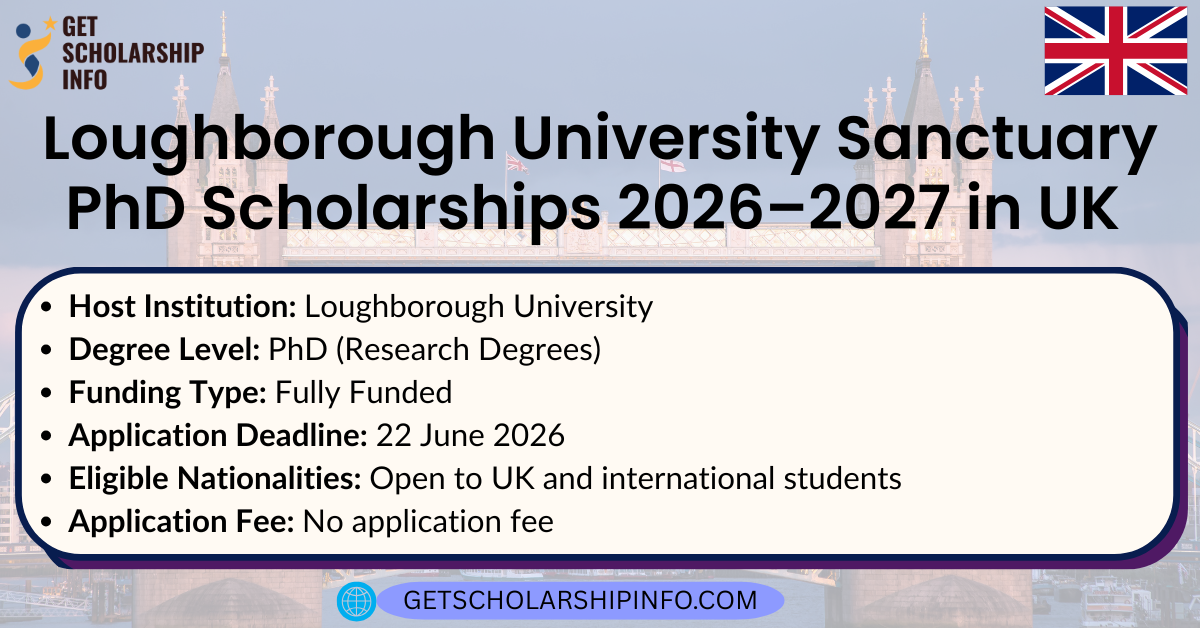
Loughborough University offers a small number of fully funded PhD scholarships each year specifically for asylum seekers, refugees, and other at risk scholars whose education has been disrupted by conflict, persecution, or forced displacement. The scholarship covers 100 percent of tuition fees plus a living stipend set at the UK Research and Innovation rate, currently £21,805 per year, for three years of full time doctoral study.
This is one of the most generous sanctuary scholarships offered by any UK university, and unlike many refugee scholarships that only cover tuition, Loughborough’s version covers both tuition and living costs in full. The most recent application round closed on 22 June 2026 for entry in October 2026, February 2027, or July 2027. Loughborough runs this scholarship annually, so a new round is expected to open for the following academic cycle. Check the official Loughborough funding page directly for the current deadline before applying, and use this guide to understand eligibility and prepare your application in advance.
What the Scholarship Covers:
- 100 percent of PhD tuition fees for the full duration of the programme
- A tax free living stipend at the UKRI recommended rate, currently £21,805 per year, subject to annual increases
- Funding for three years of full time study, with part time study also considered for scholars with specific caregiving or health related needs
- Available for study at either the main Loughborough campus in the East Midlands or Loughborough University London
Candidates are expected to cover their own travel and visa costs where these apply, so it is worth budgeting for that separately even though tuition and living costs are fully funded.
Who Counts as an At Risk Scholar:
Loughborough does not publish one rigid legal definition of an at risk scholar, since the situations that force people to flee their home countries vary widely. Instead, the university uses a framework built around a few key questions when assessing applications:
- Is your home located in a region of conflict or war such that your life, or the lives of your family, would be in danger if you returned
- Are you or your family at risk of imprisonment, injury, or persecution because of your identity, beliefs, or activities
- Have you already been forced to leave your home country, or would you be at serious risk if you attempted to return
In practical terms, the scholarship is open to people who fall into one or more of these immigration categories in the UK:
- Asylum seekers currently awaiting a decision on their application
- Refugees who have already been granted refugee status
- Individuals with humanitarian protection status
- Those with limited or discretionary leave to remain
- Those with indefinite leave to remain who are not yet British citizens
The scholarship is genuinely open across all subject areas at PhD level, not restricted to a specific department or research field.
Before You Apply: You Need a PhD Offer First
This is the step most guides to this scholarship skip, and it is the single most important part of the process. Loughborough requires applicants to already hold a conditional or unconditional offer of study for a PhD programme at the university before they can apply for the Sanctuary Scholarship itself. In other words, the scholarship application is a second, separate step that comes after you have already been accepted onto a research degree.
This means your realistic timeline looks like this:
- Identify a PhD programme and, ideally, a specific supervisor at Loughborough whose research matches your background
- Apply for and secure a conditional or unconditional offer of admission to that PhD programme
- Gather evidence of your circumstances as an at risk scholar, alongside your academic documents
- Submit the Sanctuary Scholarship application referencing your existing offer before the scholarship deadline
Because step one and two can take weeks to complete on their own, at risk applicants should start reaching out to potential supervisors several months before the scholarship deadline, not in the final weeks before it closes.
Academic Requirements:
Alongside proof of your circumstances as an at risk scholar, you will need to demonstrate exceptional academic achievement relative to the opportunities and disruption you have faced. In practice this means:
- A strong undergraduate and, where applicable, Master’s academic record
- English language proficiency, typically an IELTS score of 6.5 to 7.0 or an equivalent recognised test, though Loughborough may consider your circumstances when assessing this requirement
- A research proposal or fit with an existing supervisor’s work, as required for any PhD application to the university
Loughborough explicitly states it evaluates academic achievement relative to opportunity, meaning disrupted education, gaps in formal study, or limited access to resources during conflict or displacement are taken into account rather than counted against an applicant in the same way they might be for a standard PhD application.
How to Apply:
- Confirm your eligibility against the at risk scholar criteria above
- Secure a PhD offer from Loughborough by applying directly to your chosen department or research group
- Prepare supporting evidence of your circumstances, which may include documentation from immigration authorities, refugee status paperwork, or a personal statement describing your situation
- Submit the Sanctuary Scholarship application through the official Loughborough funding page before the deadline
- Monitor your email closely after applying, since the university may request additional documents or an interview
How Loughborough Compares to Other UK Sanctuary Scholarships:
Loughborough is far from the only UK university offering funded places to sanctuary seekers, but its PhD specific scheme stands out for how much it actually pays. Most Sanctuary Scholarships across the UK are aimed at undergraduate or taught postgraduate students, and cover tuition plus a modest grant rather than a full doctoral stipend. Here is how some of the better known schemes compare:
- University of Sheffield offers Sanctuary Scholarships covering full tuition fees plus a £10,300 cash bursary, but this is aimed at undergraduate and taught postgraduate applicants rather than PhD researchers
- Sheffield Hallam University provides a full tuition fee waiver plus a £4,000 grant, also at undergraduate and taught postgraduate level, with a matching 22 June deadline pattern
- University of Salford offers a full fee waiver with a £1,100 bursary, restricted to applicants based in the Greater Manchester area
- SOAS, University of London funds a full tuition waiver plus £12,000 a year in maintenance support, again for undergraduate study
- Article 26 partner universities such as Bristol, Keele, De Montfort, Sussex, and Manchester run a shared scheme covering tuition plus a bursary of up to £15,285, mostly for foundation, undergraduate, and postgraduate taught courses
Set against these, Loughborough’s offer of full tuition plus £21,805 a year for three years of PhD study is one of the most generous sanctuary funding packages in the UK, largely because it is one of the few schemes built specifically around doctoral research rather than taught degrees. If your goal is a research degree rather than an undergraduate or Master’s course, Loughborough is genuinely one of the strongest options to prioritise, though it is worth applying to more than one scheme in parallel since sanctuary scholarships are competitive and place numbers are small at every university offering them.
Organisations like Student Action for Refugees (STAR) and the Displaced Student Portal maintain wider lists of sanctuary funding across UK universities, and are worth checking if you want to apply to several schemes at once rather than relying on a single application.
Frequently Asked Questions?
How much is the Loughborough Sanctuary PhD Scholarship worth?
It covers 100 percent of PhD tuition fees plus a living stipend at the UKRI rate, currently £21,805 per year, for three years of full time study.
Do I need a PhD offer before I apply for this scholarship?
Yes. Loughborough requires a conditional or unconditional offer of admission to a PhD programme before you can submit a Sanctuary Scholarship application. Apply for your PhD place first.
Who is eligible for the Sanctuary Scholarship?
Asylum seekers, refugees, individuals with humanitarian protection, and those with limited, discretionary, or indefinite leave to remain in the UK, provided their education or safety has been seriously disrupted by conflict, persecution, or displacement.
Can I study part time under this scholarship?
Yes, part time study is considered for scholars who have specific needs, such as caregiving responsibilities, though full time study is the standard route.
Is this scholarship open to every subject area?
Yes. The Sanctuary Scholarship is available across all PhD subject areas at Loughborough, not limited to a specific department.
When does the scholarship open next?
The most recent round closed on 22 June 2026. Loughborough runs this scholarship annually, so check the official Loughborough funding page for the next confirmed deadline rather than relying on last year’s date.

How can I get a PhD offer letter
To get a PhD offer letter from Loughborough University, visit their official website and find a supervisor whose research matches your interests. Email them directly with your CV and a brief research proposal. If they agree to supervise you, apply formally through the university’s online application portal. Once accepted, you will receive your offer letter, which you can then use to apply for this scholarship. Good luck!