Uppsala isn’t a city most people associate with global academic prestige, but for scholars working on cultural diversity, heritage, and social structures, the Swedish Collegium for Advanced Study has quietly built one of the more respected residential fellowship programmes in the humanities and social sciences. The Barbro Klein Fellowship Programme is one of four fellowship tracks offered by SCAS, and it’s specifically designed for researchers whose work touches on cultural and social diversity in a global context.
Before going further, it’s worth being upfront: the application window for the 2027-28 academic year has already closed. What follows is a full breakdown of the programme so you understand exactly what it offers, who it’s for, and how the process works, whether you’re planning ahead for a future cycle or simply researching residential fellowships in this field.
Key Details:
- Fellowship Type: Residential Fellowship (Barbro Klein Programme)
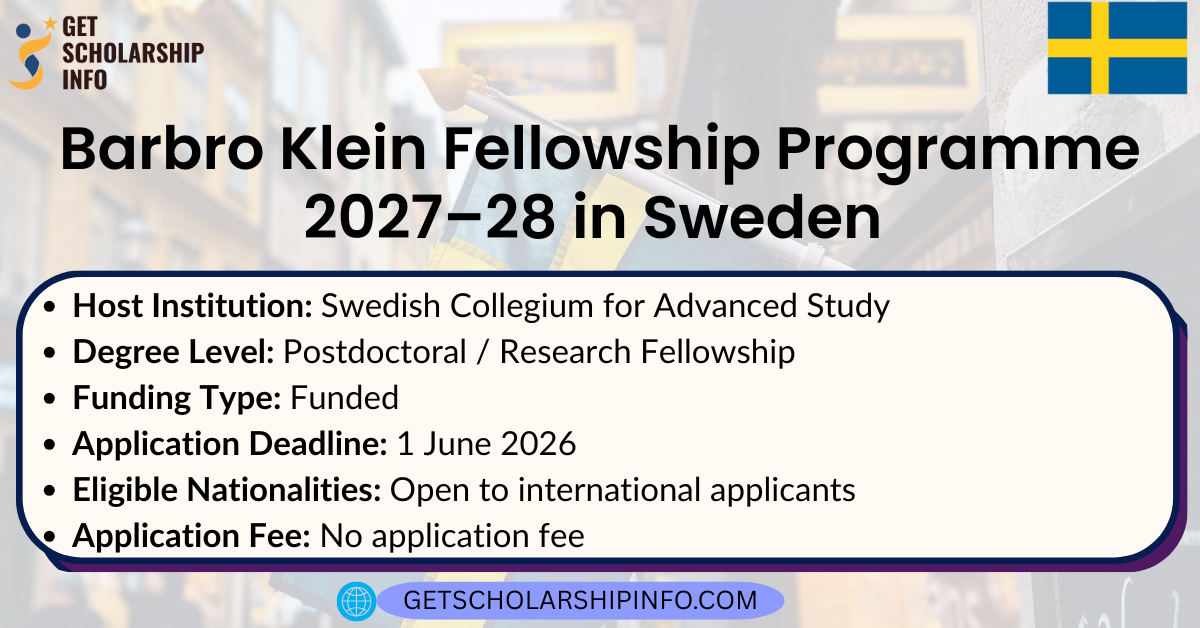
- Host Institution: Swedish Collegium for Advanced Study (SCAS)
- Host City: Uppsala, Sweden
- Host Country: Sweden
- Field of Study: Humanities and Social Sciences, with a focus on cultural diversity
- Fellowship Length: One semester or a full academic year
- Academic Year Covered: 2027-28
- Application Status: Closed for this cycle
- Results Notification: No later than 28 February 2027
- Open to All Nationalities: Yes, international applicants are welcome
- Application Fee: None mentioned
- Funding Type: Salary-based remuneration plus accommodation support, structured according to the applicant’s existing resources
This fellowship isn’t a scholarship in the traditional sense of tuition support for degree study. It’s a residential research fellowship for scholars who already hold a PhD and want dedicated time and space to pursue independent research in a highly collaborative academic community.
What This Fellowship Offers:
The support structure at SCAS is genuinely different from a standard scholarship, so it’s worth explaining clearly what a fellow actually receives:
- A monthly salary, though the exact amount depends on the fellow’s existing circumstances and outside funding sources
- Employment through Uppsala University for the duration of the fellowship, with salaries paid directly and subject to standard taxation
- Provided and paid accommodation for fellows who don’t already live in the Stockholm-Uppsala region, available from the start of the semester
- The opportunity to bring a partner and children under 18, with accommodation arrangements taking family members into account
- Full integration into an intellectual community of fellow scholars across disciplines, with regular offices and access to the Collegium’s academic resources
- A city orientation during arrival week, including a guided tour and staff recommendations for settling into life in Uppsala
- Access to schooling options for children, including an International School with English-language instruction and free tuition
- Freedom from teaching obligations during the fellowship period, allowing complete focus on research
The salary structure is tiered based on what other funding a fellow can bring with them. Those on paid sabbatical leave or with grants covering their salary receive a smaller monthly amount from SCAS, while those without any outside resources receive a higher monthly salary, differentiated further by academic rank, from postdoctoral researchers up to full professors. This system exists because SCAS deliberately encourages fellows to seek sabbatical funding or grants from their home institutions first, reserving its own limited salary funds for those who genuinely need them.
Eligibility Criteria:
To qualify for the Barbro Klein Fellowship Programme, applicants need to meet the following:
- Must have held a PhD, or an equivalent doctoral degree, for at least three years at the time of application
- Must demonstrate a strong track record of independent research achievements beyond the postdoctoral level, including meaningful publications
- Must be active in international academic forums and networks
- Are not required to hold a current university position at the time of application
- Research focus should align with the programme’s emphasis on cultural and social diversity, cultural heritage and creativity, societal structures and public resistance, or varieties of cultural expression in local and global contexts
The programme also explicitly encourages applications from talented younger scholars based in non-Western countries, as well as scholars of underrepresented gender. That said, meeting the encouragement criteria isn’t a requirement , it simply reflects where SCAS would like to see more representation in its fellow cohorts.
One rule worth noting for anyone applying to any SCAS programme: only one application per candidate is accepted across all fellowship tracks. Submitting multiple applications doesn’t improve your chances and may result in SCAS administratively assigning you to a programme rather than letting you choose.
Programmes Available:
While the Barbro Klein Fellowship has its own distinct focus, it sits within a small number of research areas that reflect the humanities and social sciences at large. Relevant fields for this specific programme include:
- Anthropology
- Sociology
- Cultural Studies
- History
- Heritage Studies
- Political Science
- Social Sciences (general)
- Media and Communication Studies
- Global and Area Studies
- Ethnic and Diversity Studies
Applicants working at the intersection of any of these fields, particularly where the research engages with cultural diversity, heritage, or social structures in a global perspective, are well aligned with what this fellowship is built to support.
Understanding the Fellowship Length and Residency Requirements:
One detail that surprises some applicants is just how structured the residency itself is. Fellows can choose to apply for either a single semester or the full academic year, and SCAS has fixed dates for each option:
- Autumn semester runs from 1 September 2027 to 17 December 2027
- Spring semester runs from 11 January 2028 to 16 June 2028
- The full academic year spans 1 September 2027 to 16 June 2028
Once accepted, fellows are expected to actually be present in Uppsala. The rules allow for no more than 10 working days of absence per academic term, on top of a scheduled one-week break in autumn and two breaks during the spring term, a winter break and a longer break around Easter. Teaching commitments, whether remote or in person, at a fellow’s home institution are not permitted during the fellowship period. This is a genuinely immersive residency, not a flexible remote arrangement.
How to Apply:
Even though this cycle’s deadline has passed, understanding the process is useful for anyone planning ahead. Applications are handled entirely through SCAS’s online system, called Varbi, and the process generally involves:
- Creating an account and submitting your application through the Varbi platform
- Selecting the Barbro Klein Fellowship Programme specifically, since applying to more than one SCAS programme is not permitted
- Submitting a description of your proposed research project, with no fixed format required beyond the length limit specified in the official call for applications
- Optionally including up to three letters of recommendation, which must be uploaded directly by the candidate before the deadline, since referees cannot submit them independently
- Optionally including a cover letter, though this is not required
- Ensuring all submitted materials, including any articles, are in English
- Submitting before the stated deadline, since no changes or additions to the application are possible once it closes
All applications are reviewed by the same selection committee, and final decisions rest with the Principal of the Collegium in consultation with a panel made up of long-term fellows. It’s also worth knowing that applications, including personal data, may be shared with external referees outside the EU/EEA as part of the review process.
What Happens After You Apply:
For context on the broader process, applicants for the 2027-28 academic year will be notified of results through Varbi no later than 28 February 2027. If a candidate’s email address changes after submission, updating it in the Varbi account is essential, since that’s the only channel through which results are communicated.
A few other things worth knowing: fellowships cannot be deferred to a later academic year, so if you’re unable to accept an offer, reapplying in a future cycle is the only option. SCAS also does not provide feedback on unsuccessful applications, and once the deadline passes, no new information or documents can be added to a submitted application.
Why This Fellowship Stands Out:
What makes the Barbro Klein Fellowship genuinely distinctive isn’t just the funding structure, it’s the intellectual environment it creates. Fellows aren’t isolated in their research; they’re part of a small, tightly knit community of scholars from a range of disciplines, working alongside long-term fellows and engaging in regular academic exchange throughout their stay. Combined with the practical support around housing, family accommodation, and schooling for children, it’s built to let scholars focus entirely on deep research without the usual logistical distractions of relocating abroad.
For scholars three or more years past their PhD who work on cultural diversity, heritage, or global social structures, and who are looking for a dedicated period of uninterrupted research time, this remains one of the more thoughtfully constructed fellowship programmes available in the field.
Frequently Asked Questions?:
Is the Barbro Klein Fellowship currently open for applications?
No. The application deadline for the 2027-28 academic year has already passed.
Do I need a PhD to apply?
Yes. Applicants must have held a PhD, or an equivalent doctoral degree, for at least three years at the time of application.
Can I apply to more than one SCAS fellowship programme?
No. Only one application per candidate is accepted across all SCAS fellowship programmes.
Is accommodation provided?
In most cases, yes. SCAS provides and pays for accommodation for fellows who do not already live in the Stockholm-Uppsala region.
Can I bring my family with me?
Yes. Partners and children under 18 are welcome to accompany fellows, and housing arrangements take them into account.
Are letters of recommendation required?
No. Letters of recommendation are optional, and applicants can choose to include up to three if they wish.
Can I teach at my home university while I’m a fellow?
No. Fellows are not permitted to have any teaching commitments, remote or in person, during the fellowship period.
When will applicants be notified of results?
No later than 28 February 2027, communicated through the Varbi online application system.
Can I defer my fellowship to a later year if I can’t accept it?
No. Fellowships cannot be deferred. Candidates who are unable to accept an offer are welcome to reapply in a future cycle.
