Introduction:
Early career researchers who’ve finished their PhD often hit the same wall: brilliant ideas, but no independent platform to pursue them without teaching loads, short contracts, or someone else’s research agenda getting in the way. Imperial College London built the Imperial Research Fellowship specifically to remove that wall.
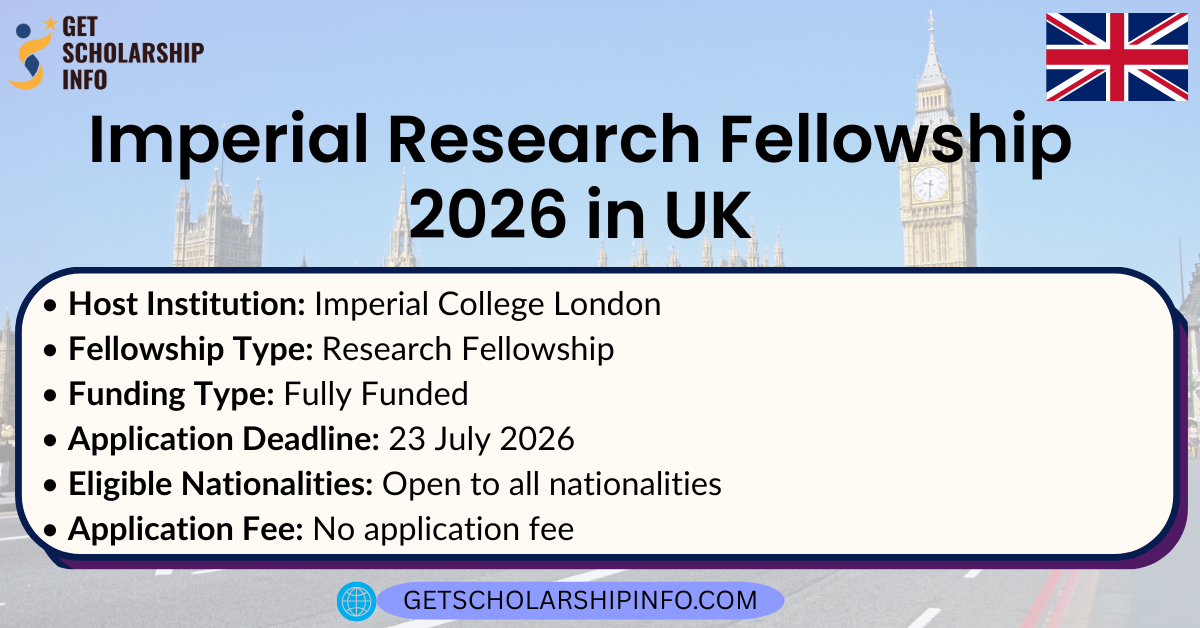
It hands selected researchers four years of protected time, a Research Associate-level salary between £49,017 and £57,472, and up to £45,000 in research and travel funding, with zero obligatory teaching attached. The scheme is open to both UK and international candidates who are within five years of their PhD award and haven’t yet held a lectureship or an intermediate-level fellowship. There’s no fee to apply, and the closing date for the current round is 23 July 2026.
Key Details:
- Fellowship Type: Imperial Research Fellowship (IRF), postdoctoral, non-degree
- Host Institution: Imperial College London
- Host Country: United Kingdom
- Application Deadline: 23 July 2026, 23:59 BST
- Duration: 4 years, fixed
- Start Date Window: Between 1 August 2027 and 1 December 2027
- Salary: £49,017 to £57,472 per year (Research Associate pay grade, 2025/26 rate)
- Research Funding: Up to £30,000 as standard, extendable to £45,000 with justification
- Open to International Applicants: Yes, almost 60% of current fellows hold non-UK nationality
- Teaching Requirement: None, though optional teaching can be arranged
- Application Fee: None
What This Fellowship Offers:
The IRF isn’t structured as a set of tasks to complete; it’s built around what a researcher gains by holding it. Here’s the actual value on the table.
- Four uninterrupted years to build a research identity. Rather than chasing consecutive short contracts, fellows get a fixed four-year runway to develop a body of independent work, something that’s genuinely rare at this career stage.
- A stable, competitive income. Salary is set on Imperial’s Research Associate scale, currently between £49,017 and £57,472 depending on experience, with normal pay progression applied throughout the fellowship.
- Serious money behind the research itself. Every fellow receives research and travel funding, typically up to £30,000, and this can climb to £45,000 when the proposed research genuinely needs it.
- A mentor invested in your growth, not your output. Every fellow is paired with a senior academic sponsor whose role is to support career development and independence, not to direct the research agenda.
- No mandatory teaching pulling focus away from research. Optional teaching or PhD co-supervision can be arranged if a fellow wants it, but it’s never required, which protects the time meant for research.
- A tailored professional development programme. Fellows join the Early Career Researcher Institute’s structured support programme, plus cohort activities designed to build connections across the fellowship community.
- Access to Imperial’s full staff benefits package. This includes generous annual leave, enhanced parental leave of up to 18 weeks at full pay, hybrid working arrangements, and confidential employee support services.
- A credible springboard to bigger funding later. By the end of the fellowship, successful researchers are expected to be ready to compete for advanced schemes like the Royal Society University Research Fellowship, giving the IRF real long-term career value beyond the four years itself.
- Flexibility to work elsewhere temporarily. Fellows can spend up to twelve months total at other institutions or in industry, including overseas, without losing their Imperial-based fellowship status.
Who Can Apply:
Imperial’s eligibility rules are specific, so it’s worth checking each point carefully before investing time in an application.
- Applicants must hold a PhD, and in most faculties, the PhD must already be submitted, with the viva passed before the final selection committee meets on 9 December 2026. Imperial College Business School is the one exception, allowing applications before PhD submission.
- The PhD itself must be formally awarded before the fellowship actually begins, regardless of faculty.
- Candidates need to be within five years of their PhD award date, calculated up to the proposed start date, which must fall between 1 August 2027 and 1 December 2027. Most successful applicants are actually much earlier in that window, typically 0 to 2 years post-PhD.
- Extensions to the five-year limit are considered for legitimate reasons such as parental or sickness leave, a change in discipline, or time spent away from research altogether.
- Researchers who currently hold, or previously held, an early-stage postdoctoral fellowship, such as an EPSRC Postdoctoral Fellowship or a Wellcome Early Career Fellowship, remain eligible.
- Anyone holding, or who has held, a lectureship or an intermediate-level fellowship, such as an EPSRC Early Career Fellowship or an MRC Career Development Award, is not eligible.
- There’s no nationality restriction. Applications are welcomed equally from UK-based and international candidates, and proof of the right to work in the UK is only required before the fellowship starts, not at application stage.
The AI in Science Theme, Supported by Schmidt Sciences:
One detail that sets the current IRF round apart is a dedicated strand co-funded by Schmidt Sciences, aimed at researchers using artificial intelligence to advance work in Natural Science and Engineering. Only six fellowships across the entire cohort will carry this Schmidt Sciences backing, so it’s a narrow but distinct opportunity within the wider scheme.
A few things worth understanding about this theme:
- Deep technical expertise in AI isn’t a prerequisite. The goal is to find strong researchers willing to build AI skills and apply them to disrupt their own scientific field, not to recruit AI specialists exclusively.
- Fellows selected for this theme join a cohort of roughly 25 Eric and Wendy Schmidt AI in Science Postdoctoral Fellows and are based at Imperial’s new I-X Centre for AI in Science at White City.
- Each fellow in this theme gets an academic buddy from the I-X faculty in addition to their regular sponsor, alongside a dedicated Career Development Consultant and Senior Teaching Fellow.
- Selected fellows are expected to build a personal training and career development plan and to design and deliver a two-hour mini course on an AI topic of their choosing.
- There’s a built-in outreach commitment too. Fellows deliver their mini course through either the African Institute for Mathematical Sciences network or the International Centre for Theoretical Physics in Trieste, both of which support researchers across a wide range of fields.
- Some departments only accept IRF applications under this Schmidt Sciences theme, while others accept both general and AI-themed applications without one affecting the odds of the other. It’s worth confirming a department’s specific stance before applying.
Fields and Departments Covered:
The fellowship spans Imperial’s full academic range, structured around four faculties:
- Engineering
- Natural Sciences
- Medicine
- Business School
Because not every department participates in a given round, and some only accept applications tied to the AI in Science theme, applicants should check departmental status directly before committing time to a proposal.
Finding and Working With a Sponsor:
No IRF application can move forward without a sponsor, and Imperial places that responsibility squarely on the applicant.
- Sponsors must be senior, permanent members of Academic or Research staff at Imperial. Honorary staff cannot act as sponsors.
- Each sponsor can only support one application per competition round and can only sponsor one active fellow at a time.
- Part-time sponsors need a second sponsor appointed alongside them to guarantee full-time support for the fellow.
- Interdisciplinary proposals can include multiple sponsors, but one lead sponsor still has to be designated.
- Internal candidates, meaning those already at Imperial, must switch to a new sponsor for the fellowship rather than continuing under whoever supervised their PhD, since the whole point of the scheme is building independence away from prior supervision.
- Sponsors are under no obligation to accept a sponsorship request, and if they decline, they’re not required to explain why.
How to Apply:
The process runs in four distinct stages, and skipping ahead without departmental buy-in is one of the most common reasons applications stall early.
- Find a sponsor and department. Applicants are responsible for identifying their own sponsor and confirming that the relevant department is currently accepting IRF applications.
- Secure departmental approval. Contact the proposed sponsor and department early to confirm support, check for internal deadlines, and get formal departmental sign-off, since no application is accepted without it.
- Submit through Imperial Jobs. Applications go through the Imperial Jobs website under reference NAT02128, with the following documents uploaded as PDFs:
- Section 1: Research Proposal and Budget, including departmental approval
- Section 2: Imperial Sponsor Details
- Research Collaborator letters of support, if applicable
- Francis Crick Institute Co-sponsor Details, if relevant
- An Additional Publications List, if applicable
- Arrange two confidential references. One reference must come from the applicant’s current institution, and if that’s Imperial, it cannot come from the proposed sponsor or host Head of Department. The second should come from someone well positioned to speak to the applicant’s current research abilities. Referees submit these directly to researchfellowships@imperial.ac.uk by 23:59 BST on 23 July 2026, using the file naming format ‘APPLICANT SURNAME_Ref_REFEREE SURNAME’.
A few formatting notes matter more than they might seem to: applications are encouraged to be written in the first person, only electronic or handwritten signatures are accepted (not typed ones), and any application missing a required signature is automatically rejected.
How Applications Are Reviewed:
Imperial runs a three-stage assessment process rather than a single review round.
- Stage 1, Faculty Review Panel. Panels shortlist candidates for interview based on track record and potential, suitability of the sponsor and lab, how much the candidate would benefit from the scheme, communication skills across specialist and general audiences, scientific merit, and alignment with Imperial’s institutional strategy.
- Stage 2, Faculty Interview Committee. Shortlisted candidates present their proposal and are ranked competitively. Faculties may request up to two extra external references at this stage, and a letter of support from the host Head of Department becomes mandatory for anyone advancing further.
- Stage 3, Imperial Research Fellowship Selection Committee. Final decisions are made here, based on how each faculty ranked its candidates.
Imperial is upfront that researchers who’ve already demonstrated clear independence, through a solid track record of external grants and fellowships, are unlikely to succeed, since the scheme exists specifically to support people on the way to independence, not those who’ve already reached it.
Key Dates:
- Application deadline: Thursday 23 July 2026, 23:59 BST
- Faculty Review Panel shortlisting: August to October 2026
- Interviews: November 2026
- Selection Committee meeting: 9 December 2026
- Results announced: December 2026
- Fellowship start window: 1 August 2027 to 1 December 2027
It’s worth noting that fellowship offers cannot be deferred to a future year, so applicants need to be genuinely ready to start within that window before applying.
Contact for Enquiries:
- General IRF enquiries: researchfellowships@imperial.ac.uk
- AI in Science Theme enquiries: Eileen Boyce, Eric and Wendy Schmidt AI in Science Centre Manager, e.boyce@imperial.ac.uk
FAQs?:
Is the Imperial Research Fellowship open to international applicants?
Yes. Almost 60% of current fellows hold non-UK nationality, and proof of the right to work in the UK is only required before the fellowship begins, not when applying.
How much funding does the fellowship provide?
Fellows receive a salary between £49,017 and £57,472 per year, along with research and travel funding of up to £30,000, extendable to £45,000 where justified.
Do I need to have already found a sponsor before applying?
Yes. Applicants are responsible for identifying and securing a sponsor and getting departmental approval before submitting an application; unsupported applications aren’t considered.
Is teaching required during the fellowship?
No. There’s no obligatory teaching, although optional teaching or PhD co-supervision can be arranged with the host department if a fellow wants that experience.
What is the AI in Science Theme?
It’s a Schmidt Sciences-funded strand of the IRF scheme aimed at researchers using AI to advance science or engineering. Only six fellowships across the cohort carry this specific backing.
Can I defer my fellowship start date to a later year?
No. Imperial has confirmed that fellowship offers cannot be deferred, so the start date must fall within the specified window of 1 August 2027 to 1 December 2027.
What happens if my chosen department only accepts AI in Science applications?
If a department only supports the AI in Science theme, applicants will only be funded if their proposal ranks highly enough specifically within that theme, so it’s important to confirm a department’s status before applying.

I had my PhD 30 June 2018
Can I apply?
Based on the information provided, applicants must be within 5 years of their PhD completion date. Since your PhD was awarded on 30 June 2018, you would normally be outside the eligibility window. However, career break extensions may be considered, so it is worth contacting Imperial College London to discuss your specific circumstances.