
Introduction
FCDO Senior Research Fellowship (SRF) Programme 2026, a highly selective paid fellowship that places senior academic researchers directly inside the Foreign, Commonwealth and Development Office (FCDO) , one of the UK’s most important government departments. This is not a scholarship in the traditional sense. It is a paid part-time placement for established academics who want to bring their expertise into real government policy work.
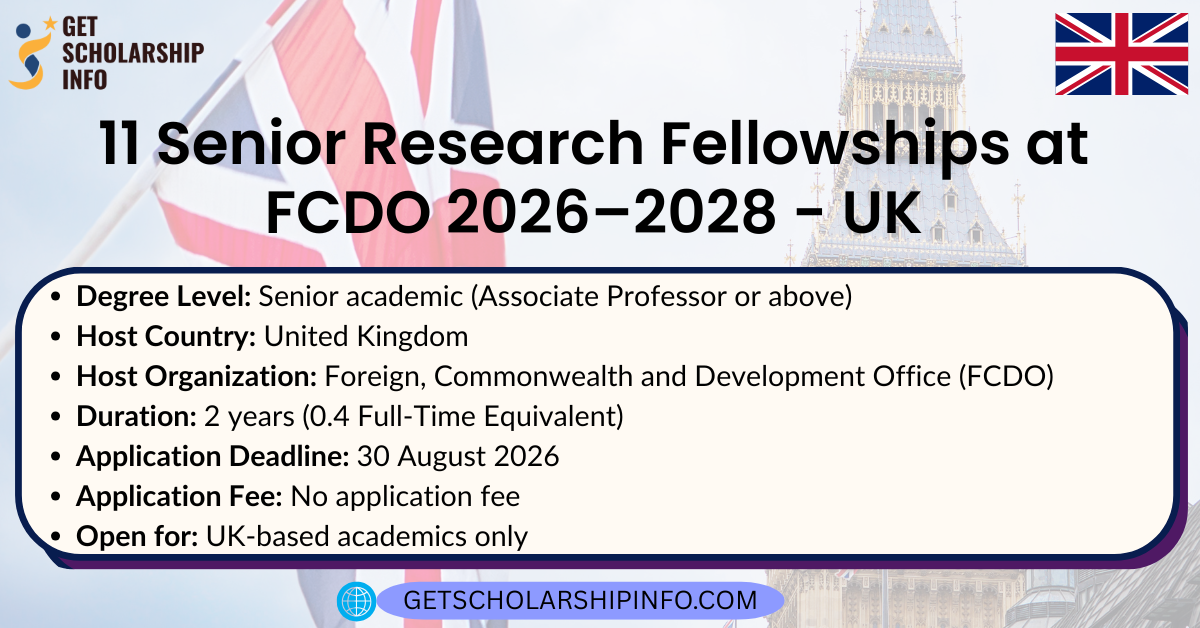
There are eleven fellowship positions available across specific thematic areas including Gender and Equity, Global Health, AI for Development, Conflict, Food and Agriculture, Critical Minerals, and more. Each placement runs for two years at 0.4 FTE , roughly two days per week , meaning fellows keep their university jobs and do this alongside their existing academic roles.
This is a fully funded placement in the sense that your 0.4 FTE salary cost is covered by FCDO through the Research Commissioning Centre (RCC). You do not give up your university employment or salary , the funding arrangement pays your institution to release you for this portion of your time.
The fellowship is open only to academics employed by UK universities or research institutes. It is not open to international applicants outside the UK academic system. There is no application fee. Fellows must be based in London or East Kilbride (Scotland) for in-person days, and security clearance is a hard requirement , not a formality.
The application deadline is 30 August 2026 at 5pm GMT. Applications are reviewed on a rolling basis, so submitting early is genuinely to your advantage. Interviews are scheduled for early October 2026, with fellowships beginning on 1 April 2027.
If you are a senior academic , Reader level, Principal Research Fellow, Associate Professor, or above working in one of the eleven thematic areas and you have ever wondered what it would look like to actually influence UK foreign and development policy from the inside, this programme is built for exactly that.
Key Details:
- Fellowship Name: FCDO Senior Research Fellowship (SRF) Programme
- Commissioning Body: Global Research and Technology Development (GRTD) Research Commissioning Centre (RCC), co-led by 3ie and the University of Birmingham
- Host Organisation: Foreign, Commonwealth and Development Office (FCDO), UK Government
- Host Country: United Kingdom (London or East Kilbride, Scotland)
- Fellowship Type: Paid part-time placement / secondment , not a traditional scholarship
- Number of Positions: 11 fellowships across 11 thematic areas
- Duration: 2 years at 0.4 FTE (approximately 2 days per week)
- Start Date: 1 April 2027
- Funding: Full 0.4 FTE salary cost covered , fellows remain employed by their university throughout
- Open To: Academics employed by UK universities or research institutes only
- Minimum Seniority Required: Associate Professor level or equivalent (Reader / Principal Research Fellow / Grade 9)
- Security Clearance: Required , SC or DV level depending on the specific role
- Application Deadline: 30 August 2026 at 5:00 PM GMT
- Interview Date: Early October 2026
- Application Fee: None
- Application Portal: RCC Grant Management System
What This Fellowship Offers:
This programme is structured differently from most fellowships, and what you gain from it goes well beyond a line on your CV. Here is what accepted fellows actually receive:
Your full 0.4 FTE salary continues to be paid throughout the fellowship. Your university receives funding from FCDO through the RCC to cover the cost of releasing you for two days a week, including employer pension and National Insurance contributions. You are not taking a pay cut. You are not working for free. Your employment contract with your university stays in place the entire time.
Direct access to the highest levels of UK government policy-making. Fellows are embedded inside FCDO teams , not placed in an adjacent think-tank or consultancy relationship, but working within the department itself. This gives you visibility of how policy decisions are actually made, where evidence gaps exist, and how research does or does not translate into government action. That kind of firsthand understanding is something you simply cannot get from the outside.
Your research gets real policy traction. One of the most frustrating things for academics working on development, conflict, health, or climate issues is producing excellent research that never reaches decision-makers in a useful form. Being inside FCDO means your analytical work directly informs programme design and policy priorities. Your expertise shapes how the UK government commissions research and responds to global challenges.
You build a genuine government network. Over two years, you work alongside FCDO staff, policy leads, and research commissioners across multiple teams. These connections have lasting value , for future research partnerships, for policy impact case studies in REF submissions, and for understanding how to make your academic work more relevant to the people who actually implement it.
Travel costs to FCDO offices are covered. Fellows are expected to attend an FCDO office at least once a month. Reasonable travel costs are included in the budget agreed at the time of award. In exceptional cases where later stays are required, accommodation and subsistence costs are also covered.
Flexibility in how your time is structured. The 0.4 FTE commitment is applied with flexibility in agreement with your FCDO team. While regular in-person presence is expected, the hybrid working arrangement means you are not commuting to London or East Kilbride every week.
A unique credential for your academic career. Very few researchers get the chance to work embedded in a major government department. Whether you are building an impact case, positioning yourself for senior leadership roles, or developing a research agenda that speaks to real-world policy needs, this fellowship gives you something that no grant or publication alone can provide.
Eligibility Criteria:
This fellowship has specific and non-negotiable eligibility requirements. Read these carefully before investing time in an application.
Academic seniority:
- You must be at Associate Professor level or equivalent at minimum. In UK university terms this typically means Grade 9, Reader, Principal Research Fellow, or Senior Research Fellow at the upper end of the scale
- Your role should involve substantial research leadership and autonomy , not primarily supporting others’ programmes
- Indicators of the right level include: leading or having led significant research programmes, editorial or advisory roles in your field, recognition as a leader or emerging leader in your thematic area, and the ability to represent your institution at senior external forums
- You do not need the exact title “Associate Professor” , but you need to clearly demonstrate you are operating at that level or above. If your job title is different, make the case explicitly in your application
Employment:
- You must be currently employed by a UK university or research institute
- You will remain an employee of your institution throughout the fellowship , FCDO does not employ you directly
- Your institution must approve the application and sign off on the proposed budget
Security clearance:
- This is a hard requirement. The fellowship offer is conditional on obtaining the relevant security clearance
- The level of clearance depends on the specific thematic area you apply for , check the individual job description for your chosen area
- Security Clearance (SC) level: You must have been physically present in the UK for at least 2 of the last 5 years
- Developed Vetting (DV) level (required for more sensitive roles): You must have been physically present in the UK for at least 5 of the last 10 years
- Holding a UK bank account or postal address does not count , physical residency is what matters
- SC clearance typically takes 2 to 3 months to process; DV clearance can take 3 to 6 months. Plan accordingly , if you cannot obtain clearance, the fellowship offer will be withdrawn
Previous fellows:
- If you have previously held an FCDO fellowship, you must have a gap of at least 12 months between the end of your previous placement and the start of this one. All eligibility criteria apply regardless of prior participation
Thematic Areas ; Available Fellowship Positions:
There are eleven fellowships available, one per thematic area. Each has its own job description with specific requirements for that area. You apply to a specific thematic area, not to a general pool.
- Gender and Equity
- Conflict
- AI for Development
- Food and Agriculture
- Economic Development
- Systemic Resilience of Combined Human (Social, Economic, Political) and Ecological Systems
- Hybrid and Transnational Threats
- Polar Regions
- Critical Minerals
- Technology, Geopolitics and Information Manipulation
- Global Health
What the Role Actually Involves Day-to-Day:
It is worth being clear about what this fellowship is and is not. This is not a traditional research role where you design studies, collect data, and write papers. It combines policy advisory work with research engagement inside a government department.
In practice, this means fellows work within FCDO teams to provide high-level, evidence-informed advice on their thematic area. You help shape how FCDO commissions and uses research, translate academic findings into formats that are useful for policy and programme decisions, and produce rapid analytical outputs when the department needs expert input quickly.
You also draw on your academic and professional networks to connect FCDO with relevant expertise outside the department, and you contribute to building research capacity within FCDO over time. This is advisory and engagement work, not independent research. If that combination appeals to you , and for the right kind of senior academic it genuinely does , the fellowship is an unusual and valuable opportunity.
The working pattern is hybrid. You are expected to attend an FCDO office (London or East Kilbride) at least once per month, and potentially more frequently depending on the team’s needs. The remaining time can be done remotely, with the schedule agreed flexibly with your team.
How to Apply:
The application process has several components and requires institutional involvement from the start. Do not leave this to the last minute.
Step 1 — Read the job description for your thematic area. Each of the eleven areas has its own detailed job description on the GRTD website. The requirements vary between areas. Before anything else, download and read the description for your chosen field.
Step 2 — Get your institution on board. You need institutional approval and sign-off for both the application and the budget. This takes time. Speak to your research office or finance team early , they need to prepare the budget using your institution’s standard costing methodology (most UK HEIs use TRAC).
Step 3 — Prepare your budget. Your budget covers four cost lines for each year of the fellowship: salary (0.4 FTE including employer on-costs), estates and indirect costs (calculated using your institution’s standard rates), and travel to FCDO offices. Budget templates are provided through the RCC Grant Management System. There are no fixed cost limits beyond the overall funding envelope, but all costs must comply with FCDO eligible cost guidance and full justification will be required.
Step 4 — Complete the application on RCC GMS. The application is submitted through the RCC Grant Management System. A user guide is available on the GRTD website. You will need to submit:
- Completed application form via the RCC GMS portal
- Your CV
- A budget for the full duration of the fellowship, prepared with your institution
Step 5 — Submit before the deadline. Applications close 30 August 2026 at 5pm GMT. Applications are reviewed on a rolling basis , earlier submission is better. Do not wait until the final days.
Important salary note: If your salary is above the Senior Civil Service Pay Band 2 minimum (currently above £100,000), Civil Service Commission approval is required before any offer can be made. RCC will request salary details from candidates after interview to determine whether this applies.
For any questions about the opportunity, email rcc@3ieimpact.org with the subject line “Senior Research Fellow Request for Clarification.”
The Security Clearance Process — What You Need to Know Before Applying:
Security clearance is the part of this process that catches people off guard. It is not a routine step , it is a genuine condition of the fellowship, and if you cannot obtain it, the offer is withdrawn regardless of how strong your application was.
The level of clearance required depends on the specific thematic area. Some roles require standard Security Clearance (SC), others require Developed Vetting (DV), which is a more intensive process used for more sensitive positions. The individual job description for each thematic area specifies which level is needed.
Processing times matter here because of the April 2027 start date. SC-level clearance typically takes two to three months. DV-level clearance can take three to six months. Given that interviews are in early October 2026, the clearance process would need to run from roughly October 2026 through to early 2027 at the latest. Build this into your planning.
Residency in the UK means physical presence , not registration, not a bank account, not a postal address. The checks are carried out in the UK and require verifiable records of your actual presence during the relevant period. If you have spent significant time outside the UK in recent years, check the residency requirements for your specific clearance level carefully before applying.
The Selection Process ; From Application to Award:
Understanding how selection works helps you prepare a stronger application.
Applications are reviewed on a rolling basis from the moment the call opens. This means early applications may be reviewed and shortlisted before the deadline closes. The top four candidates per thematic area who best demonstrate the required qualifications, relevant skills, and essential criteria are invited to interview.
Shortlisted candidates are told the outcome of the shortlisting process and given a proposed interview date. If that date does not work, alternative dates can be proposed. Depending on the thematic area, you may be asked to prepare a short presentation as part of the interview. Results are communicated after all interviews for that area are completed.
After the interview, the successful candidate confirms acceptance. The budget is reviewed , RCC may request clarifications on specific costs. A draft fellowship agreement is shared with the successful candidate’s institution for review. Once security clearance is obtained and all approvals are in place, the agreement is signed and the fellowship is formally awarded.
Frequently Asked Questions (FAQs)?:
Who is this fellowship open to? Can researchers outside the UK apply?
No. This fellowship is exclusively for academics currently employed by a UK university or research institute. Researchers based outside the UK are not eligible. You must remain an employee of your UK institution for the entire duration of the fellowship.
Do fellows keep their university salary and job during the fellowship?
Yes. Fellows remain employed by their academic institution throughout. The 0.4 FTE cost ; including salary, pension, and National Insurance contributions , is covered by FCDO through the RCC agreement. You do not lose your university employment or benefits.
What does 0.4 FTE actually mean in practice?
It means roughly two days per week. The exact schedule is agreed flexibly with your FCDO team, but this is the committed portion of your working time that goes to the fellowship. You continue your normal academic work for the remaining 0.6 FTE.
Is security clearance really a hard requirement, or can it be waived?
It is a hard requirement. If you cannot obtain the required level of clearance, the fellowship offer will be withdrawn. There is no waiver or alternative process. The specific clearance level needed depends on your chosen thematic area , check the individual job description before applying.
Can I apply for more than one thematic area?
The application process asks you to apply for a specific thematic area. If you have strong expertise across more than one area, review each job description and determine where your fit is strongest. Submitting multiple applications for different areas is not explicitly prohibited, but your application should be tailored to the specific role.
What happens to my application budget if I am shortlisted?
Shortlisted candidates have the opportunity to refine their budgets in discussion with RCC, FCDO, and their institution. Final costs are agreed before the award is made. The budget template is provided through the RCC GMS portal, and all costs must follow your institution’s standard methodology and comply with FCDO eligible cost guidance.
Can someone who previously held an FCDO fellowship apply again?
Yes, but only if at least 12 months have passed since the end of their most recent FCDO fellowship placement. All eligibility criteria apply regardless of prior participation , previous fellowship experience does not give any automatic advantage or bypass any requirement.
What is the difference between SC and DV clearance, and how do I know which one I need?
SC (Security Clearance) requires you to have been physically present in the UK for at least 2 of the last 5 years. DV (Developed Vetting) is a more intensive process used for more sensitive appointments and requires physical UK presence for at least 5 of the last 10 years. The specific level required for each fellowship is stated in the individual thematic area job description — read it carefully before applying.
