
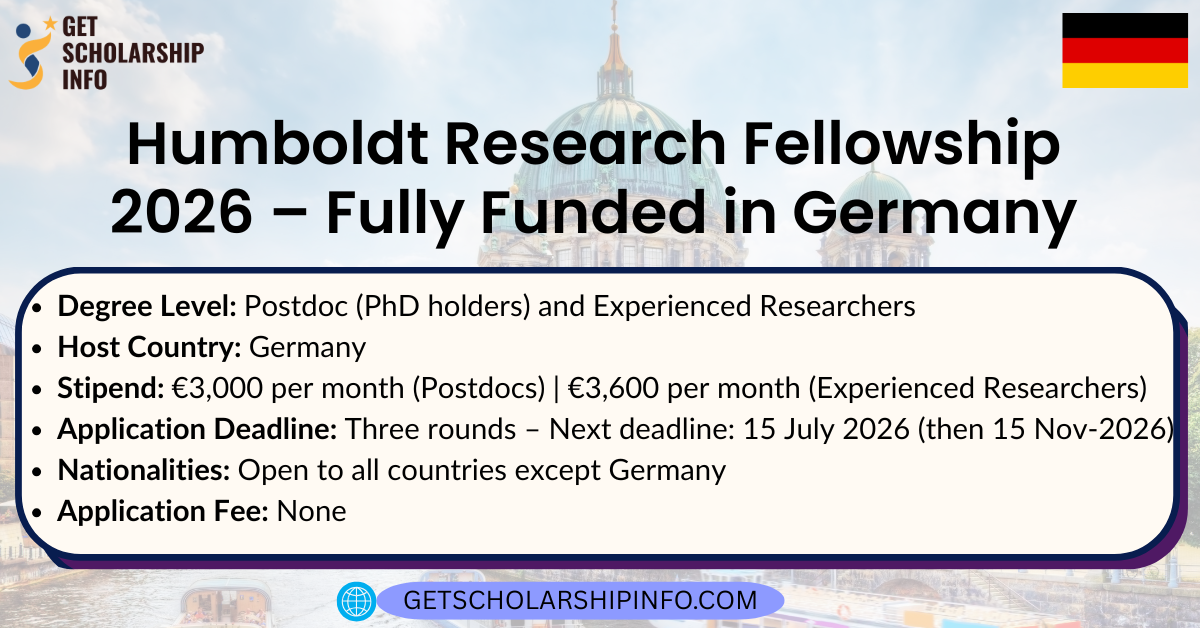
The Fellowship at a Glance
If you are a postdoctoral researcher or an experienced academic looking to spend serious time doing independent research in Germany, the Alexander von Humboldt Research Fellowship is one of the most well-regarded opportunities in the world for exactly that. It is open to researchers of all nationalities (excluding German nationals conducting research in their home country), from all academic disciplines, and at two different career stages , postdoc and experienced researcher.
This is a fully funded fellowship in the most meaningful sense. You receive a monthly stipend, family and travel allowances, health insurance support, and even a language course before you start. There is no application fee. You choose your own research topic, pick your own host institution in Germany, and design your own research plan. The Humboldt Foundation supports you financially and personally while you carry it out.
The next call opens on 15 July 2026 for a selection meeting in March 2027, with fellowships starting as early as May 2027. There are three calls per year, each capped at 800 applications , once the cap is hit, the round closes. The current call for March 2026 has already reached its maximum, so the July 2026 call is the next available window.
Acceptance rates run at roughly 20 to 25% of submitted applications ; competitive, but not impossibly so, especially if your publications are strong and your research proposal is focused and well-argued.
Key Details:
- Fellowship Name: Alexander von Humboldt Research Fellowship
- Offered By: Alexander von Humboldt Foundation (Germany)
- Funded By: Federal Ministry of Research, Technology and Space (Germany), as part of the Global Minds Initiative Germany
- Host Country: Germany
- Open To: Researchers of all nationalities worldwide , excluding German nationals for their own country (researchers from all non-German countries are eligible)
- Career Level: Postdoctoral researchers and experienced researchers
- Fields of Study: All academic disciplines , no restriction
- Fellowship Type: Fully funded research fellowship
- Monthly Stipend (Postdocs): €3,000 per month plus additional benefits
- Monthly Stipend (Experienced Researchers): €3,600 per month plus additional benefits
- Duration (Postdocs): 6 to 24 months, split into up to three stays within three years
- Duration (Experienced Researchers): 6 to 18 months, split into up to three stays within three years
- Application Fee: None
- Next Call Opens: 15 July 2026
- Selection Meeting (July call): March 2027
- Earliest Fellowship Start (July call): May 2027
- Application Cap Per Round: 800 applications , round closes once cap is reached
- Acceptance Rate: Approximately 20–25% of submitted applications
- Application Method: Online only via the Humboldt Foundation portal
What the Humboldt Research Fellowship Actually Gives You:
This is one of those fellowships where the full picture is better than most people realise when they first come across it. Here is everything you receive as a Humboldt fellow:
A monthly stipend that covers real living costs in Germany. Postdocs receive €3,000 per month and experienced researchers receive €3,600 per month. These are not small amounts ; they cover rent, food, transport, and day-to-day expenses in Germany comfortably, including in larger cities like Munich, Frankfurt, or Berlin.
Family support that recognises you have a life outside research. If you have a partner or children, Humboldt provides additional financial support. A monthly allowance is available for partners who accompany you, and child allowances are provided for dependent children. The foundation also covers a subsidy for private full health insurance, which in Germany is a significant cost for people not in the standard public insurance system.
Travel expense allowances for getting to and from Germany at the start and end of your fellowship, and potentially for any required travel during your research stay.
A free intensive German language course for both you and your partner before your fellowship begins. Even if your research is conducted in English , which is perfectly fine for most disciplines , the language course gives you and your family a foundation for daily life in Germany that makes the whole experience much more manageable.
Complete freedom in choosing your research topic and host. This is one of the most distinctive features of the Humboldt fellowship compared to many others. You are not assigned a project or a supervisor. You approach a host institution and researcher in Germany yourself, develop your own research proposal, and apply with that plan already in place. The research is yours from the start.
Flexibility in how and when you take the fellowship. The fellowship period can be divided into up to three separate stays within three years, which gives you significant scheduling flexibility , useful if you are balancing teaching commitments, family responsibilities, or field research that takes you elsewhere.
Personal support from the Humboldt Foundation throughout your stay. This is not just financial , the foundation provides active individual support during your fellowship period, connecting you with other fellows, assisting with administrative matters, and helping you navigate life and research in Germany.
Alumni membership and long-term benefits after your fellowship ends. Once a Humboldtian, always a Humboldtian. The foundation maintains contact with its alumni for life. Return fellowships, later visits to Germany, and research collaboration support are all available through the alumni programme. The Humboldt network is genuinely one of the most active and valuable research alumni communities in the world , over 30,000 scholars across more than 140 countries.
Research cost subsidies for your host institution. Your host in Germany can also apply for a subsidy towards the costs of hosting you and supporting your research. This matters because it makes hosts more willing to take on Humboldt fellows , the financial burden of hosting is reduced.
Eligibility Criteria:
The fellowship is designed for two distinct groups of researchers. Read both carefully to understand which category applies to your career stage.
Postdoctoral Researchers ; you qualify if:
- You completed your doctorate (or an equivalent academic qualification) within the last four years before the selection meeting date
- Or you will complete your doctorate before the selection meeting and can already provide a written summary of your findings
- You have publications in academic journals or with publishing houses that are reviewed according to international standards
- You are not a German national conducting research in Germany (there are separate programmes for that)
Experienced Researchers ; you qualify if:
- You completed your doctorate within the last twelve years before the selection meeting date
- Your academic profile includes an extensive publication record, with important papers in which you served as thematic lead
- You hold a leadership role appropriate to your career level , this includes positions like assistant professor, lecturer, head of an independent research group, or any higher-level position
Special rule for researchers in countries where doctorates are uncommon: If a doctorate is not standard or possible in your field or country, you can apply up to 16 years after completing your master’s or other postgraduate degree, provided your publication record reflects your career level.
What disqualifies you:
- You have already received direct sponsorship from the Humboldt Foundation (a research fellowship or an award) ; if so, you are redirected to their alumni programmes, not this one
- You are a German national applying to research in Germany
- Your application documents are significantly incomplete or do not follow Humboldt’s formatting specifications , these are formally rejected without review
- For the postdoc category: your doctorate was completed more than four years before the relevant selection meeting date
General requirements that apply to both categories:
- You must abide by the rules of good scientific practice and principles of scientific ethics
- You must have a confirmed host at a German research institution who provides a detailed statement and confirmation of research facilities
- You must have two expert reviews submitted on your behalf
- Language requirements depend on your specific research plans (German may be required for certain fields or approaches; many fellows work in English)
Fields and Research Areas Covered:
There are no field restrictions. The Humboldt Research Fellowship is open to researchers across all academic disciplines. Some of the broad areas where fellows regularly work include:
- Natural Sciences (Physics, Chemistry, Biology, Earth Sciences)
- Mathematics
- Computer Science and Informatics
- Engineering and Technology
- Medicine and Health Sciences
- Life Sciences and Biochemistry
- Environmental Sciences and Climate Research
- Social Sciences
- Economics and Business
- Law
- Political Science and International Relations
- History
- Philosophy
- Literature and Linguistics
- Cultural Studies
- Archaeology
- Psychology
- Education and Pedagogy
- Agriculture and Food Sciences
- Materials Science
- Astronomy and Astrophysics
- Neuroscience
- Biotechnology
The Three-Call System , How the Application Calendar Works:
This is something many applicants do not understand at first, and getting the timing wrong means you could miss your window entirely.
The Humboldt Foundation runs three selection rounds per year. Each round opens approximately eight months before the corresponding selection committee meeting. Once 800 applications are received in a given round, that round closes , even if the official opening period has not technically ended. The current round (opened 15 March 2026) has already hit its cap.
Here is the schedule for the remaining 2026 calls:
The July 2026 call opens on 15 July 2026. It feeds into a selection meeting in March 2027, with the earliest possible fellowship start date of May 2027.
The November 2026 call opens on 15 November 2026. It feeds into a selection meeting in July 2027, with the earliest fellowship start of September 2027.
The practical consequence of the cap system is this: if you are ready to apply when a round opens, submit early. Waiting until you think the deadline is approaching and then discovering the round already closed is a frustrating situation that happens to applicants every cycle.
Also important: if you start an application before a round closes but cannot submit in time, you can save your work and continue building the application , but you cannot submit it until the next round opens. This means your career-stage eligibility will be checked based on the date your complete application is actually received.
Required Application Documents ; What You Need Before You Start:
The Humboldt Foundation is strict about completeness and formatting. Applications that are missing documents or that do not follow specifications are formally rejected without review. Prepare everything before you begin submitting.
Here is the full list of what you need to upload:
- Curriculum vitae ; maximum two pages
- Research outline ; maximum five pages
- Complete list of publications (following the Humboldt sample list format exactly)
- List of selected key publications (following the sample format)
- Actual copies of your key publications
- Doctoral certificate, or proof of successful completion, or written confirmation that you will complete your doctorate before the selection meeting date
- German language certificate if required for your research
- Publisher’s acceptance notifications and/or acknowledgements of receipt for publications not yet available, plus summaries or translations of key publications not available in German or English (if applicable)
- Two expert reviews , these must be uploaded directly by your expert reviewers through a protected area of the portal. You cannot submit your application until these are in place (if the portal is open at the time)
- A detailed statement from your host in Germany confirming research facilities , your host uploads this separately after you submit your application. Your application is not forwarded to the Foundation until the host has uploaded all required documents
That last point about the host is worth flagging clearly. After you submit, your host receives a link giving access to your application documents and the upload area for their statement. The Foundation does not receive your complete application until the host finishes their part. This means you need to coordinate your submission timing with your host , do not submit at the last minute and then expect your host to turn around their statement immediately.
How to Apply ; Step by Step:
Step 1 — Find a host in Germany first. Before you do anything else, identify the German research institution and the specific researcher you want to work with. Reach out, discuss your research ideas, and secure their agreement to host you. Without a confirmed host, you cannot complete your application. Choose your host based on genuine scientific fit , the quality of the host statement matters to the selection committee.
Step 2 — Develop your research proposal. Write a focused, clear, and feasible research outline of up to five pages. This is the heart of your application. The selection committee evaluates the originality and innovative potential of your proposed research, so a vague or overambitious proposal will damage an otherwise strong application. The research must be viable at your chosen host institution within your requested fellowship period.
Step 3 — Arrange your two expert reviews early. Your expert reviewers upload their assessments independently through a protected portal area. Give them plenty of notice , waiting until the last week and then expecting two expert reviewers to drop everything is unrealistic. If their reviews are not uploaded, you cannot submit.
Step 4 — Prepare all your documents to specification. Pay particular attention to the publication list format. The Humboldt Foundation provides sample lists , use them exactly. Deviations from the specified format are grounds for formal rejection without review.
Step 5 — Submit your application online through the Humboldt Foundation’s application portal. Applications are only accepted online — no paper or email submissions. If you have questions before submitting, contact the Foundation at info@avh.de.
Step 6 — Your host uploads their statement. After your submission, your host receives an automatic link to upload their confirmation and statement. Keep in contact with them and make sure they complete this promptly. Your application is not passed to the Foundation until this step is done.
Step 7 — Wait for confirmation and the selection timeline. After the Foundation receives your complete application, there is a formal eligibility and completeness check lasting 4 to 8 weeks. If you pass, your application goes to expert review (typically 3 to 6 months), then to the selection committee. You and your host receive notification of the outcome approximately five weeks after the selection meeting.
What Happens After Selection:
If your application is approved, grant documents are issued approximately four weeks after the selection meeting. Your fellowship can start no less than two months and no more than twelve months after the selection meeting date , giving you meaningful flexibility in planning your move to Germany. If a language course is required, it takes place before your fellowship start date.
If your application is rejected, you can request information on the factors that led to the decision by emailing the Foundation informally. You can reapply, but if your application was unanimously rejected, you must wait a minimum of 18 months before submitting again. A reapplication is only worth doing if you have made significant improvements to the aspects that led to rejection the first time.
Decisions cannot be formally appealed.
Frequently Asked Questions (FAQs)?:
Can researchers from any country apply for the Humboldt Research Fellowship?
Almost any country. The fellowship is open to researchers of all nationalities from across the globe. The only general exclusion is German nationals applying to conduct research within Germany , there are separate Humboldt programmes designed for that scenario. Researchers from Brazil should specifically check the CAPES-Humboldt Research Fellowship first; if not eligible there, they can apply to the standard programme.
Is there an age limit for the Humboldt Research Fellowship?
No. There is no age limit. Eligibility is defined by how many years have passed since you completed your doctorate , four years for postdocs and twelve years for experienced researchers , not by your age.
What is the difference between the postdoc fellowship and the experienced researcher fellowship?
The postdoc fellowship is for researchers who completed their doctorate within the last four years and are at the earlier stages of their independent academic career. The experienced researcher fellowship is for those who completed their doctorate within the last twelve years, have a substantial publication record where they led the research, and hold a senior position such as assistant professor, lecturer, or head of a research group. The experienced researcher fellowship also carries a higher monthly stipend (€3,600 versus €3,000).
Do I need to speak German to apply or to conduct research as a Humboldt fellow?
Not necessarily. Many fellows conduct their research in English, which is the working language in most scientific disciplines internationally. Whether German is required depends on your specific research area and methods. A free intensive German language course is provided for you and your partner before the fellowship begins regardless, which is useful for daily life even if not for your research itself.
What is the acceptance rate for the Humboldt Research Fellowship?
The Foundation states that approximately 20 to 25% of submitted applications are approved. This varies slightly between selection rounds and disciplines, but it means roughly one in four or five applicants is successful. Strong publications, a focused research proposal, a credible and enthusiastic host, and thorough application documents are the most important factors.
Can I apply if I have already received a Humboldt Fellowship or award in the past?
No. If you have already received direct sponsorship from the Humboldt Foundation , either a research fellowship or a Humboldt award , you are not eligible to apply for this programme again. Instead, the Foundation’s alumni programmes are available to you, which include return fellowships and other forms of continued engagement.
What happens if the application round closes before I finish my application?
If the cap of 800 applications is reached before you submit, you can save your in-progress application and continue working on it, but you cannot submit it until the next call opens. When you eventually submit in the next round, your career-stage eligibility (the four-year or twelve-year post-doctorate window) will be assessed based on the date your complete application is received in that subsequent round.
How long does the full process take from application to fellowship start?
From the date you submit a complete application, expect roughly 4 to 8 weeks for the formal check, then 3 to 6 months for expert review and the selection committee meeting. After a positive decision, grant documents take about four weeks to issue, and your fellowship must start within twelve months of the selection meeting. Realistically, from submission to arriving in Germany, the total process takes somewhere between 9 and 18 months depending on the round you apply in.
Postdoc
Yes, this fellowship is open to postdoctoral researchers. If you have completed your PhD within the last 4 years and can secure a host researcher in Germany, you may be eligible to apply.