Introduction
Seoul National University is one of the most respected universities in Asia, and every year it opens its doors to international students from around the world. For the 2027 Spring semester, SNU is accepting applications from international students for both undergraduate and graduate programmes. Whether you want to study engineering, medicine, business, arts, or natural sciences, there is likely a programme here that fits your goals.
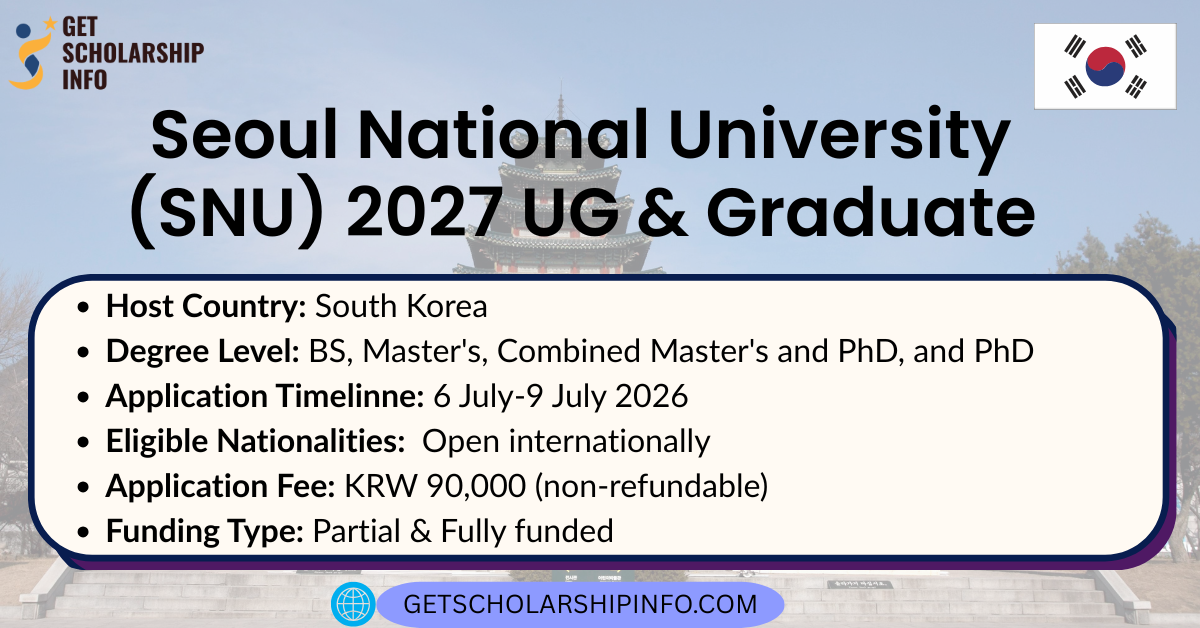
Applications are now open for the SNU 2027 Spring International Admissions. The application window is very short — it runs from 6 July 2026 to 9 July 2026 only — so if you are interested, you need to start preparing your documents right now. The online application fee is KRW 90,000 (roughly USD 65–70), which is non-refundable.
This is not a fully funded scholarship programme on its own, but SNU does offer two separate scholarship programmes that international students can apply for at the same time as their admission application. The Graduate Scholarship for Foreign Students (GSFS) covers full tuition for up to two years plus a monthly living stipend. The SNU President Fellowship (SPF) is even more generous and covers tuition, living costs, airfare, health insurance, and more — but it is only for PhD applicants who are currently teaching at a university in a developing country.
Both scholarships are only available under International Admission Type I, which means the applicant and both parents must all hold foreign (non-Korean) citizenship. Students who do not qualify for a scholarship can still apply for admission and pay the tuition themselves. Tuition at SNU is relatively affordable compared to universities in the UK, US, or Australia, ranging from around KRW 3.2 million to KRW 6.1 million per semester depending on the field.
The admissions process is open to students of all nationalities. SNU evaluates applicants based on their academic record, language proficiency, personal statement, study plan, and recommendation letters. There are no written entrance exams in most cases, though some specific departments may conduct interviews or practical tests.
Key Details:
- Degree Level: Undergraduate, Master’s, Combined Master’s and PhD, and PhD
- Host Country: South Korea
- Host University: Seoul National University (SNU), Seoul
- Application Opens: 6 July 2026 at 10:00 AM (Korea Standard Time)
- Application Deadline: 9 July 2026 at 5:00 PM (Korea Standard Time)
- Recommendation Letter Deadline: 10 July 2026 at 5:00 PM (Korea Standard Time)
- Final Results Announced: 20 November 2026
- Semester Start: Spring 2027 (enrollment from December 2026 – February 2027)
- Open to All Nationalities: Yes — students from any country can apply
- Application Fee: KRW 90,000 (non-refundable)
- Funding Type: Partial (tuition-only for most students) — Full funding available through GSFS and SPF scholarships for eligible Type I applicants
- Language of Instruction: Korean (most programmes) and English (select programmes — confirm with individual departments)
What This Opportunity Offers:
Studying at Seoul National University gives you much more than just a degree. Here is what you actually gain from this experience.
Academic Recognition
SNU consistently ranks among the top universities in Asia and is well recognized globally. A degree from SNU carries significant weight in academic and professional circles, especially in fields like engineering, medicine, natural sciences, and business. Employers and academic institutions around the world are familiar with its reputation.
Graduate Scholarship for Foreign Students (GSFS)
If you are applying under International Admission Type I and have never studied or graduated from any institution in South Korea before, you can apply for the GSFS scholarship at the time of your admission application.
Through this scholarship, you receive:
- Full tuition coverage for up to 4 semesters (2 years)
- A monthly living stipend of at least KRW 500,000 per year — the exact amount depends on your college
SNU President Fellowship Program (SPF)
This scholarship is designed for faculty and instructors at universities in developing countries who want to pursue a PhD at SNU. You can apply for it at the same time as your admissions application, but only if you are applying for a PhD programme under Type I.
Through this fellowship, you receive:
- Full PhD tuition covered for up to 6 semesters (3 years)
- Monthly living allowance of KRW 1,500,000 to KRW 2,000,000 for 3 to 4 years
- Round-trip international airfare
- National health insurance coverage throughout your studies
- Korean language training during the semester
- Child care support for those who need it
Access to World-Class Research and Facilities
SNU has strong research infrastructure across nearly every academic discipline. Graduate students in particular benefit from working alongside leading researchers in their field, which helps with publishing academic papers, building a research portfolio, and preparing for careers in academia or industry.
Life in Seoul
Seoul is a modern, safe, and well-connected city with excellent public transport, affordable food options, and a strong international student community. SNU also offers on-campus dormitory housing through the Gwanak Residence Halls, which international students can apply for separately after receiving their admission offer.
Eligibility Criteria:
Before applying, make sure you meet the right eligibility criteria. SNU has two types of international admissions, and the requirements are slightly different for each.
International Admission Type I
This type is for students who hold full foreign citizenship along with both of their parents.
- Both you and both of your parents must hold foreign (non-Korean) nationality
- If any of you previously held Korean citizenship, all must have officially renounced it before 9 July 2026
- For Master’s or Combined programmes: you must hold a bachelor’s degree or be graduating by 28 February 2027
- For PhD programmes: you must hold a master’s degree or be graduating by 28 February 2027
- You must provide at least one proof of language proficiency in Korean or English (minimum TOEFL iBT 80, IELTS Academic 6.0, or TOPIK Level 3)
- Degrees obtained through homeschooling, GED-equivalent exams, or fully online self-study programmes are not accepted
International Admission Type II
This type is for students who have completed their entire education — from elementary school through university — outside of South Korea.
- Your full education history (primary, secondary, and university) must have been completed abroad
- North Korean refugees who completed their schooling in North Korea or abroad can also apply under this type
- Same degree-level requirements apply as Type I
- You must also provide a Certificate of Entry and Departure from South Korea — note that this document can be difficult for foreign nationals to obtain, which is why SNU recommends that those who qualify for Type I apply under Type I instead
Language Requirements
You must submit at least one of the following:
- TOPIK Level 3 (Korean proficiency test) or completion of Level 4 at a Korean university language centre
- TOEFL iBT 80 — or a score of 4.0 for tests taken on or after 21 January 2026
- IELTS Academic Band Score 6.0
- TEPS 269
- Official school documents confirming your entire bachelor’s or master’s programme was taught in Korean or English (if applicable)
All test scores must be from tests taken on or after 9 July 2024. Scores that are not officially confirmed before the application deadline will not be accepted.
Programmes Available:
SNU offers graduate and undergraduate programmes across almost every major academic field. Below is a list of the subject areas open to international applicants:
- Korean Language and Literature
- Chinese Language and Literature
- English Language and Literature
- French Language and Literature
- German Language and Literature
- Russian Language and Literature
- Hispanic Language and Literature
- Linguistics
- Korean History
- Asian History
- Western History
- Philosophy
- Religious Studies
- Aesthetics
- Archaeology and Art History
- Cognitive Science
- Comparative Literature
- Archival Studies
- Performing Arts Studies
- Political Science
- International Relations
- Economics
- Sociology
- Anthropology
- Geography
- Social Welfare
- Communication
- Gender Studies
- Business Administration
- Agricultural and Resource Economics
- Law
- Education (multiple specializations)
- Korean Language Education
- Foreign Language Education (English, German, French)
- Social Studies Education
- Ethics Education
- Physical Education and Sport Sciences
- Consumer Science
- Child Development and Family Studies
- Public Administration
- International Studies
- Mathematical Sciences
- Statistics
- Physics and Astronomy
- Chemistry
- Biological Sciences
- Earth and Environmental Sciences
- Genetic Engineering
- Neuroscience
- Bioinformatics
- Nursing
- Agriculture, Forestry and Bioresources
- Agricultural Biotechnology
- Landscape Architecture
- Biosystems Engineering
- Food Science and Biotechnology
- Animal Science and Biotechnology
- Applied Life Chemistry
- Entomology
- Mathematics Education
- Science Education (Physics, Chemistry, Biology, Earth Science)
- Food and Nutrition
- Fashion and Textiles
- Pharmaceutical Sciences
- Public Health
- Environmental Health Sciences
- Urban Planning
- Environmental Management
- Architecture and Architectural Engineering
- Energy Resources Engineering
- Nuclear Engineering
- Electrical and Computer Engineering
- Computer Science and Engineering
- Materials Science and Engineering
- Mechanical Engineering
- Aerospace Engineering
- Civil and Environmental Engineering
- Smart City Engineering
- Chemical and Biological Engineering
- Industrial Engineering
- Naval Architecture and Ocean Engineering
- Bioengineering
- Data Science
- Applied Bioengineering
- Intelligence and Information
- Biomedical Sciences
- Medicine (Anatomy, Pathology, Surgery, Internal Medicine, Psychiatry, Radiology, and many more specializations)
- Dentistry
- Veterinary Medicine
- Music (Vocal, Composition, Piano, Orchestral, Korean Music)
- Fine Arts (Ceramics, Visual Communication Design, Industrial Design, Painting, Sculpture)
- Art Management
Required Documents:
Make sure you have all of these ready before the application window opens because the deadline is only four days long.
- Completed application form (filled out online)
- Personal statement and study plan — written in Korean or English, maximum 3,000 bytes per section (around 600 English words)
- Two recommendation letters — submitted online directly by your recommenders, not by you
- Proof of language proficiency (Korean or English, minimum scores listed above)
- Bachelor’s degree certificate or expected graduation certificate
- Official academic transcripts (all semesters)
- Valid passport copy as proof of nationality
- For PhD applicants: master’s degree certificate and master’s transcripts as well
- If documents are not in Korean or English: a notarized translation must be included alongside the original
For students from countries that are members of the Apostille Convention, your graduation certificate and transcript must carry an Apostille stamp. For students from countries not in the Apostille Convention, these documents must be authenticated by the nearest Korean Embassy or Consulate. You can check whether your country is an Apostille member at www.hcch.net.
How to Apply:
Applying to SNU as an international student is done entirely online during the application window. Here is the process step by step:
- Go to the official SNU admissions website at en.snu.ac.kr/admission, then navigate to Overview and then Announcements to find the 2027 Spring application link
- Create your application and fill in all personal information, your desired college, programme, and degree level
- Pay the application fee of KRW 90,000 — this is what generates your application number and officially submits your application
- Upload all required documents as scanned files in JPG, PNG, or PDF format — each file must be under 8MB and each category must be merged into a single file
- Enter the email addresses of your two recommenders — they will automatically receive a link to submit their letters online
- If you are applying to departments that require a portfolio (Fine Arts, Music, Architecture, etc.), submit the portfolio directly to the relevant department — not through the admissions office — by 9 July 2026
- If you wish to be considered for the GSFS or SPF scholarship, check the relevant box in the scholarship section of your application form
After the application window closes, SNU will review all submitted materials. If you receive a preliminary admission offer in October 2026, you will then be required to send original physical copies of your documents to SNU by post or in person. Final results are announced on 20 November 2026.
For scholarship enquiries: intlscholarship@snu.ac.kr
For admissions enquiries: snuadmit2@snu.ac.kr | +82-2-880-6971 / 6977
Official admissions page: https://en.snu.ac.kr/admission
