Ambitious PhD students seeking world-class research experience in physics, engineering, or computing often dream of working at one of the most prestigious scientific organizations on the planet. CERN’s Doctoral Student Programme offers exactly that, a chance to conduct meaningful thesis work in a truly international environment where groundbreaking discoveries happen every day.
This fully supported programme lets you spend up to three years (with possible extension) advancing your doctoral research while collaborating with top experts at CERN in Switzerland. You receive a generous monthly allowance, health coverage, and practical support that removes many common barriers for international researchers. Although specific application windows close periodically, the opportunity returns regularly, making it worth preparing for future cycles.
The programme stands out because it combines rigorous academic work with hands-on technical experience in fields that shape our understanding of the universe. Participants leave with advanced skills, strong professional networks, and contributions to real CERN projects that advance human knowledge.
Programme Essentials You Should Know
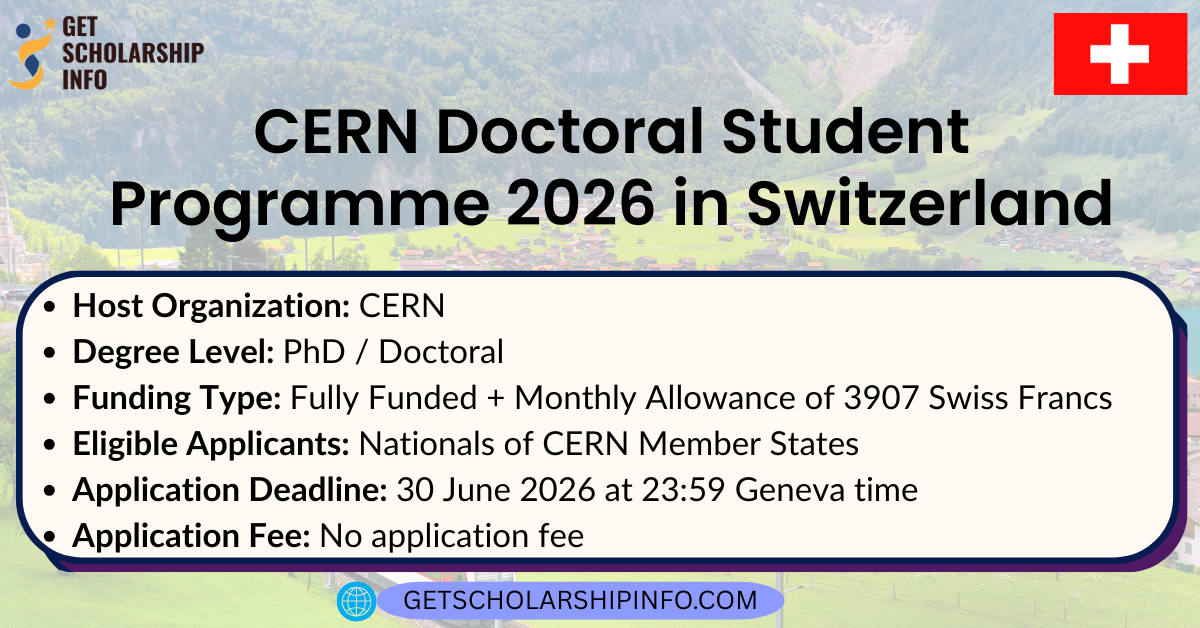
Programme Name: CERN Doctoral Student Programme
Location: Meyrin, Switzerland (CERN campus)
Duration: 12 to 36 months (renewable, maximum 4 years total)
Start Timing: Flexible, often aligned with academic calendars
Monthly Allowance: 3,907 Swiss Francs (tax-free)
Application Fee: None
Work Schedule: Full-time, 40 hours per week, onsite
These fundamentals show how CERN invests seriously in developing the next generation of researchers.
What Selected Students Actually Receive and Achieve:
The financial package makes focusing on research possible without constant money worries. The tax-free monthly allowance covers living expenses comfortably in the Geneva area. Comprehensive health insurance protects you and, in some cases, family members depending on circumstances. You also receive paid leave, including an annual closure period, and help with travel costs to join CERN.
Beyond money, the real benefits come from the environment. You work alongside world-renowned scientists and engineers on cutting-edge projects. This hands-on involvement accelerates your learning far beyond traditional university settings. Many participants publish papers, present at conferences, and build relationships that shape their entire careers.
The experience strengthens both technical expertise and soft skills like teamwork in multicultural settings, project management, and scientific communication. Graduates often secure strong positions in academia, research institutes, or industry because employers value CERN experience highly.
Living in Switzerland adds personal growth through exposure to different cultures, languages, and a high quality of life. The beautiful surroundings and CERN’s vibrant campus community create lasting memories alongside professional achievements.
Who Typically Succeeds in This Programme:
CERN looks for motivated doctoral students whose research aligns with its scientific goals. You need to be a national of a CERN Member State or Associate Member State and already enrolled in a relevant PhD programme at your home university. Your institution must support the idea that time at CERN will count toward your thesis.
Solid academic background in fields like applied physics, engineering, or computing matters most. Strong English or French skills help daily communication, though CERN’s international atmosphere means many languages are spoken.
The programme suits curious, proactive individuals who thrive in collaborative, innovative settings. Previous research experience helps but is not always required if you show genuine potential and enthusiasm.
Research Areas and Project Possibilities:
CERN’s work spans many exciting domains. Common fields for doctoral students include:
- Particle Physics
- Accelerator Technology
- Detector Development
- Computing and Data Science
- Engineering and Mechanics
- Applied Physics
- Materials Science
- Electronics
- Software Development
- Radiation Protection
- Cryogenics and Superconductivity
Projects vary widely but often involve real contributions to ongoing experiments like those at the Large Hadron Collider. This practical focus helps turn theoretical knowledge into tangible results while advancing your thesis.
Navigating the Application Process for Future Cycles:
Applications usually open several times per year with deadlines around spring and autumn. The process is fully online through CERN’s careers portal. You will need a CV, motivation letter, and confirmation from your university that they support your participation.
Take time to research current projects and identify supervisors whose work matches your interests. A strong application clearly explains how your research fits CERN’s activities and what you hope to contribute. Reference letters and transcripts can strengthen your profile, though some are optional.
Results come out a few months after the deadline. Selected candidates work with their CERN supervisor and home university to finalize arrangements.
Daily Life and Work Culture at CERN:
CERN creates a unique atmosphere where science feels alive. You spend most days on research tasks, attending meetings, or collaborating with team members from dozens of countries. The campus buzzes with energy from ongoing experiments and international visitors.
Work-life balance receives attention through generous leave and social activities. Many doctoral students participate in language classes, sports, or cultural events organized on site. The international community makes forming friendships easy despite the demanding research schedule.
Geneva and surrounding areas offer excellent quality of life with beautiful nature, rich history, and easy travel connections across Europe.
Important Practical Matters to Consider:
Moving to Switzerland involves some planning. CERN helps with initial formalities, but you handle certain administrative steps like residence permits. The allowance is calculated to support a comfortable single lifestyle, with family supplements available in specific cases.
Health insurance is comprehensive, but understanding Swiss systems helps avoid surprises. Budgeting for occasional travel home or personal expenses remains wise even with good financial support.
Preparing a Competitive Application:
Strong candidates demonstrate clear research alignment, academic capability, and enthusiasm for CERN’s mission. Spend time learning about current projects through CERN’s website. Reach out to potential supervisors if possible, though this is not required.
Write a genuine motivation statement that shows understanding of both your field and CERN’s work. Highlight relevant experience, skills, and what you hope to gain from the programme. Proofread carefully and submit well before deadlines.
Even if not selected first time, feedback from the process can strengthen future attempts.
Why CERN Doctoral Experience Stands Apart:
Few places match CERN’s combination of scientific ambition, technical resources, and collaborative spirit. Working here means contributing to humanity’s fundamental questions about the universe while developing expertise that opens many career doors.
The multicultural environment builds adaptability and global perspectives highly valued in today’s research world. Alumni often credit their time at CERN with shaping not just their technical skills but their entire professional identity.
Common Questions About the Programme?:
Is the allowance enough to live on in Switzerland?
Yes, the tax-free 3,907 CHF monthly covers comfortable living for most single students, with adjustments for families in some cases.
Can I extend the contract beyond three years?
Contracts run up to 36 months but can be structured over four years total to allow university time.
Do I need to speak French?
English is widely used, though basic French helps with daily life in the region.
What happens if my home university does not support the programme?
You must have university agreement for the research to count toward your PhD.
Are there opportunities for family accompaniment?
Family supplements exist, but bringing dependants is your responsibility to arrange and fund beyond the basic allowance.
How competitive is selection?
Very competitive due to CERN’s reputation, but strong alignment with projects improves chances significantly.
Can I apply multiple times?
Yes, unsuccessful candidates are welcome to apply in future cycles.
Does CERN help with visa and relocation?
Support is provided for travel and administrative matters, though you handle some paperwork.
What fields are most in demand?
Computing, engineering, and applied physics often have strong opportunities alongside core physics research.
Is previous research experience mandatory?
Not always, but relevant skills and strong motivation matter greatly.
Long-Term Career Impact of CERN Doctoral Training:
Time at CERN significantly boosts your professional profile. The combination of cutting-edge research experience, international exposure, and prestigious name opens doors to academic positions, research institutes, technology companies, and international organizations worldwide.
Many graduates continue collaborations started during their doctoral years. The skills in complex problem-solving, data analysis, and teamwork transfer well across sectors.
Making the Decision: Is This Programme Right for You?:
Consider your research interests, career goals, and readiness for international life. If you thrive in collaborative, innovative environments and want to work on fundamental scientific questions, CERN offers an unmatched opportunity.
The programme demands dedication but rewards participants with exceptional growth and memories. For those accepted, it often becomes a defining chapter in their scientific journey.
Stay alert for future application periods and use the time to strengthen your profile through relevant coursework, projects, or language improvement. With proper preparation, this could become your gateway to a rewarding career at the frontiers of science.
