
Not every valuable academic opportunity comes with a scholarship label attached to it. Sometimes the real experience-builder is a hands-on internship inside an active research lab, working directly under a professor who is already leading real projects. That is exactly what the University of Liège (ULiège) in Belgium is offering right now, through its ArGenCo Department, across the 2025-26 academic year.
Two separate internship tracks are open, each led by a different professor and focused on a completely different problem. One track is built around flood risk research, covering four distinct topics under Professor Benjamin Dewaels. The other is a single, highly practical internship on zero-energy building design under Professor Shady Attia. If you are studying engineering, data science, architecture, or environmental sciences, one of these six options is likely to fit your background closely.
This post breaks down both offers in detail: what each topic actually involves, who qualifies, what skills you walk away with, and exactly how to apply.
Quick Overview:
- Host University: University of Liège (ULiège), Belgium
- Department: ArGenCo Department, Faculty of Applied Sciences
- Number of Offers: 2 separate internship tracks, with 4 topics under the first offer
- Duration: Flexible; ranges from a few months up to two years depending on the topic
- Start Window: September 2025 through September 2027 (Offer 1); flexible start date (Offer 2)
- Application Fee: None. Applications are submitted directly to the supervising professor by email
- Nationality Restriction: None mentioned; open internationally
- Application Method: CV and motivation letter sent directly by email, no online portal involved
Offer 1: Flood Risk Research Internships Under Prof. Benjamin Dewaels:
The first offer is really four internships in one, each tackling a different angle of flood risk and water management. All four sit within the ArGenCo Department and are supervised by Professor Benjamin Dewaels, whose research group works extensively on hydrology, flood modelling, and river system behavior.
These are research-heavy placements, meaning you will be working with real datasets, running simulations, and contributing to ongoing scientific questions rather than doing routine administrative tasks. If you enjoy applied research and want something you could eventually turn into a thesis or publication, this track is worth serious consideration.
Who Should Apply for This Offer:
This first offer is aimed at students with a background in any of the following areas:
- Data science
- Data science and engineering
- Computer science
- Computer science and engineering
- Physical engineering
- Geology and mining engineering
- Architectural engineering
- Civil engineering
Topic 1: Assessing Flood Damage in the Business Sector:
Most flood damage research focuses on homes and residential losses, but businesses face their own set of complicated impacts, from damaged equipment and lost stock to full business interruption. This topic addresses that gap directly.
You will work with survey data already collected, plus new data gathered during the internship, from catchments spread across Belgium, Germany, and the Netherlands. The research questions guiding this project include identifying which components of business flood losses matter most, understanding what drives these losses differently across regions, testing how accurately predictive models can estimate damage, and exploring how businesses actually recover from and adapt to flood and drought risk over time.
If you are interested in economic modelling, risk analysis, or applied data science with a real-world impact angle, this is a strong match.
Topic 2: Modelling and Evaluation of Nature-Based Solutions for Flood Risk:
Traditional flood barriers and grey infrastructure are being reconsidered in favor of nature-based solutions, which tend to offer better resilience along with side benefits like ecosystem health and community inclusion. This internship is centered on numerical modelling to evaluate how well these green solutions actually perform.
The Vesdre catchment serves as the real-world case study here, and the work involves connecting big-picture spatial planning ideas with the practical sizing and design of protective measures, including handling more complex situations like river junctions.
This topic suits students who want to combine environmental design thinking with technical modelling work.
Topic 3: Numerical Modelling of Flood-Induced Pollutant Transport:
When rivers flood, they do not just move water. They carry pollutants into riparian systems, and understanding how these pollutants disperse is essential for protecting water quality afterward. This internship focuses on building numerical tools to model exactly that process during flood events.
The end goal is contributing to sustainable water management practices and helping strengthen the natural resilience of affected river systems. This is a good fit for students with strong numerical modelling skills who are interested in environmental and water quality research specifically.
Topic 4: Flood Storage in River Systems as a Nature-Based Solution:
Flood storage systems help absorb excess water and reduce downstream flood risk, but across Europe, the way these systems are designed, operated, and maintained is inconsistent. This makes it harder for municipalities to adopt them at scale.
In this internship, you will help benchmark existing approaches and build a shared typology of temporary flood storage systems. Beyond that, you will develop spatial analysis methods to automatically identify good locations for these systems, and test how effective they are, including under extreme flood scenarios.
This topic is ideal if you enjoy spatial analysis, GIS-style work, and practical risk assessment.
How to Apply for Offer 1:
- Send your CV and a motivation letter directly to Prof. B. Dewaels at B.Dewals@uliege.be
- Mention clearly which of the four topics interests you most
- Internships under this offer can start any time from September 2025 through September 2027, giving you flexibility in timing
Offer 2: Zero-Energy Senior House Building Model Under Prof. Shady Attia:
The second offer moves away from flood research entirely and focuses instead on sustainable building design. It is based in ULiège’s Sustainable Building Design Lab, located within the Faculty of Applied Sciences.
The project centers on a nearly zero-energy senior row house located in Gissenburg, in the Netherlands. This is a fully electric building, meaning it relies entirely on electric systems like heat pumps and solar panels rather than gas or other fuel sources. Your task as an intern will be to help build and calibrate a detailed simulation model of how this building actually performs.
What You Will Actually Be Doing:
The internship is structured around real building performance data rather than theoretical assumptions alone. Specific responsibilities include:
- Collecting data from post-occupancy monitoring and on-site field surveys
- Carrying out a simplified energy audit and comparing the results against public benchmarks
- Analyzing electricity consumption and calibrating the building model using actual monthly energy bills
- Evaluating indoor environmental quality, along with the real-world performance of the building’s heat pump and solar PV system
The simulation model itself will be built using DesignBuilder software, and it needs to align with two European technical standards: CEN 16798 and CEN 15316. This gives the internship a strong technical and standards-based dimension that looks excellent on an engineering or architecture CV.
Skills You Will Gain:
This internship is designed to leave you with concrete, transferable technical skills, including:
- Building energy and performance modelling
- 3D modelling using photogrammetry techniques
- Comfort monitoring and energy audit practices
- Real-life analysis of heat pump and solar PV system performance
- Practical application of EU building energy simulation standards
Who Should Apply for Offer 2:
This internship is open to students in their final year of a Bachelor’s or Master’s degree in the following fields:
- Mechanical Engineering
- Environmental Engineering
- Civil Engineering
- Architectural Engineering, with a focus on energy
The working language for this internship is English, so strong written and spoken English is expected.
Duration, Timing, and Location:
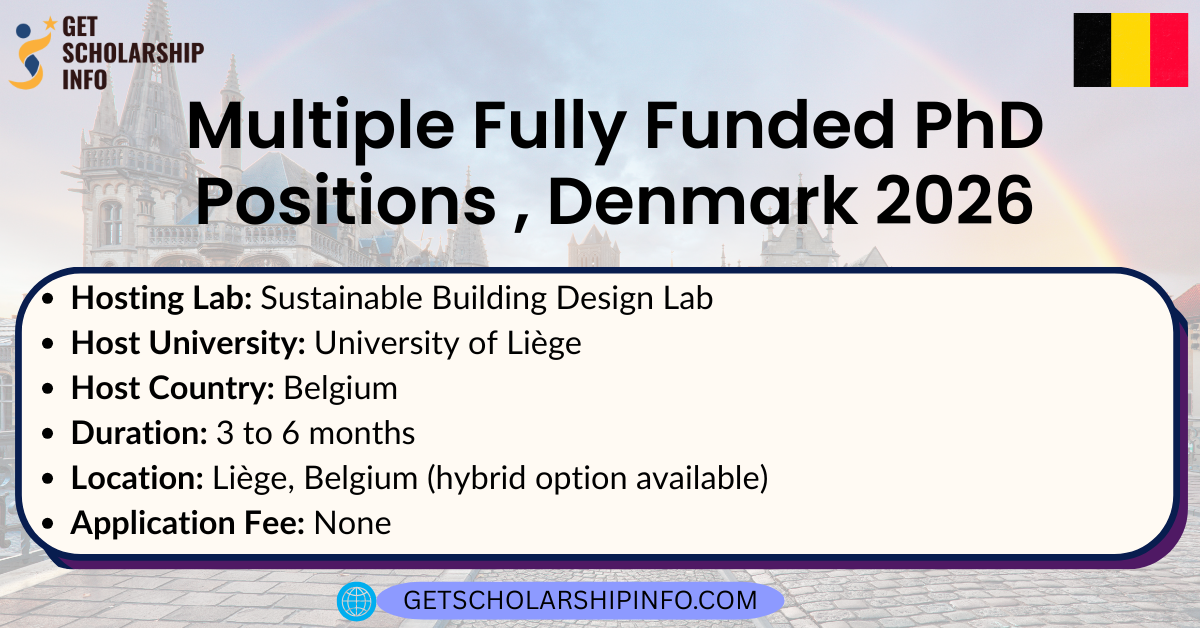
- Duration: Between 3 and 6 months
- Start date: Flexible, based on when the candidate is available
- Location: Liège, Belgium, with the possibility of hybrid working arrangements
How to Apply for Offer 2:
- Send your CV and motivation letter directly to Prof. Shady Attia at shady.attia@uliege.be
- Clearly state your availability and preferred start date in your motivation letter, since timing is flexible and depends on you
Programs and Fields Covered:
Between both offers, the following academic fields are relevant for applicants:
- Data science
- Data science and engineering
- Computer science
- Computer science and engineering
- Physical engineering
- Geology and mining engineering
- Architectural engineering
- Civil engineering
- Mechanical engineering
- Environmental engineering
Why These Internships Are Worth Considering:
Unlike many advertised opportunities that involve long queues of applicants and formal online systems, both of these ULiège internships work through direct email contact with the supervising professor. That means your application gets seen by the actual person running the project, not filtered through layers of an automated portal. It also means your CV and motivation letter genuinely need to speak to the specific topic you are applying for, since the professor is reading it personally.
Both tracks also give you something increasingly valuable in today’s job and academic market: applied, hands-on research experience tied to real data and real buildings, rather than purely theoretical coursework. Whether your interest is in climate risk and flood modelling or sustainable building performance, either path here builds a technical portfolio you can carry into future thesis work, PhD applications, or industry roles in engineering and environmental sectors.
A Few Tips Before You Reach Out:
Since these applications go straight to the professor by email, your motivation letter needs to do some real work. Be specific about why the particular topic interests you, not just the department in general. If you are applying to Offer 1, name the exact topic number and explain briefly what draws you to it. If you are applying to Offer 2, mention your familiarity with building energy concepts or software like DesignBuilder if you have any, even at a beginner level.
It also helps to keep your email short and professional, attach your CV as a clean PDF, and avoid long generic cover letters that could apply to any internship anywhere. Professors supervising active research projects tend to respond faster to applicants who show they have actually read and understood the specific project description.
Frequently Asked Questions?:
Are these ULiège internships paid?
The internship details provided do not mention a stipend or salary. Applicants are encouraged to confirm payment or funding details directly with the supervising professor before applying.
Do I need to be a Belgian or EU citizen to apply?
No nationality restriction is mentioned for either offer, so international students are welcome to apply.
Is there a formal online application portal for these internships?
No. Both offers are applied for by sending a CV and motivation letter directly to the supervising professor’s email address.
Can I apply to more than one topic under Offer 1?
The listing does not restrict you to a single topic, but it is best to clearly state which specific topic interests you most in your motivation letter rather than applying vaguely to all four.
What is the difference between Offer 1 and Offer 2?
Offer 1 covers four flood and water-related research topics under Prof. Dewaels, open to engineering, data science, and geology students. Offer 2 is a single project on zero-energy building modelling under Prof. Attia, aimed at mechanical, environmental, civil, and architectural engineering students.
What software or technical skills will I need for the building energy internship?
Familiarity with building simulation concepts is useful, and the project uses DesignBuilder software. Prior experience is not stated as mandatory, but a basic understanding of energy systems will help your application stand out.
How long can these internships last?
Offer 1 internships can start anytime from September 2025 to September 2027, giving a flexible window. Offer 2 lasts between 3 and 6 months with a flexible start date.
Is remote or hybrid work possible?
For Offer 2, hybrid working is mentioned as a possibility alongside the Liège-based placement. Offer 1 does not specify remote options, so applicants should confirm directly with Prof. Dewaels.
