
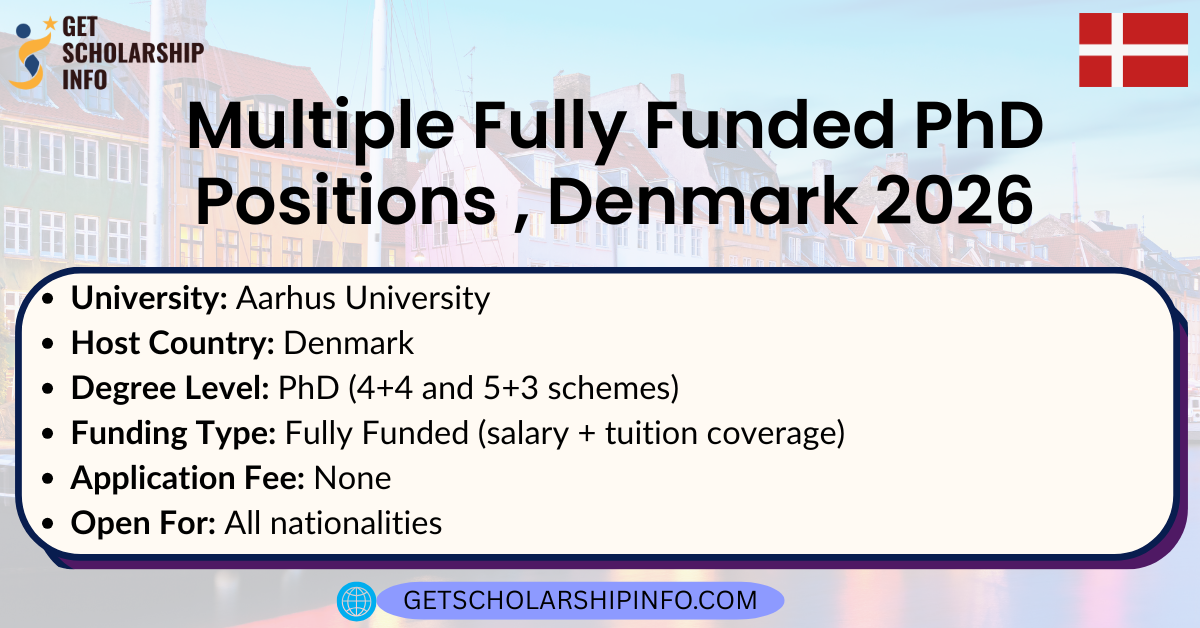
Aarhus University in Denmark posts fully funded PhD positions all year round across nearly every department, from mathematics and computer science to molecular biology and engineering. Unlike a single national scholarship with one closing date, Aarhus runs its PhD vacancies the way most European research universities do: each project, lab, or professor opens its own call with its own deadline whenever funding becomes available. That means new PhD positions at Aarhus University appear almost every week, and applicants who check the vacancy list regularly have a real, ongoing chance rather than a single yearly shot.
This guide explains how Aarhus PhD funding actually works, what a PhD fellow is paid, which departments post the most positions, and how to set up a simple weekly habit that catches new calls before they close.
Why Aarhus University Is Worth Applying To:
Aarhus is consistently ranked among the top 100 universities in the world and is Denmark’s second largest university. It sits in Aarhus, Denmark’s second biggest city, which is smaller and considerably cheaper to live in than Copenhagen while still offering a strong international student community, reliable public transport, and a large number of English taught research groups.
For a PhD candidate, the practical advantages are:
- A genuine three year employment contract, not a stipend or grant, which means Danish labour protections, paid holiday, and pension contributions apply
- No tuition fees for PhD students, since Danish PhDs are structured as jobs rather than degree programmes you pay for
- Access to well funded labs across STEM, social science, and humanities departments
- A clear route to a Danish work permit and, eventually, permanent residency if you choose to stay after graduating
How Much Aarhus PhD Fellows Are Actually Paid:
This is the detail most PhD guides skip, and it was missing from this page before. Aarhus PhD fellows are hired on the standard Danish state salary scale for PhD employees. As a starting point, base pay is roughly DKK 29,000 to DKK 30,000 per month before tax, which works out to approximately EUR 3,900 to EUR 4,000 monthly. On top of base salary, the university contributes an employer pension of around 17.1 percent, meaning the real value of the package is noticeably higher than the listed salary alone.
Exact figures vary slightly by seniority level and collective agreement category, and some fellowships (particularly those funded by external bodies like the Novo Nordisk Foundation or the Lundbeck Foundation) pay above the standard scale. Always check the specific vacancy posting for the exact monthly figure before applying, since it is listed on every individual call.
Which Departments Post PhD Positions Most Often:
Rather than treating Aarhus as one undifferentiated list of 37 departments, it helps to know where the volume actually is. Based on recent posting activity, these departments consistently publish the largest number of PhD calls:
- Department of Molecular Biology and Genetics – frequent openings in genomics, bioinformatics, and cell biology, often with deadlines in May and June
- Department of Mathematics – regular calls in statistics, machine learning, and applied mathematics, commonly closing in the summer months
- Department of Computer Science – growing number of positions tied to AI and data science research groups
- Department of Biomedicine – frequent postdoc and PhD calls in neuroscience, immunology, and structural biology
- Department of Civil and Architectural Engineering and Department of Agroecology – smaller but steady flow of positions, often with autumn start dates
Because each department manages its own recruitment, deadlines genuinely do spread across the whole year. Positions closing in February, May, June, August, and even December are all normal, not exceptions.
How to Actually Find and Track Open Positions:
The single biggest mistake applicants make is checking Aarhus vacancies once, seeing nothing that fits, and giving up. Because listings rotate constantly, a better approach is:
- Bookmark the official Aarhus University vacancies page and check it on a fixed schedule, such as every Monday morning
- Search by keyword for your specific research area rather than browsing the full list, since new postings are added faster than most people can read them
- Set up a free Google Alert for “PhD Aarhus University [your field]” so new postings reach your inbox automatically
- Follow the department pages directly for your field of interest, since some smaller calls are announced there before appearing in the general search
Eligibility for Aarhus University PhD Positions:
While every project has its own specific requirements, the baseline eligibility across almost all Aarhus PhD calls is:
- A completed Master’s degree (or equivalent) in a relevant field, usually with above average grades
- Strong written and spoken English, since almost all PhD programmes are taught and researched in English
- Research experience relevant to the specific project, which can include a strong Master’s thesis, prior lab work, or publications
- For some STEM projects, specific technical skills stated in the individual vacancy, such as programming languages or laboratory techniques
There is no general application fee for Aarhus PhD positions.
How to Apply:
Applications are submitted directly through the individual vacancy listing, not through one central PhD application portal. Each posting includes its own application button, required documents list, and deadline. In general, expect to prepare:
- An academic CV
- A cover letter or motivation letter tailored to the specific project
- Contact details for two or three academic references
- Copies of your degree certificates and transcripts
- For some positions, a short research proposal or writing sample
Read the individual call carefully, since document requirements do vary between departments and even between individual projects within the same department.
Frequently Asked Questions?
Is there one single deadline for all Aarhus University PhD positions?
No. Aarhus does not run one central PhD scholarship with a single yearly deadline. Instead, individual departments and research groups post positions throughout the year, each with its own closing date. This means new opportunities appear regularly rather than only once a year.
Are Aarhus University PhD positions really fully funded?
Yes, in the sense that matters most: PhD candidates are hired as paid employees on a three year contract with a monthly salary, pension contributions, and no tuition fees, rather than receiving a stipend that may not cover living costs.
Is there an application fee for Aarhus PhD positions?
No. There is no general application fee to apply for a PhD position at Aarhus University.
Can international students without a Danish or EU passport apply?
Yes. Aarhus PhD positions are generally open to applicants of any nationality who meet the academic and language requirements for the specific project, though non EU citizens will need to arrange a Danish residence and work permit after being offered a position.
How competitive are Aarhus PhD positions?
Competitiveness varies significantly by field and by how well a candidate’s background matches the specific project. Popular fields like machine learning and molecular biology tend to receive more applications per position than smaller or highly specialised research areas.
