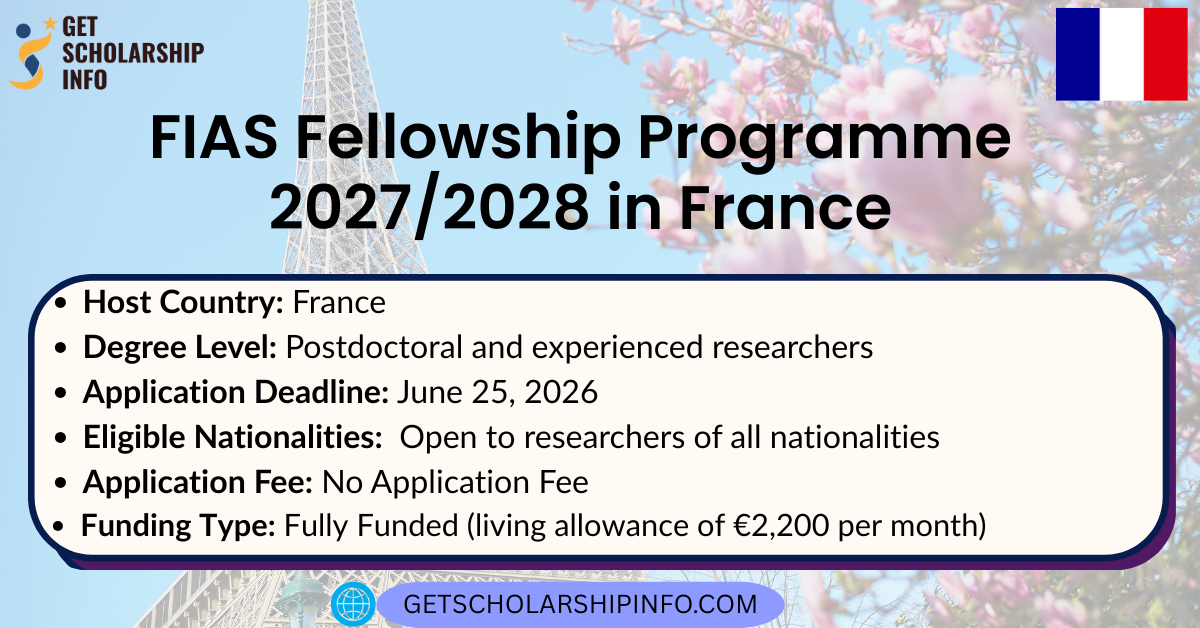
Are you ready to apply for the French Institutes for Advanced Study (FIAS) Fellowship Programme 2027/2028 — a fully funded, ten-month research fellowship that places experienced international researchers inside seven of France’s most respected Institutes for Advanced Study. This is not a student scholarship and it is not a grant you apply for and then disappear with. It is a structured residency: you live and work at one of seven institutes across France, surrounded by a multidisciplinary cohort of researchers from around the world, and you get uninterrupted time to do the research you have always needed more time for.
The programme is open to researchers in the Social Sciences and Humanities (SSH) and to any other research field that meaningfully connects with SSH. All nationalities are welcome , the one condition is that you must not have spent more than 12 months in France during the three years before the application deadline. There is no application fee at any stage.
The deadline for the 2027/2028 cycle is 25 June 2026 at 6:00 pm Paris time. That is firm , the online platform locks after that point and late submissions are not reviewed under any circumstances. There are 29 available positions spread across seven cities: Aix-Marseille, Cergy, Loire Valley, Lyon, Montpellier, Nantes, and Paris.
Every selected fellow receives a net living allowance of at least €2,200 per month, a personal research and training budget of €2,500 for the year, return travel from their home country, office space, IT support, and either a French employment contract or a paid leave arrangement , depending on their situation at home. This is a fully funded programme. You do not cover your own costs.
Key Details:
- Fellowship Duration: 10 months (one full academic year)
- Monthly Allowance: Minimum €2,200 net (take-home pay)
- Research Budget: €2,500 per year for scientific events, training, and research activities
- Travel: One round trip covered from your home country
- Host Country: France
- Available Positions: 29 total across 7 institutes for the 2027/2028 academic year
- Application Deadline: 25 June 2026, 6:00 pm (Paris time)
- Application Fee: None
- Open to All Nationalities: Yes , with a mobility condition (maximum 12 months in France in the last 3 years)
- Degree Required: PhD plus at least 2 years of post-doctoral research experience
- Fields: Social Sciences, Humanities, and any research field that connects with SSH
- Application Language: English only , applications in any other language are not considered
- Contact: programme-officer@fias-fp.eu
The Seven Host Institutes and Available Positions:
One of the things that makes FIAS different from a generic research grant is that you are placed inside a specific institute with its own scientific identity, its own community of fellows, and its own connections to local universities and research centres. Before you apply, you are expected to look at each institute’s website and understand what they focus on. Applying without doing this is a real mistake , the selection committees look at how well your research fits the specific priorities of the institute you are applying to.
The 29 available positions for 2027/2028 are distributed as follows:
- IMéRA – Aix-Marseille: 7 positions
- Institute for Advanced Study – Paris: 8 positions
- Institute for Advanced Study – Nantes: 4 positions
- Collegium de Lyon – Lyon: 3 positions
- CY AS – Cergy: 3 positions
- MAK’IT – Montpellier: 2 positions
- Le Studium – Loire Valley (Orléans-Tours): 2 positions
Paris and Aix-Marseille have the most spots, but that does not mean they are the easiest to get into. Each institute makes its own final selection decisions, and a smaller institute with two positions may be a better fit for your specific work than a larger one. Read their pages carefully before deciding where to apply.
What the FIAS Fellowship Actually Gives You:
Let’s be direct about what this fellowship means in practice, because the benefits go further than most fellowship programmes that researchers come across.
A living allowance that actually covers your expenses. The minimum net monthly allowance is €2,200 , this is take-home pay, not gross. Depending on your individual situation and which contractual arrangement you choose, this figure may be higher. For ten months in France, that is a meaningful and realistic amount to live on, particularly in cities like Lyon, Nantes, or Montpellier where costs are lower than Paris.
Two flexible contract options that fit your situation. This is something FIAS does better than most fellowship programmes. If you do not have an active full-time contract with your home institution, FIAS offers you a French employment contract. That means you are enrolled in France’s national insurance system , unemployment cover, pension contributions, health insurance, and accident insurance. If you already have an ongoing contract with your home university and you are coming on academic leave, FIAS switches to a different arrangement: a direct contract with a living allowance, and the option for FIAS to reimburse your home institution’s salary payments if they are lower than the FIAS allowance , with any difference transferred directly to you. Fellows on this second track also receive a monthly healthcare top-up of €200 to cover private insurance where needed.
A personal research budget of €2,500 for the year. This money sits with the host institute and is released on your request. It covers conference attendance, scientific events, training, and other research-related costs. It is not attached to any particular agenda , it is there to support whatever your research needs during the fellowship year.
Return travel from your home country. One round trip is covered. This is not a reimbursement after the fact with complicated receipts , it is part of the standard package.
Dedicated office space, IT services, meeting rooms, and library access. You are not working from a rented desk. You have a proper working environment inside the institute, with the same access as all other fellows there.
Administrative support from day one. The institutes’ administrative teams help you deal with everything that comes with relocating to France: academic leave negotiations with your home institution, finding accommodation, enrolling in language courses if needed, and any other logistical or legal issues that come up. This is especially useful for non-European researchers who are navigating French administrative procedures for the first time.
Intellectual community and cross-disciplinary exposure. Each institute runs a cohort model , you are in residence alongside other international researchers working on different topics. The collaborative and intellectual environment that comes from this is something that is genuinely hard to replicate in a normal university posting. Your work gets challenged and enriched by people who do not share your assumptions.
A significant career accelerator. FIAS is explicit about this: the fellowship is designed to let you produce in ten months what might otherwise take years of fragmented work around teaching and administrative duties. That is not a promotional claim , it is the actual structure of the programme. You have no teaching obligations and no administrative responsibilities. You are there to research.
Eligibility Criteria:
Read through every point before starting your application. Missing any of these conditions makes your application ineligible regardless of how strong your research proposal is.
- You must hold a PhD degree at the time of the application deadline
- You must have at least 2 years of full-time research experience after your PhD , the time spent doing your PhD itself does not count toward this
- You must not have resided or carried out your main professional or academic activity in France for more than 12 months during the 3 years immediately before the application deadline (this is the MSCA transnational mobility rule)
- Your research must be in the Social Sciences, Humanities, or a field that meaningfully connects with SSH , purely natural science or engineering projects with no SSH interface are not eligible
- Your entire application , every document, every section must be in English; partial use of another language disqualifies the full application
- Your application must be submitted through the online platform before the deadline; paper applications are not accepted and late submissions are not considered regardless of the reason
- All submitted documents must meet the specified length and format requirements; documents that exceed the allowed length are not reviewed
Artists who meet the eligibility requirements are also welcome to apply.
Research Fields Covered:
The FIAS Fellowship Programme is open to researchers across a wide range of disciplines. The focus is on Social Sciences and Humanities, along with fields that work at the boundary between these and other research areas. Fields typically covered include:
- Sociology
- History
- Philosophy
- Political Science
- Anthropology
- Economics
- Law
- Linguistics and Language Studies
- Literature and Cultural Studies
- Psychology
- Geography
- Communication and Media Studies
- Education and Pedagogy
- Ethics and Science Studies
- Interdisciplinary and Transdisciplinary Research
- Art and Artistic Research (where it meets SSH criteria)
- Environmental Humanities
- Digital Humanities
- Migration and Mobility Studies
- Urban Studies
If your field sits at the boundary between the natural sciences or engineering and one or more of these areas, you are encouraged to apply , but you should check the specific scientific priorities of the institute you are targeting before submitting.
How the Selection Works:
It is worth understanding how FIAS evaluates applications, because it directly affects how you should write your research proposal.
All eligible applications go through international independent peer review. Every application is assessed on two criteria, each with a fixed weight:
- Scientific excellence of the applicant — 40% of the total score. This is based on your track record: your publications, your research history, your standing in your field.
- Quality of the research proposal — 60% of the total score. This is the bigger factor. A strong publication record will not save a weak proposal, and a well-written, clearly argued proposal from a less senior researcher can compete with more established candidates.
After the peer review stage, the FIAS Scientific Committee carries out a pre-selection. The final selection decision then sits with each institute’s own Scientific Advisory Board, which applies additional criteria:
- How well your research fits the institute’s stated scientific priorities
- The potential contribution your presence would make to the institute’s scholarly community
- Opportunities for collaboration with local academic and external partners
- The likelihood that the fellowship will create lasting scientific connections beyond the fellowship year
- The expected impact of the fellowship on your own career trajectory
This last point is worth thinking about. Committees are looking for applications where the fellowship year represents a genuine turning point , not just a productive period but a career-defining one. Your research proposal should make that case clearly.
How to Apply — Step by Step:
The entire process happens online. There is no paper option and no in-person submission. Here is what you need to do:
- Go to the FIAS online application platform at fias-fp.eu and create an account in the user space
- Log in and access the application form
- Prepare and upload all required documents , everything must be in English
- Submit before 25 June 2026 at 6:00 pm Paris time , the platform closes automatically after this point
Required documents:
- Completed FIAS online application form
- Detailed curriculum vitae including a full list of publications and the contact details of three academic scholars familiar with your work
- Copy of your PhD diploma in PDF format , if your diploma uses a non-Latin writing system (Cyrillic, Arabic, Chinese, etc.), you must also provide an official university-issued certificate or translation in Latin script
- A detailed research proposal of maximum 5 pages plus 1 additional page for bibliography , the proposal must cover the scientific goals of your project, its relationship to current state of the art, your methodology, expected outcomes, and a justification for why the fellowship duration is appropriate for what you are trying to achieve
- A selection of 3 to 5 of your publications (articles or book chapters) , each must include a clear bibliographical reference, must not exceed 60 pages in length, and must include an English abstract if the publication is in a language other than English
- Up to 2 letters of recommendation (these are optional, not required)
On recommendation letters: if you choose to include them, you have two options. You can upload the letters yourself as PDF files, or you can enter your referees’ email addresses in the form , they will then receive a direct link to upload their letters confidentially. You will not be able to read the letters submitted by referees through the second route.
What Happens After You Apply:
Once your application is submitted, here is the timeline for the 2027/2028 cycle:
- June 25, 2026: Application deadline
- July 2026: Eligibility check , you will be notified whether your application meets the formal requirements
- August – November 2026: Double peer review by international independent experts
- December 2026: Pre-selection by the FIAS Scientific Committee
- January – February 2027: Final selection by the Scientific Advisory Board of each host institute
- March 2027: Results communicated to all applicants via their FIAS user space
You are notified at each stage , after the eligibility check, after pre-selection, and after the final selection. You do not wait until March 2027 to find out whether your application passed the initial checks.
A Few Things Worth Knowing Before You Apply:
This is the kind of programme where the details matter. A few practical notes:
The programme strongly encourages you to visit each institute’s website before applying. The scientific priorities differ between institutes , what IMéRA in Aix-Marseille focuses on is not the same as what the Paris IAS or MAK’IT in Montpellier prioritises. Your research proposal needs to speak directly to the institute you are applying to. Generic proposals that could have been submitted to any institute tend not to survive the final selection stage.
Your research proposal carries 60% of the total evaluation score. Spend the most time on it. It needs to explain what you are researching, why it matters now, how you plan to conduct the work, what you expect to produce, and why ten months at this specific institute is the right context for this specific project.
Applications in languages other than English are immediately disqualified , even partially. If any section of your form, any uploaded document, or any part of your proposal contains text in another language without an English translation or abstract, the entire application is rejected.
For any questions about the programme, the FIAS Programme Officer can be reached at programme-officer@fias-fp.eu. The FAQ section at fias-fp.eu/fellowships/faq also covers most common questions about eligibility, contracts, and the application process.
