
Introduction:
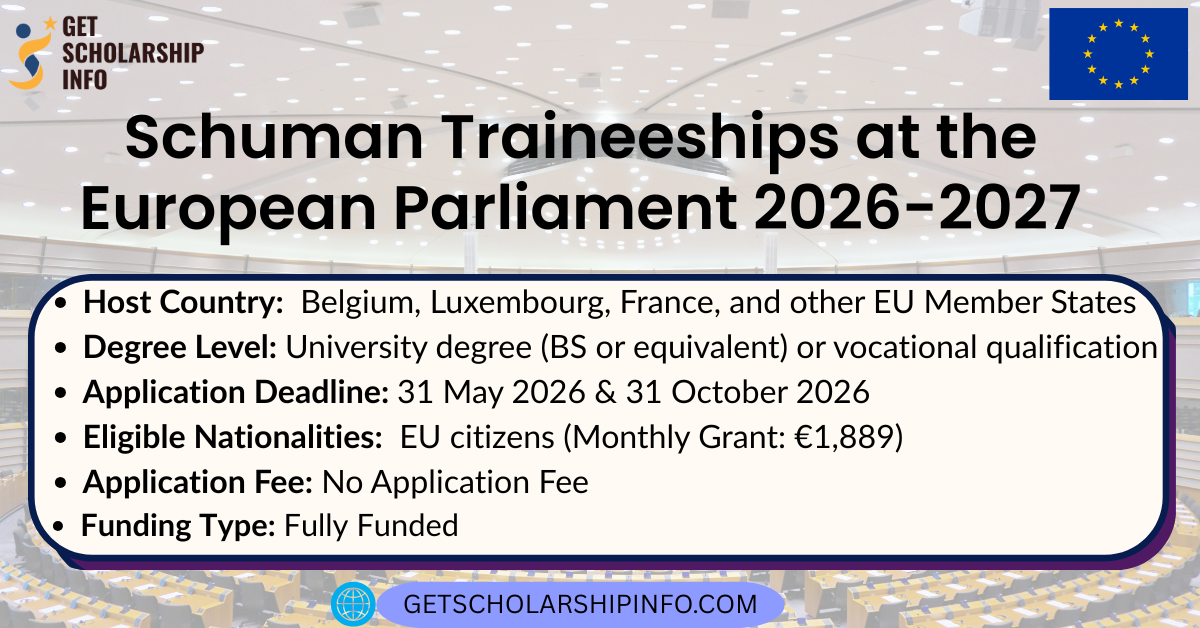
Be ready to apply for the European Parliament Schuman Traineeship 2026–2027 , a fully funded, five-month paid programme for university graduates and vocational qualification holders who want real, hands-on experience inside one of the world’s most significant democratic institutions. This is not a coffee-fetching internship. You will be placed in an active department of the European Parliament and work alongside professional staff on real policy, communication, legal, IT, finance, or administrative tasks , depending on your background and the position you apply for.
The programme runs twice a year. One cycle starts on 1 October and runs through late February. The other starts on 1 March and runs through 31 July. There are no application fees at any stage, and selected trainees receive a monthly financial grant, a one-time travel allowance, and for those with a recognised disability , an additional payment of up to 50% on top of the standard grant.
EU citizens and nationals of accession or candidate countries are eligible to apply. A very limited number of spots are also available for nationals of other countries. You must hold at least a university degree (EQF Level 6) to apply for most positions, though a limited number of spots are open to those with vocational qualifications at EQF Levels 3, 4, or 5. There is no upper age limit , you simply need to be 18 or older.
If you have been wondering how to get your foot in the door at the European Parliament, this programme is one of the most direct and legitimate paths available. And beyond the traineeship itself, high-performing participants may be considered for the Schuman Recruitment and Development Programme, which can lead to a contract agent position within the Parliament after the traineeship ends.
Key Details:
- Programme Name: Schuman Traineeship (Traineeships in the Secretariat)
- Offered by: European Parliament
- Duration: 5 months (full-time)
- Monthly Grant: Approximately €1,889 (Brussels/Luxembourg, 2026 figures) , adjusted by location
- Travel Allowance: One-time payment of €300
- Disability Supplement: Up to 50% additional monthly grant for candidates with a recognised disability of at least 20%
- Application Fee: None
- Degree Required: University degree (EQF Level 6) for most positions; vocational qualifications (EQF Levels 3–5) accepted for a limited number of posts
- Open to: EU Member State nationals and citizens of accession/candidate countries; very limited spots for other nationalities
- Locations: Brussels (Belgium), Luxembourg, Strasbourg (France), and European Parliament Liaison Offices across EU Member States
- Start Dates: 1 October or 1 March each year
- Maximum Applications Per Person: 3 positions per application period
Application Deadlines:
Missing the application window means waiting another six months. There are only two open periods per year, and spontaneous applications sent outside these windows are not considered under any circumstances.
- Traineeship period 1 October 2026 – 28/29 February 2027: Apply between 1 and 31 May 2026
- Traineeship period 1 March 2027 – 31 July 2027: Apply between 1 and 31 October 2026
Mark these dates in your calendar well in advance. The portals close strictly at the end of the respective month.
What This Traineeship Actually Gives You:
A lot of traineeship programmes sound impressive on paper but leave participants with little more than a certificate and a line on their CV. The Schuman Traineeship is different in several important ways , and it is worth being specific about what you actually walk away with.
Financial support that covers your living costs. You receive a monthly grant , roughly €1,889 as of 2026 for those based in Brussels or Luxembourg , which is adjusted depending on where you are placed. This is not pocket money. It is a proper financial allowance designed to let you focus on the work rather than scrambling for side income.
A one-time travel allowance. You receive €300 to help cover the cost of getting to your placement location. This applies once, at the start of your traineeship.
Extra financial support if you have a disability. The Parliament takes inclusion seriously. If you have a long-term physical, mental, intellectual, or sensory impairment of at least 20%, you can apply through the Positive Action Scheme. Successful candidates under this scheme receive up to 50% on top of the standard monthly grant to help offset any additional costs that come with your disability. This is confirmed after the Parliament’s Medical Service verifies your eligibility.
Real professional experience in EU institutions. You are embedded in a working department of the European Parliament. The fields range from law and finance to IT, communication, multilingualism, and human resources. You will understand from the inside how EU legislation is drafted, how internal administration works, and how political debate at the highest level actually gets managed.
A genuinely multicultural working environment. The Parliament works in 24 official EU languages and brings together staff from across the continent. The professional and personal exposure you get from working in this environment , especially early in your career , is something that is genuinely hard to replicate elsewhere.
A stronger position for future EU careers. Completing a Schuman Traineeship signals to future employers , particularly in the EU institutions, international organisations, NGOs, and policy-focused sectors , that you have cleared a competitive selection process and worked at a high level inside a major institution. That carries weight.
A potential pathway into permanent EU employment. The Schuman Recruitment and Development Programme is a formal route through which top-performing trainees can be considered for contract agent positions within the Parliament. You need to be endorsed by your hosting Directorate-General and then pass a series of competency-based tests. If you succeed, your name goes onto a reserve list valid for one year, from which the Parliament can recruit. There is no guarantee of recruitment, but the pathway is real and it is one that does not exist anywhere else for trainees.
Access to a programme dedicated to press freedom. The Directorate-General for Communication runs a specific set of Schuman Traineeships in memory of Ján Kuciak, the Slovak investigative journalist who was killed in February 2018. If you have a background in journalism or communication, these positions carry additional meaning and recognition.
Eligibility Criteria:
Before applying, go through each of these carefully. Missing even one condition will make your application ineligible.
- You must be at least 18 years old (there is no upper age limit)
- You must be a national of an EU Member State or an accession/candidate country , a very limited number of positions exist for nationals of other countries
- You must hold a full university degree at EQF Level 6 (Bachelor’s degree or equivalent) , or a vocational education qualification at EQF Levels 3, 4, or 5 for the limited number of positions that accept these
- You must have a thorough knowledge of one official EU language and a very good knowledge of a second; if you hold a vocational qualification rather than a university degree, a good knowledge of the second language is sufficient; citizens of non-Member States must have very good (or good, for vocational qualification holders) knowledge of English, French, or German specifically
- You must be able to provide a recent and clean criminal record extract
- You must not have previously worked or completed a traineeship in any EU institution, body, or agency for more than two months in total
- You must not have completed a study visit at the European Parliament Secretariat within the six months before the start date of the traineeship you are applying for
Available Fields and Departments:
The Schuman Traineeship covers a wide range of professional areas. Below are the main fields in which positions are typically offered:
- Communication
- Law
- Finance
- Multilingualism and Translation
- EU Internal Policies
- EU External Policies
- Administration
- Infrastructure and Logistics
- Information Technology (IT)
- Human Resources
- International Relations
- Research and Documentation
- Security and Safety
- Journalism and Media (Ján Kuciak memorial traineeships)
Not all fields are available in equal numbers or in every location. When you access the application portal during the open window, you will see the specific positions available and their respective locations and departments.
The Positive Action Scheme , A Dedicated Path for Candidates with Disabilities:
This deserves its own section because it is not something every candidate is aware of, and it matters.
The European Parliament runs a separate track specifically for candidates who have a long-term physical, mental, intellectual, or sensory impairment of a level of at least 20%. Through the Positive Action Scheme, these candidates have a greater chance of being selected than they would through the general pool.
The process works like this: you apply through the same portal as everyone else (there is no separate application form), but you indicate your eligibility for the Positive Action Scheme. If shortlisted, the Parliament’s Medical Service will verify your disability status. Once confirmed, you may receive an offer for a traineeship position , and your monthly grant will include the additional top-up of up to 50%.
Reasonable accommodation is also made available for successful candidates who need specific adjustments during the traineeship itself. The Parliament is explicit that inclusion is a priority, not an afterthought.
How to Apply — Step by Step:
The process is straightforward, but there are a few things worth knowing before you start.
- Go to the official European Parliament traineeship application portal. Only apply during the open window (May for October start; October for March start).
- Create an account on the portal if you do not already have one.
- Browse the available positions and select up to three to apply for. You cannot apply for more than three in a single period.
- Prepare your CV , preferably in English or French, as these are the most common working languages , and write a motivation letter tailored to each position you are applying for.
- Submit your applications before the deadline. The portal closes at the end of the relevant month.
- If you are shortlisted, you will be contacted and asked to provide supporting documents. These typically include proof of your degree or qualification, a copy of your ID or passport, and a recent criminal record extract.
- If selected, you will receive an official Admission Letter by email confirming your placement.
Do not submit applications outside of these open periods. The Parliament does not review spontaneous applications, and there are no exceptions to this rule.
MEP Traineeships — A Second Option Worth Knowing About:
While this post is focused on the Schuman Traineeship (Secretariat), the European Parliament also offers a separate traineeship programme directly with Members of the European Parliament (MEPs). These are different in structure.
MEP traineeships are offered directly by individual Members at their offices in Brussels or Strasbourg. The duration ranges from six weeks to five consecutive months, and the start date can be at any point during the year , it is determined entirely by the MEP who offers the position. Monthly grants range from €1,133 to €1,856 for a full-time traineeship.
The eligibility criteria are slightly more flexible: you need a secondary school leaving certificate or equivalent rather than a full university degree. However, you must not already be party to any employment or working contract during the traineeship period.
To apply, you contact MEPs directly through the European Parliament’s official MEP directory. There is no central application portal for MEP traineeships.
If you are interested in MEP traineeships, you can reach the Trainee Outreach and Recruitment Unit at: PERS-MEP-Trainees@europarl.europa.eu
Final Thoughts:
The Schuman Traineeship is one of the better-structured paid traineeship programmes in Europe , not just because of the financial support, but because of the seriousness with which the work is treated. You are not a visitor. You are placed in a real role in a real institution, and the experience you build there has genuine long-term value for a career in European affairs, law, policy, international relations, or public administration.
If you are a recent graduate , or even a few years into your career but still within the eligibility window , and you have ever wanted to understand how the European Union actually works from the inside, this is about as direct a route as you will find.
Applications for the October 2026 intake are open during May 2026. Plan your documents early, write your motivation letters carefully, and apply for the three positions that best match your background.
This post covers both the Schuman Traineeship (Secretariat) and MEP Traineeship options within the European Parliament. Always verify current grant amounts, deadlines, and available positions on the official European Parliament website before applying.
