
Finding a PhD scholarship that’s actually tied to a real, funded research project , rather than a vague promise of “possible funding” , isn’t something that happens every day. La Trobe University in Australia currently has exactly that on offer, with a wide spread of active research projects across science, health, education, humanities, and engineering, each one carrying its own dedicated scholarship package. If you’ve been searching for a PhD pathway backed by genuine financial support and a supervisor already waiting to work with you, this is worth reading in full.
Let’s walk through what’s actually being offered, who can apply, which projects are currently open, and exactly how the process works , because this one runs a little differently from a typical scholarship application.
The Core Offer in Plain Terms:
La Trobe is running a set of Graduate Research PhD Project Scholarships, designed to support outstanding candidates joining specific, already-established research projects rather than proposing something entirely from scratch. Each successful applicant receives a stipend package worth $36,000 per year for three and a half years, on top of full tuition fee relief, making this a genuinely comprehensive funding arrangement rather than a partial contribution toward costs.
Because this is a project-based scheme, your first step isn’t filling out a form , it’s finding a project that matches your background and interests, then getting the supervisor’s support before anything else moves forward.
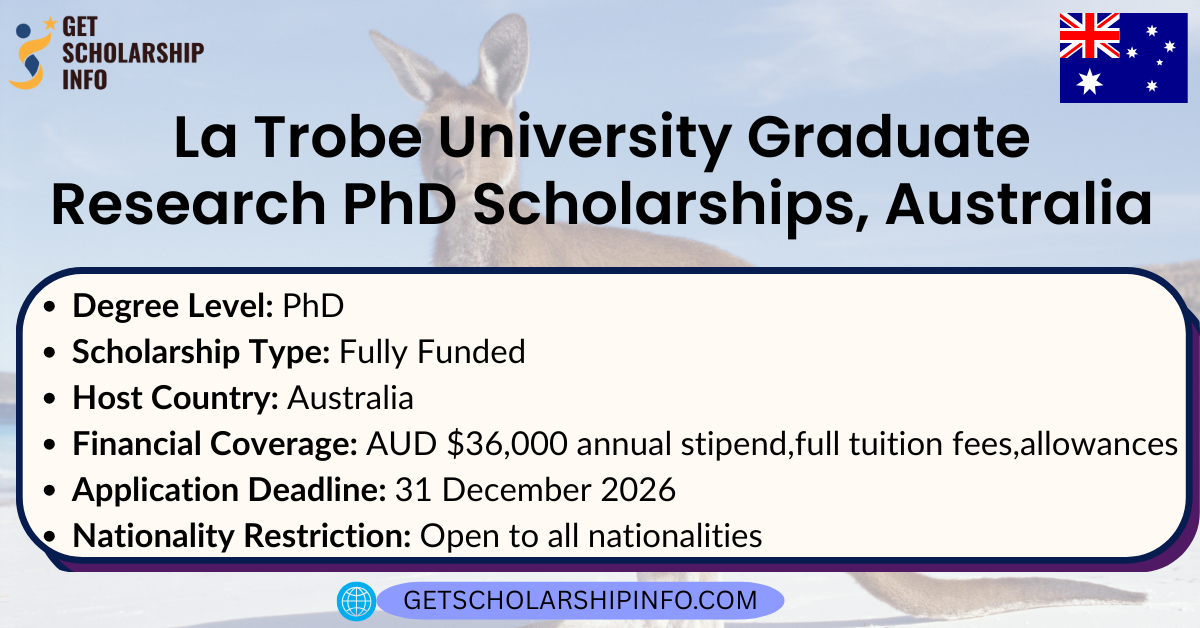
Quick Reference Details:
- Scholarship Type: Graduate Research PhD Project Scholarship
- Host University: La Trobe University, Australia
- Campus Locations: Albury-Wodonga, Bendigo, Melbourne, Mildura, and Shepparton campuses
- Stipend Value: $36,000 per year (2026 rate), paid fortnightly, for up to three and a half years
- Tuition Support: Fee offset or full fee scholarship covering up to four years of doctoral study
- Application Status: Open, with applications accepted year-round for most listed projects
- Reference Closing Date: 31 December 2026, though many individual projects remain open until filled
- Nationality: Open to Australian citizens, New Zealand citizens, Australian permanent residents, and international students
- Application Fee: Not mentioned anywhere in the scholarship information, so no cost appears to be attached to applying
What Successful Applicants Actually Receive:
It helps to look past the activity of “doing a PhD” and focus on what you personally walk away with as a funded candidate.
- A living stipend of $36,000 per year for up to 3.5 years, giving you consistent fortnightly income throughout your candidature rather than a single lump payment
- Full or partial tuition fee coverage for up to four years, removing one of the biggest financial barriers to doctoral study
- A relocation allowance, easing the transition if you’re moving from elsewhere to take up your project
- A thesis and publication allowance, supporting the practical costs of preparing your final work and getting your research into print
- Direct access to an assigned supervisor and research team already active in your chosen field, meaning you’re stepping into an established environment rather than building one from nothing
- The chance to work alongside La Trobe’s recognised researchers and tap into the university’s broader professional development programs, which strengthens your CV well beyond the PhD itself
Altogether, this isn’t just financial aid. It’s a structured entry point into an active research team with your living costs, study costs, and career development all factored in.
Do You Meet the Requirements?:
Eligibility here works a little differently than a standard scholarship, since a lot depends on the specific project you’re targeting.
- You must first contact the primary supervisor listed against your chosen project and receive their invitation to apply , without this step, your application cannot proceed
- You need to meet the general entrance requirements for PhD candidature at La Trobe
- Priority is given to applicants who intend to study full-time and carry out their research physically at a La Trobe campus
- Preference is also given to those who have completed a Master’s by Research, or an equivalent significant body of research such as an honours thesis or lead authorship on a peer-reviewed publication, assessed at a standard of 75 or above
For general PhD candidature (separate from project-specific priority), you’ll typically need either a Master’s by Research completed within the last ten years and assessed at 70 or above, or a Bachelor’s Honours or Master’s by Coursework degree including a minor thesis assessed at that same standard. If you don’t meet these entry requirements outright, alternative entry based on equivalent skills and experience may still be considered, ideally discussed directly with your prospective supervisor first.
International applicants also need to demonstrate English language proficiency, either through standard evidence or, where that’s not possible, through a written case for equivalency assessed against specific criteria such as prior study conducted entirely in English or supervisor endorsement following an interview.
Research Areas Currently Open for Applications:
Rather than one general PhD scholarship, this program spans multiple schools and disciplines, each with active projects seeking candidates. Here are the broad fields currently represented:
- Agriculture, Biomedicine and Environment
- Allied Health, Human Services and Sport
- Cancer Medicine (through the Olivia Newton John Cancer Research Institute)
- Computing, Engineering and Mathematical Sciences
- Education
- Humanities and Social Sciences
- Nursing and Midwifery
- Psychology and Public Health
- Rural Health
A Closer Look at the Available Projects:
If any of the fields above caught your attention, here’s the actual project list currently open, broken down by school, so you can see exactly what’s on the table before reaching out to a supervisor.
School of Agriculture, Biomedicine and Environment:
- Optical Biosensor for Continuous Monitoring Applications
School of Allied Health, Human Services and Sport:
- Towards Building a Sustainable, Resilient and Fit for Purpose Allied Health Care Hospital System
- Measuring Hip Dysplasia Burden: Periacetabular Osteotomy and Co-designed Rehabilitation Versus Co-designed Rehabilitation in Adolescents and Young Adults with Hip Dysplasia (the HOpE Randomised Controlled Trial)
School of Cancer Medicine (Olivia Newton John Cancer Research Institute):
- Development of HCK Inhibitors
- Targeting Metastasis: Uncovering New Vulnerabilities in Cancer Clonality and its Interplay with the Microenvironment
- Understanding Inherent and Acquired Resistance to MAPK Pathway Inhibitors
- Harnessing Nanotechnology to Advance Drug and Gene Delivery
- Identifying and Targeting Drivers of Pre-leukaemia Transformation
- Enhancing Immunosurveillance of Myeloid Malignancies
- Epigenetic Variation, X-chromosome Biology & Long-read Genomics in Human Populations and Cancer
School of Computing, Engineering and Mathematical Sciences:
- Robotic Large Scale Water Tank Inspection Systems
- Flexible and Stretchable Pressure Sensors and Soft Electronic Systems for Next-Generation Wearable and Biomedical Devices
- Machine Learning-Driven Simulation of Synchrotron and XFEL Beamlines
School of Education:
- Understanding Teacher Retention Success in High-Turnover Schools: A Case Study Approach
School of Humanities and Social Sciences:
- The Political History of Australian Colonial Poetry
School of Nursing and Midwifery:
- Exploring the Impact of Midwife-led Group Antenatal Care on Caesarean Section Rates and Infant Health
School of Psychology and Public Health:
- Critical Moments in Responses for Children Affected by Family Substance Use
- Understanding Safety from Family Violence for First Nations Families Involved in Family Court Litigation
La Trobe Rural Health School:
- Global Evaluation of Health Equity Impact
- Mapping Impact of Co-design Interventions
Since this list reflects currently advertised projects, it’s worth checking La Trobe’s own scholarships search page for the most up-to-date listing before you commit to one, as projects open and close on a rolling basis throughout the year.
Understanding the PhD Itself, Not Just the Funding:
It’s worth knowing what you’re actually signing up for academically, separate from the scholarship money. As a PhD candidate at La Trobe, you’ll carry out a supervised research project that leads to a thesis for examination. That thesis needs to demonstrate a genuinely original contribution to your field, a solid critical understanding of existing literature and research, clear knowledge of the methods you used and their limitations, and the ability to communicate all of this clearly and professionally.
Full-time candidates are expected to submit their thesis three years and three months after starting, with four years being the maximum allowed full-time period (or the part-time equivalent). Depending on your discipline, your thesis can also be completed in practice-based mode or as a thesis with publications rather than the traditional single-document format.
Steps to Apply for a Project Scholarship:
Because this scholarship is tied to specific research projects rather than a general pool, the process looks a little different from most other applications you’ll come across.
- Confirm you meet the general PhD entry requirements before going any further
- Browse the list of available projects and choose one that genuinely matches your background and interests
- Read the specific eligibility criteria and any extra conditions attached to that particular project, since these can vary
- Email the primary supervisor listed for your chosen project to express interest, including a short statement on your research goals, your academic transcripts, any relevant publications or thesis work, and your current CV
- Wait for the supervisor to assess your eligibility — only those invited by the supervisor can move on to a full application, so don’t submit through the online portal beforehand
- Once invited, follow the full PhD application instructions and make sure to quote the correct project code in your submission
- If you’re a domestic applicant, select the ‘Graduate Research Applicants’ scholarship option in your application
- If you’re an international applicant, select ‘Project-based PhD Scholarship OR La Trobe Industry Research Scholarship,’ and remember you’ll also need to complete a Research Statement Form for your nominated project, since only one project can be nominated per application
Finding the Right Supervisor Before You Apply:
Since supervision approval is mandatory before your application can be processed, it’s worth understanding your options here. You can look through the currently listed scholarship projects, each with a named contact for enquiries, or search La Trobe’s database of researchers using keywords related to your intended topic, filtering specifically for those open to Master’s or PhD supervision. Alternatively, browsing a School’s own website and research pages can help you identify potential supervisors or active research groups working in your area.
When reaching out to a potential supervisor, include your most recent academic results, your research background, any publications, and a short description of your intended project or which advertised project has caught your interest. If you don’t hear back within a week or so, a polite follow-up email is entirely reasonable.
Documents You’ll Need to Prepare:
Once you’re ready to move forward, both domestic and international applicants are generally expected to provide the following:
- Certified copies of academic transcripts and completion certificates
- A professional CV outlining relevant work experience, academic awards, and research background
- Details of any publications
- A copy of your Master’s thesis, translated into English if it wasn’t originally written in English
- A preliminary research proposal of no more than 300 words, unless the specific project states otherwise
- Any additional documentation stipulated in the individual scholarship advertisement
- A birth certificate or citizenship certificate, for domestic applicants
- Evidence of English language proficiency and a copy of your passport or Australian visa, for international applicants
Frequently Asked Questions?:
Is the La Trobe PhD Project Scholarship fully funded?
Yes. It includes a $36,000 annual stipend for up to 3.5 years, plus tuition fee coverage for up to four years, along with relocation and thesis or publication allowances.
Can international students apply for this scholarship?
Yes. The scholarship is open to Australian citizens, New Zealand citizens, Australian permanent residents, and international applicants, subject to the specific eligibility criteria listed under each project.
Is there an application fee?
No application fee is mentioned in the official scholarship details.
Do I need to contact a supervisor before applying?
Yes, and this step is mandatory. You must contact the primary supervisor for your chosen project and receive their invitation before you can submit a full application.
Can I apply for more than one project at once?
Domestic applicants can generally express interest in multiple projects, but international applicants may only nominate one project through their Research Statement Form.
How long does the scholarship last?
The stipend runs for up to 3.5 years, while tuition fee support can extend for up to 4 years to cover the full expected duration of a doctoral degree.
Is there a strict application deadline?
Applications for most PhD Project Scholarships are accepted year-round and remain open until each individual project is filled, though a broader reference closing date of 31 December 2026 also applies.
What academic background do I need to be eligible?
Generally, a Master’s by Research or an equivalent significant research body of work, such as an honours thesis or lead-authored publication, assessed at a standard of 75 or above is prioritised for project scholarships.
What happens if I don’t meet the standard entry requirements?
You may still be considered through alternative entry equivalency, provided you can demonstrate equivalent knowledge and skills, ideally after discussing your situation with a prospective supervisor.
Final Thoughts Before You Reach Out:
Given how many active projects are currently listed across such a wide range of disciplines, the smartest first move is matching your own research background against the specific project descriptions rather than applying broadly. Once you’ve found a genuine fit, reaching out to the supervisor early , with a clear, well-prepared email , puts you in the strongest possible position before the formal application process even begins.
