Getting your own lab before you’ve even landed a faculty job sounds like something reserved for a handful of exceptional cases. At the Rowland Institute at Harvard, it’s actually the entire premise of the fellowship. Early-career experimentalists ; physicists, chemists, biologists, engineers, neuroscientists, and researchers working across the boundaries of these fields , are handed full principal investigator status, their own lab space, and serious funding to chase research ideas that don’t yet fit neatly into an existing department. If you’re finishing your PhD or recently earned one and you’ve got a bold experimental idea you haven’t had the freedom to pursue, this fellowship was built with exactly that situation in mind.
Here’s a full breakdown of what the Rowland Fellowship actually involves, who qualifies, what you’ll need to prepare, and how the selection process unfolds from application to final decision.
The Institute Behind the Fellowship:
The Rowland Institute traces back to 1980, founded by Edwin Land specifically to support high-risk, creative scientific research outside the constraints of a typical academic department. In 2002, the Institute joined Harvard University, sharpening its mission toward advancing the early careers of experimental scientists and engineers. More recently, in 2024, the Institute relocated from its original building onto Harvard’s main campus, putting Fellows closer to collaborators and the university’s broader research resources. The founding philosophy still shapes who gets selected today: scholars capable of building genuinely groundbreaking research programs, particularly those working across traditional disciplinary lines rather than confined within them.
Key Facts You Should Know First:
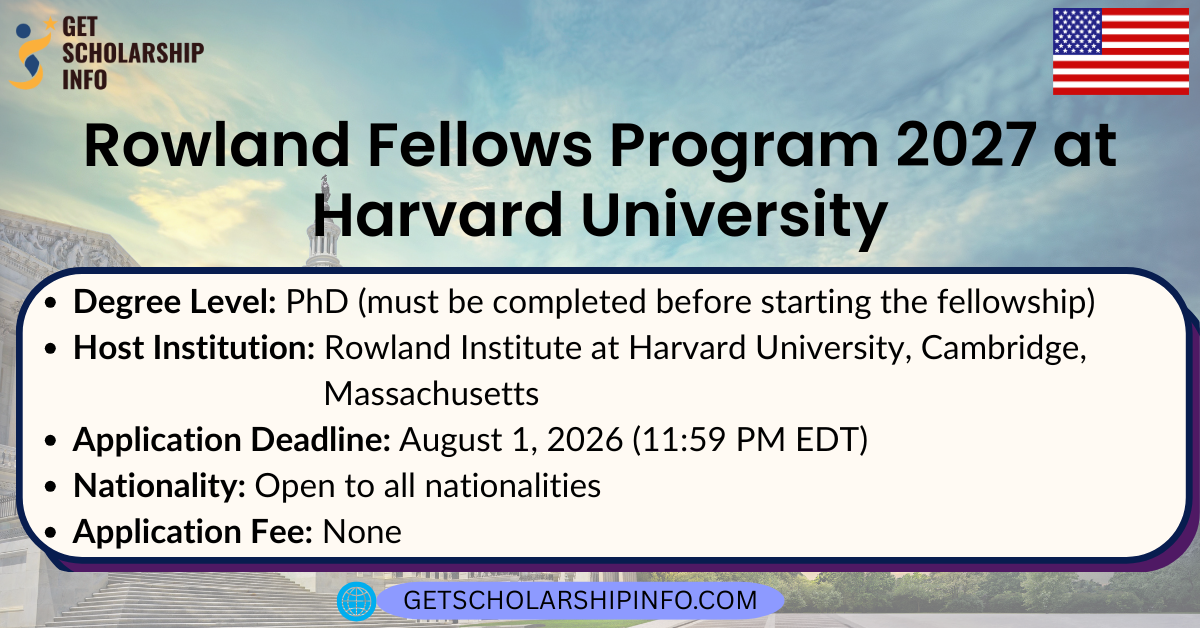
- Fellowship Name: Rowland Fellows Program
- Host Institution: Rowland Institute at Harvard, located in Cambridge, Massachusetts
- Field of Study: Experimental science and engineering, open across physics, chemistry, biology, engineering, neuroscience, and interdisciplinary combinations of these
- Career Stage: Early-career, for those completing or having recently completed a PhD
- Fellowship Length: Up to five years, with a flexible start date
- 2027 Cohort Start Window: July through December 2027
- Application Deadline: Saturday, August 1, 2026, at 11:59PM EDT
- Nationality: Open to both US citizens and non-citizens, with visa support available where needed
- Application Fee: Not mentioned, so there appears to be no cost attached to applying
- Application Platform: Harvard Careers website only; applications submitted elsewhere will not be considered
What You Actually Gain as a Rowland Fellow:
This isn’t a stipend-only fellowship. It’s closer to being handed the keys to your own research operation years earlier than most scientists get that chance. Here’s what’s included:
- Full principal investigator rights, meaning you lead your own independent research program rather than working under someone else’s lab
- Dedicated laboratory space, plus ancillary spaces such as tissue culture facilities where relevant to your research
- Generous start-up funding for capital equipment, scaled to the actual needs of your specific research program
- A yearly operating budget starting at $225,000, covering lab supplies, travel, and the hiring of personnel such as postdoctoral fellows, postbaccalaureate researchers, and undergraduates
- A starting salary of $89,999 per year, along with full Harvard employee benefits
- Optional opportunities to teach undergraduates, ideally through active research supervision rather than classroom lecturing, which also helps you recruit talented students into your lab
- Direct access to staff scientists and engineers who help design and build custom experimental setups
- Shared access to advanced research equipment, both within the Institute and across Harvard facilities such as the Center for Nanoscale Systems and the Bauer Life Science Core Facility
- Structured mentoring aimed at building a healthy, productive lab culture
- Support for scientific writing and budgeting throughout your Fellowship
- Ongoing career development resources, including leadership training and access to Harvard’s Core for Mentorship Excellence
Put together, this gives you not just money, but genuine infrastructure, mentorship, and independence at a stage in your career when most researchers are still working under someone else’s direction.
Who This Fellowship Is Looking For:
Eligibility is refreshingly specific here, which actually makes it easier to figure out if you’re a fit.
- You should currently be completing your PhD, or you should have received your PhD after May 1, 2025
- You must have fully completed your doctoral degree before your Fellowship term actually begins
- Your proposed research must be experimentally focused, sitting within any field of science or engineering
- Both US citizens and non-citizens are eligible, with Harvard and the Institute able to assist with the visa process if needed
- Applicants can come from any accredited academic institution, whether based in the United States or internationally
There is one clear boundary worth flagging: the fellowship cannot support human subjects research or clinical research of any kind. This isn’t arbitrary, it’s tied to how the Institute is physically structured, with Fellows from different disciplines sharing overlapping lab spaces.
Fields of Research Covered:
Because the fellowship spans experimental science broadly rather than one narrow subject, here are the core fields explicitly welcomed:
- Physics
- Chemistry
- Biology
- Engineering
- Neuroscience
- Interdisciplinary research spanning two or more of the above
The Institute is upfront that this list shouldn’t be treated as restrictive. Past and current Fellows’ work can be used as a general guide to the kind of research valued here, but selection ultimately comes down to the strength and originality of the proposed science at the time of submission, not whether it fits a predefined category.
What Your Application Actually Needs to Include:
Unlike scholarships that ask for a single essay, this application is built from several distinct pieces, each serving a different purpose in how the committee evaluates you.
- A 250-word “elevator pitch” explaining your research goals in a way a general audience could understand
- A Statement of Research, capped at three pages including references, laying out your research proposal and, where relevant, a summary of prior work supporting your planned experiments
- A current curriculum vitae
- A Vision Statement, limited to one page, describing how your personal values and academic experiences shape your approach to building a productive and supportive research group
- Contact information for three or four references, who will automatically receive an email request for a letter of recommendation once you submit your application
A quick but important note on the writing itself: the Institute explicitly asks applicants to declare any use of AI tools and describe how they were used. Materials should reflect your own voice, personal motivations, and specific experience, admissions committees are described as generally able to detect AI-generated writing because it tends to lack personal nuance and specific detail. Treat this section of your application as a place to write authentically, not to polish something generic.
The Full Application Timeline for the 2027 Cycle:
Knowing the sequence of events ahead of time helps you plan your months around it rather than being caught off guard.
- August 1, 2026: Applications are due by 11:59PM EDT
- August 15, 2026: Letters of recommendation are due from your references
- September 2026: Applicants who don’t meet the eligibility criteria are notified by email
- October 2026: Selected candidates are invited to a first-round Zoom interview, while unsuccessful candidates are notified by email
- November 2026: Finalists travel to the Institute for a two-day, in-person interview process
- December 2026: Final selection decisions are made and finalists are informed
The two-day interview stage in November is worth understanding in a bit more detail. On the first day, candidates take part in a symposium and give a short presentation covering both their past research and their proposed future work. On the second day, candidates sit down for interviews with current Rowland Fellows, Institute staff, and the admissions committee itself.
How to Actually Submit Your Application:
- Go to the official Harvard Careers website, since applications submitted anywhere else will not be considered
- Prepare and upload all required documents: your elevator pitch, Statement of Research, CV, and Vision Statement
- Provide contact details for three to four references, understanding that automated recommendation requests will be sent directly to them once you submit
- Alert your referees ahead of time by email, since the automated system gives them only a two-week window to submit their letter once requested
- Take advantage of the flexibility built into the platform, your application doesn’t need to be completed in one sitting, and you can log back in to make changes before final submission
- Know that once you formally submit, your materials cannot be revised. If a genuine need arises to submit an updated version before the deadline, email rf@g.harvard.edu and your account can be reactivated for resubmission
- Reach out to rf@g.harvard.edu directly if you have any questions about eligibility or the process itself
A Program Built Around Career Outcomes:
One detail worth sitting with is what happens after the Fellowship ends. Previous Rowland Fellows have gone on to build highly successful careers, primarily in academia, but also in industry roles and as founders of their own startups. That range matters, because it reflects how the fellowship is structured, not as a narrow academic pipeline, but as genuine early-stage independence that prepares Fellows for whatever direction their research and interests eventually take them.
Harvard’s Commitment to Equal Opportunity:
Harvard University maintains a formal commitment to equal opportunity and non-discrimination throughout its hiring and fellowship processes. The university actively seeks talent from all parts of society and the world, with policies in place that prohibit discrimination based on race, sex, ethnicity, color, national origin, religion, disability, or any other characteristic protected by law or the university’s own non-discrimination policy. This commitment extends fully to how Rowland Fellows are recruited and supported throughout their time at the Institute.
Frequently Asked Questions?:
Is the Rowland Fellowship fully funded?
Yes. It includes a starting salary of $89,999 per year with full Harvard benefits, an annual operating budget starting at $225,000, dedicated lab space, and start-up funding for equipment.
Can international applicants apply for this fellowship?
Yes. Both US citizens and non-citizens are eligible, and the Institute along with Harvard can assist with the visa process for those who need it.
Is there an application fee?
No application fee is mentioned anywhere in the official fellowship details.
Do I need to have already finished my PhD to apply?
Not necessarily at the time of application, but you must have received your PhD after May 1, 2025, or currently be in the process of completing it, and your doctoral degree must be fully completed before your Fellowship term begins.
What fields of research are eligible?
Any experimentally focused field of science or engineering, including physics, chemistry, biology, engineering, neuroscience, and interdisciplinary combinations of these areas.
Can I propose human subjects or clinical research?
No. The fellowship cannot support human subjects research or clinical research of any type, since Fellows from different disciplines share overlapping laboratory spaces.
How long does the fellowship last?
Up to five years, with a flexible start date. The 2027 cohort is expected to begin sometime between July and December 2027.
Where do I submit my application?
Only through the official Harvard Careers website. Applications sent through any other channel will not be considered.
Can I use AI tools while preparing my application?
You’re required to declare any use of AI tools and explain how they were used. Your final materials should reflect your own personal voice and experience rather than relying on AI-generated content as-is.
What happens during the interview stage?
Finalists are invited to a two-day, in-person process at the Institute, including a symposium with a research presentation on the first day and interviews with current Fellows, staff, and the admissions committee on the second.
One Last Thing Before You Start Preparing:
Given how many separate components make up this application, the biggest advantage you can give yourself is starting early rather than compressing everything into the final weeks before August 1, 2026. Reach out to your intended references well ahead of time, take the Vision Statement seriously rather than treating it as an afterthought, and make sure your Statement of Research reflects genuinely original thinking rather than something safely conventional. This fellowship isn’t looking for a finished expert, it’s looking for the researcher whose next big idea hasn’t found its lab yet.
