Every year, the Ministry of Foreign Affairs of Taiwan opens a door for scholars around the world who want to study Taiwan up close instead of through books and secondhand sources. The Taiwan Fellowship funds professors, postdoctoral researchers, and doctoral students who research topics connected to Taiwan, cross-strait relations, mainland China, the wider Asia-Pacific region, or Sinology.
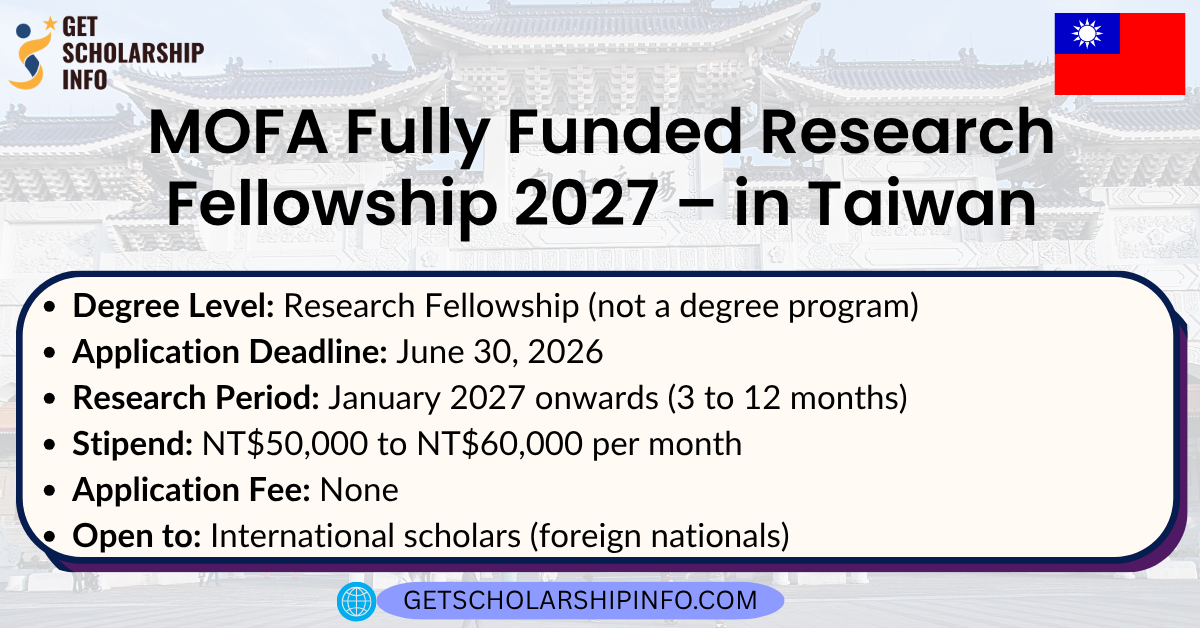
Since it began, more than 1,500 scholars from 93 countries have taken part in this program, which says a lot about how established and trusted it has become in academic circles. The 2027 cycle accepts online applications between 1 May and 30 June 2026, and successful applicants can start their research in Taiwan as early as January 2027. There is no application fee, and the funding covers a monthly stipend, a flight subsidy, and accident insurance for the entire research period.
A Program Built on Academic Trust, Not Just Money:
What separates this fellowship from a typical study-abroad scholarship is that it does not fund degree programs. Instead, it supports independent research conducted at a Taiwanese university, college, or research institution. You are expected to already hold an academic position or be deep into your doctoral work, and the program trusts you to design and carry out your own research plan once you arrive. This makes it a good fit for someone who already knows exactly what they want to study and simply needs the resources and access to do it properly.
Key Details at a Glance:
- Program Level: open to professors, associate professors, assistant professors, postdoctoral researchers, doctoral candidates, and doctoral program students
- Host Country: Taiwan, at a university, college, or academic research institution of the applicant’s choosing
- Application Window: 1 May to 30 June 2026 for the 2027 fellowship cycle
- Research Start Date: as early as January 2027
- Funding Type: fully funded through a monthly stipend, travel subsidy, and insurance coverage
- Fellowship Duration: minimum of three months, maximum of twelve months
- Application Fee: none
- Nationality Requirement: open to foreign nationals worldwide, though applicants already residing or studying in Taiwan are not eligible
What You Actually Receive as a Fellow:
The financial structure of this fellowship is detailed and transparent, which is part of why it has remained popular for so long. Being selected gives you access to the following.
- A monthly stipend of NT$60,000 if you hold the rank of professor, associate professor, research fellow, or associate research fellow
- A monthly stipend of NT$50,000 if you are an assistant professor, assistant research fellow, postdoctoral researcher, doctoral candidate, doctoral student, or a candidate recommended through an ROC mission
- A subsidized round-trip economy class ticket between your home country and Taiwan, with the subsidy amount varying by region, ranging from NT$35,000 for Northeast and Southeast Asia up to NT$90,000 for Africa
- Group accident insurance during your entire research term, covering up to NT$1 million for accidental death and NT$50,000 for accident-related medical expenses
- A waived visa fee, with your visa specially marked as “FR-Taiwan Fellowship Recipient”
- The freedom to design your own research schedule and make your own arrangements with your host institution in Taiwan
- The opportunity to attend academic seminars and related events hosted by MOFA and its partner organizations during your stay
Who Is Eligible to Apply:
Eligibility for this fellowship is based on your academic standing rather than your age or nationality alone. You may apply if you fall into one of these categories.
- A professor, associate professor, or assistant professor at an overseas university
- A postdoctoral researcher affiliated with an overseas academic institution
- A doctoral candidate or doctoral program student at a related department abroad
- A research fellow or associate research fellow at an equivalent academic level abroad
- A candidate recommended by a ROC (Taiwan) overseas mission whose research focuses on Taiwan’s foreign relations or cross-strait relations
One important restriction to keep in mind is that anyone currently conducting research, teaching, or studying in Taiwan at the time of application is not eligible for this fellowship.
Research Fields That Qualify:
Your proposed research needs to sit within the social sciences and humanities, connected to one of the following themes.
- Taiwan Studies
- Cross-Strait Relations
- Mainland China Studies
- Asia-Pacific Regional Studies
- Sinology
Documents You Need Before You Apply:
- Completed online application form
- Updated resume including a full list of your publications
- A research proposal, typically around three pages long, written in standard academic research format
- Two letters of recommendation, or alternatively one letter of recommendation paired with a letter of consent from the head of your institution
The Application and Selection Journey:
Unlike scholarships that use a single online portal from start to finish, this fellowship involves your local ROC embassy or representative office as a key part of the process.
- Submit your online application form first through the official Taiwan Fellowship platform
- Send your resume, research proposal, and recommendation letters to the ROC Embassy or Representative Office nearest to your country of residence
- The embassy or office reviews your documents and evaluates your academic background and research potential
- The embassy or office writes a recommendation explaining why your candidacy should move forward
- MOFA convenes an evaluation committee made up of scholars, experts, and MOFA representatives to screen all recommended candidates
- Once approved, you must obtain a Letter of Consent for Research from a university or academic institution in Taiwan and submit it to MOFA to finalize your application
Rules You Must Follow Once You Are Selected:
Accepting this fellowship comes with a set of responsibilities that recipients are expected to honor throughout their stay.
- You cannot change your approved research proposal or research area without getting prior consent from MOFA
- You must submit a written research report of at least 20 pages to the Center for Chinese Studies within three months after your program ends
- You are required to attend academic seminars and related activities organized by MOFA or its commissioned partners during your stay
- You cannot accept funding from any other Taiwan-based government agency or academic institution while holding this fellowship
- You cannot take on part-time work without MOFA’s approval, though speaking fees and limited paid teaching, up to four hours per week, are allowed under the agreement terms
- You must follow all ROC laws while in Taiwan, and any criminal conviction or serious misconduct will result in your fellowship being revoked
- Any expenses beyond what the fellowship covers are your own responsibility
- Every research report or presentation coming out of your fellowship period must acknowledge the support of the Taiwan Fellowship program
- You are responsible for arranging your own research activities and logistics once you arrive in Taiwan
- Before departing your home country, you must submit your travel itinerary and details of your cooperating institution in Taiwan to your nearest ROC embassy or representative office
Visa Arrangements for Recipients:
The type of visa you receive depends on how long your fellowship lasts. If your approved fellowship period is under six months, you will be issued a visitor visa. If it runs longer than six months, you will receive a residence visa instead. In both cases, the visa fee is waived, and the visa carries a special notation identifying you as a Taiwan Fellowship recipient.
Practical Notes Before You Apply:
Since the fellowship is administered by the Center for Chinese Studies at the National Central Library, it helps to review their website for supporting resources before you begin drafting your research proposal. It is also worth remembering that the number of recipients accepted each year depends on MOFA’s annual budget, so a well-written proposal that clearly connects to one of the eligible research themes will always stand a better chance during the evaluation process.
Frequently Asked Questions?:
Is the Taiwan Fellowship fully funded? Yes. It includes a monthly stipend, a subsidized round-trip flight, and accident insurance for the entire research period.
How long does the fellowship last? The duration ranges from a minimum of three months to a maximum of twelve months, depending on your approved research plan.
Is there an application fee? No, there is no fee to apply for this fellowship.
Can I apply if I am already studying in Taiwan? No. Anyone currently conducting research, teaching, or studying in Taiwan at the time of application is not eligible.
What fields of study are accepted? Only social sciences and humanities research connected to Taiwan, cross-strait relations, mainland China, the Asia-Pacific region, or Sinology qualifies.
When can I start my research in Taiwan? Recipients typically begin their research as early as January of the year following their application cycle.
Do I apply directly to MOFA? No. You submit your documents to the ROC Embassy or Representative Office nearest to your country of residence, and they forward a recommendation to MOFA’s evaluation committee.
