
Fellowship Overview:
Quebec has built one of the more thoughtful postdoctoral funding schemes for international researchers, and it comes from an unusual partnership between two bodies: the Ministry of Higher Education (MES) and the Quebec Research Fund for Nature and Technologies (FRQNT). Together they run the Excellence Scholarship Program for International Students, known locally by its French acronym PBEEE, and one of its components is dedicated entirely to postdoctoral researchers who want to base their next research chapter at Université Laval in Quebec City.
The purpose behind this funding is not just generosity for its own sake. Quebec’s Ministry of Higher Education created it specifically to strengthen the international standing of its universities, pull in strong foreign researchers, and build research partnerships that stretch beyond the province’s borders. For a postdoctoral researcher, that translates into real, tangible support rather than a token gesture.
The current competition cycle has already closed, and the next one is expected to open in summer 2027. That gap matters. Anyone reading this now still has real time to prepare, and given how document-heavy this application is, that preparation time is genuinely useful rather than wasted. Funding awarded through the 2027-2028 competition cannot begin before May 2027 and must start no later than January 2028, so the timeline for actually beginning research work stretches out over several months even after an award is confirmed.
Key Facts You Should Know:
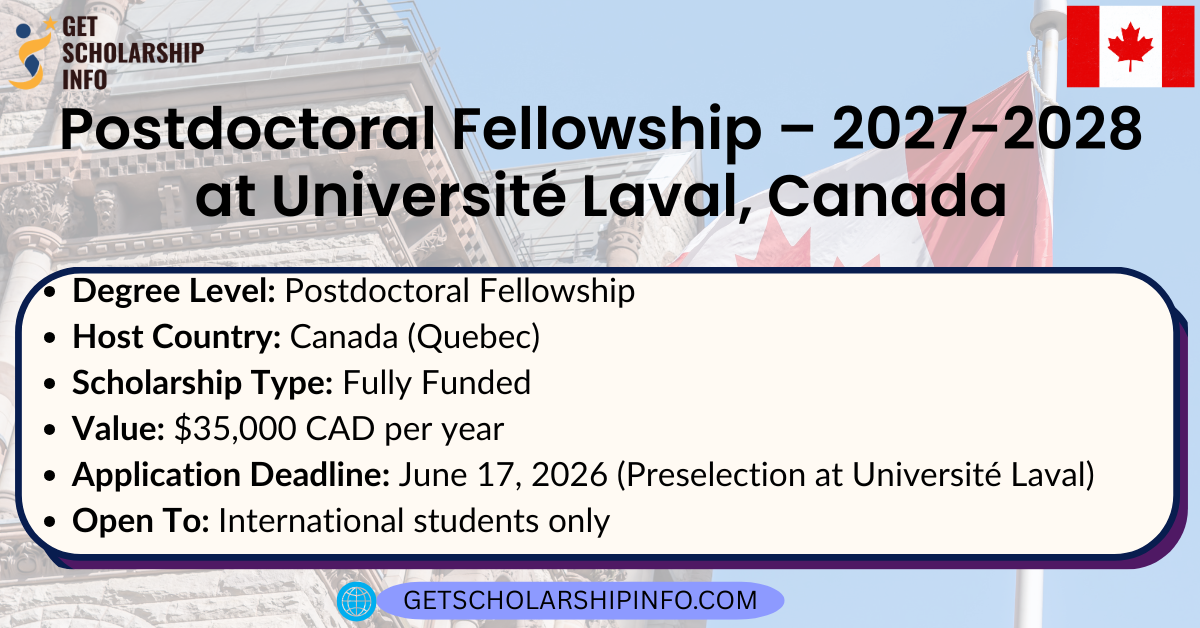
- Degree Level: Postdoctoral research only. This is not designed for master’s, PhD, or undergraduate applicants.
- Host Institution: Université Laval, located in Quebec City, Canada.
- Funding Amount: $35,000 CAD, awarded for a single year and not renewable beyond that period.
- Next Competition: Expected to open in summer 2027, since the current cycle has already closed.
- Funding Start Window: No earlier than May 2027 and no later than January 2028, for anyone awarded through the 2027-2028 cycle.
- Open To: International postdoctoral researchers only, not Canadian citizens or permanent residents.
- Application Fee: None mentioned anywhere in the official documentation.
- Fields of Research: Open to all postdoctoral research areas, with no subject restriction stated.
What You Gain As a Fellow:
It is worth spelling out exactly what this money and support actually buys a recipient, rather than just listing the numbers.
- A $35,000 CAD grant for one full year, providing a real income base while transitioning into postdoctoral research without needing to chase short-term teaching gigs or freelance work on the side.
- A full exemption from the additional tuition fees charged to international students. This is a significant win, since international surcharges in Canada can otherwise add thousands of dollars on top of standard costs.
- Health insurance coverage through the Régie de l’assurance maladie du Québec (RAMQ), meaning medical costs are handled through Quebec’s public health system instead of requiring separate, often expensive, private international insurance.
- A direct connection to a research supervisor at a research-active university, since finding and securing a supervisor at Université Laval is a required first step before applying, which naturally sets recipients up with an academic mentor from day one.
- Institutional support through the Scholarships and Financial Aid Office (BBAF), a dedicated office that manages applications, answers questions, and helps candidates prepare stronger submissions.
- Recognition tied to a competitive, merit-based national funding body, since FRQNT funding carries weight on a CV well beyond the one-year funding period itself.
Eligibility Requirements:
The eligibility rules here are specific, and missing even one of them can disqualify an otherwise strong application, so each point deserves attention.
- Applicants must first secure a supervisor at Université Laval who agrees to oversee their postdoctoral work. This step comes before the formal application, not after it, and the university’s own website is the recommended starting point for identifying potential supervisors.
- Applicants need to have completed their doctorate no more than two years before the competition’s closing date. Alternatively, candidates who have not yet defended can still apply if they will have submitted their doctoral thesis by January 15, 2028.
- Applicants must not have already submitted an application for Canadian permanent residence by the date FRQNT finalises its selection. This scholarship is specifically for international researchers, not for those already on a pathway to Canadian residency.
- There is no nationality restriction beyond this, meaning researchers from virtually any country outside Canada can apply, provided the other conditions are met.
Fields of Research Covered:
Unlike many postdoctoral schemes that limit funding to a narrow list of disciplines, this program is open across the board. The official listing simply states that all postdoctoral positions qualify, which means candidates from any of the following broad research areas, among others, can apply:
- Natural Sciences
- Engineering and Applied Sciences
- Life Sciences and Biomedical Research
- Environmental and Earth Sciences
- Mathematics and Computational Sciences
- Physics and Chemistry
- Agricultural and Food Sciences
- Technology and Innovation-Focused Research
Since Université Laval hosts research groups across nearly every academic domain, the practical scope depends far more on finding a willing supervisor than on any restriction from FRQNT or MES themselves.
Application Process Explained:
This is not a quick online form. It is a document-heavy submission that runs through Université Laval before reaching FRQNT, and understanding the sequence matters as much as understanding the requirements themselves.
- Find a supervisor first. Before anything else, candidates need a Université Laval-based researcher willing to supervise their postdoctoral work. This step should not be rushed, since it forms the foundation of the entire application.
- Prepare a single, combined PDF document. All required materials are submitted electronically as one file, sent to pbeee@bbaf.ulaval.ca.
- Secure formal reference letters on letterhead. For Université Laval’s pre-selection stage, letters need to be signed by the referee and printed on official letterhead. These can be included directly within the application package.
- Keep confidential letters separate if needed. If a referee prefers their letter remain confidential, it can instead be emailed directly to the scholarship office rather than included in the applicant’s own submission.
- Submit Capsule copies of transcripts at the pre-selection stage only. These unofficial copies are accepted for the first round, but official transcripts become mandatory if the application advances to final selection.
- Wait for shortlisting before completing the FRQNT form. The formal FRQNT application form is only required once Université Laval shortlists a candidate, so it is not needed at the very first submission stage.
- Track the funding start window. Successful applicants in the 2027-2028 competition should expect their funding to begin sometime between May 2027 and January 2028, not immediately after being notified of an award.
Good to Know Before You Apply:
A few practical details often get missed by first-time applicants, and each one can genuinely affect the outcome of an application.
- Processing support requests takes time, and reaching out to the scholarships office right before a deadline is unlikely to get a same-day response. Starting the process early, ideally weeks or even months ahead, avoids unnecessary stress.
- Two guidance documents are available directly from FRQNT to help applicants strengthen their submissions, one focused on overall application quality and another centred on writing a strong project description and securing solid recommendation letters. Reviewing both before drafting an application is a smart move.
- Competition details are subject to change year to year, so anyone planning around the summer 2027 opening should check the official FRQ website once the competition formally launches, rather than relying purely on last year’s requirements.
- Because this scholarship sits at the intersection of two funding bodies, MES and FRQNT, some administrative steps move through Université Laval first before reaching the provincial funding body, which is part of why the timeline stretches out as long as it does.
Who Should Consider This Fellowship:
This scholarship suits a fairly specific kind of applicant: someone who has recently finished, or is about to finish, a doctorate, who has no interest in staying in Canada permanently in the near term, and who is genuinely drawn to conducting research at a Quebec institution. Researchers hoping to build ties with francophone research networks, or those interested in Quebec’s particular strengths in natural sciences, engineering, and technology research, will find this a particularly good fit. It is less suited to those already deep into a Canadian immigration process, since the eligibility rules explicitly exclude that group.
Frequently Asked Questions?:
How much funding does this postdoctoral fellowship provide? Recipients receive $35,000 CAD for one year. The award is not renewable beyond that single year.
When does the next competition open? The current competition cycle is already closed. The next one is expected to open in summer 2027.
Is there an application fee? No application fee is mentioned in the official scholarship documentation.
Do I need a supervisor before applying? Yes. Finding a supervisor at Université Laval who agrees to oversee your postdoctoral research is a required first step before you can submit an application.
Who is eligible for this fellowship? International postdoctoral researchers who completed their doctorate within two years of the competition’s closing date, or who will submit their doctoral thesis by January 15, 2028, and who have not applied for Canadian permanent residence by the FRQNT final selection date.
Does this scholarship cover tuition and health insurance? Yes. Beyond the $35,000 grant, recipients receive an exemption from the extra tuition fees charged to international students, along with health insurance through the Régie de l’assurance maladie du Québec.
When would funding actually begin if I’m awarded this scholarship? For the 2027-2028 competition, funding can start no earlier than May 2027 and no later than January 2028.
Are all research fields eligible? Yes. The program covers all postdoctoral research positions without restricting applicants to specific disciplines.
What documents are needed for the pre-selection stage? A single combined PDF application, along with formal reference letters on letterhead and unofficial Capsule copies of transcripts, submitted by email to the scholarships office.
Is this scholarship open to Canadian citizens or permanent residents? No. It is specifically reserved for international students and researchers, and applicants who have already applied for Canadian permanent residence by the final selection date are not eligible.
