
What Makes This Opportunity Different:
Most undergraduate scholarships ask a student to study hard and stay out of trouble. The Ellison Scholars programme asks for something bigger. Run through EIT in partnership with the University of Oxford, this award is built for students who want their degree to sit alongside real research work on problems that affect the whole planet, not just their own transcript.
Scholars study any discipline they choose at Oxford, fully funded, while also spending their summers working directly on EIT innovation projects. It is not a scholarship that hands out money and disappears. It pairs financial support with hands-on internships, access to serious laboratory and research facilities, and direct contact with people who are already leaders in science and technology. The programme is genuinely global in reach, and while there is no explicit mention of an application fee in the official materials, the selection process itself is intensely competitive, so preparation matters far more than paperwork.
Below is everything a prospective applicant needs to know, broken into sections that are easy to skim, easy to reference, and easy to act on.
At a Glance:
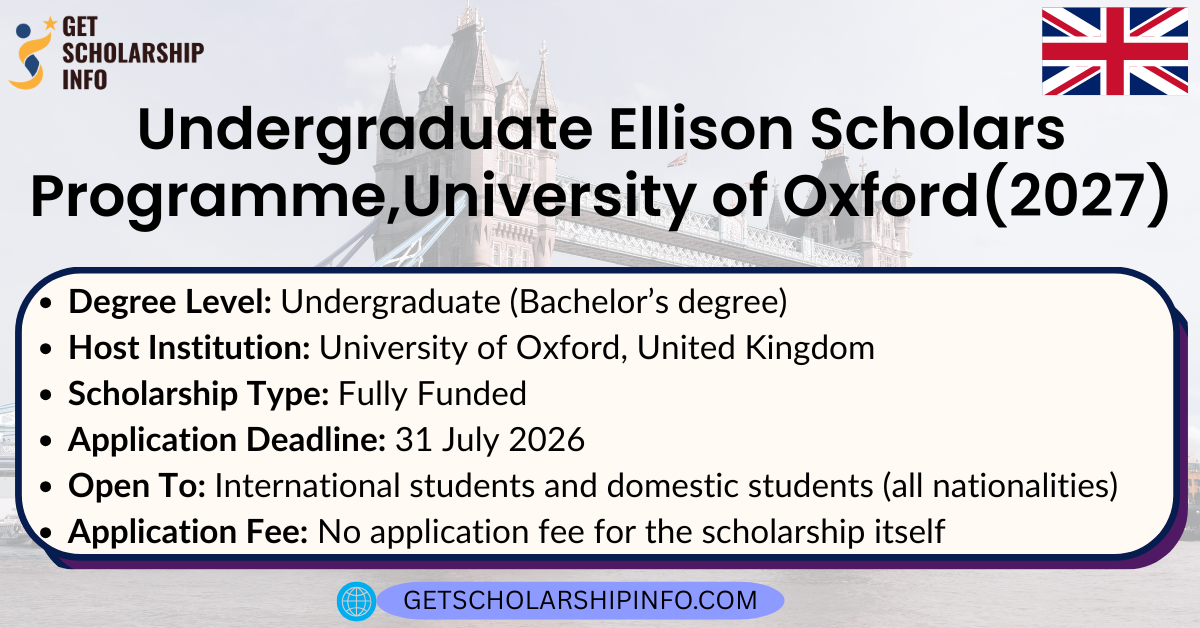
- Degree Level: Undergraduate study, open to any subject offered at the University of Oxford.
- Host Institution: University of Oxford, working in conjunction with EIT Oxford, located at the Oxford Science Park.
- Funding Type: Fully funded, covering the full degree along with a living stipend.
- Application Window: Opens 1 May 2026 and closes 31 July 2026.
- Study Start Date: October 2027, at the beginning of the academic year.
- Nationality Restrictions: None specified. The programme is open to applicants worldwide who meet Oxford’s admissions standards.
- Preferred Fields: Computer science, artificial intelligence, economics, mathematics, robotics, plant sciences, machine learning, chemistry, biology, engineering, medicine, and microbiology, though this list is described as non-exhaustive.
- Selection Difficulty: Highly competitive, with a multi-stage process spanning nearly a year.
The Real Value: What Scholars Actually Gain:
It helps to separate what a scholar does from what a scholar receives, because the two are easy to blur together. Here is what someone actually walks away with as an Ellison Scholar:
- A fully funded Oxford degree, removing tuition costs as a barrier to studying at one of the most respected universities in the world.
- A generous living stipend, which means covering rent, food, and daily expenses does not depend on part-time work or family support during term time.
- Paid summer internships, giving scholars an income during the ten-week EIT placement rather than an unpaid resume-building exercise.
- Direct exposure to unresolved, real-world problems, letting scholars contribute to research that has genuine consequences instead of working through simulated coursework exercises.
- Access to state-of-the-art facilities, meaning scholars are not limited by the equipment available in a typical undergraduate lab.
- Mentorship from established leaders in science and technology, a connection that often shapes career direction long after the internship ends.
- A built-in professional and academic network, formed through collaboration with fellow scholars and EIT teams across multiple disciplines.
- A structured onboarding and support system, with the Education & Scholarships team helping scholars prepare for their move to Oxford well before classes start.
The Four Humane Endeavours: Where the Research Happens:
EIT organises its work around four broad research pillars, referred to as Humane Endeavours. Every internship project a scholar takes on will connect to one or more of these areas:
- Health, Medical Science & Generative Biology
- Food Security & Sustainable Agriculture
- Climate Change & Managing Atmospheric CO2
- Artificial Intelligence & Robotics
These four areas are intentionally broad, which is why the programme welcomes such a wide range of academic backgrounds. A student studying chemistry might end up contributing to food security research, while a computer science student might find themselves working on climate modelling instead of a purely technical AI project.
Fields Considered for This Scholarship:
While Oxford accepts students into any undergraduate course, the Ellison Scholars selection process shows particular interest in candidates from the following fields:
- Computer Science
- Artificial Intelligence
- Economics
- Mathematics
- Robotics
- Plant Sciences
- Machine Learning
- Chemistry
- Biology
- Engineering
- Medicine
- Microbiology
Applicants outside these fields are not excluded. The programme explicitly states that strong candidates who believe their skills would benefit an EIT project are welcome to apply, even if their subject is not listed above.
Do You Qualify? Understanding the Eligibility Rules:
Eligibility for this scholarship works in two layers, and both need to be satisfied before an application stands a real chance.
Layer one covers Oxford’s own entry requirements:
- Applicants must hold, or be on track to hold, a secondary school leaving qualification, diploma, or certificate that Oxford officially accepts.
- Applicants must meet, or be on track to meet, the minimum grades required for their chosen undergraduate course at Oxford.
- Applicants must meet, or be on track to meet, Oxford’s English language requirements tied to their intended course.
Layer two covers the Ellison Scholars selection criteria, which sits on top of Oxford’s standard admissions bar. Candidates who do not meet this second layer are strongly discouraged from applying at all, since the programme is designed for a narrower pool of exceptionally motivated, research-driven students rather than general Oxford applicants.
Before starting an application, candidates are encouraged to use the programme’s eligibility checker and to review Oxford’s admissions pages directly, particularly around accepted international qualifications, course-specific grade requirements, and English language standards.
How the Selection Process Unfolds, Step by Step:
Unlike scholarships that resolve in a matter of weeks, this one plays out across nearly a full academic cycle. Here is how it moves forward:
- May to July 2026: The application window opens on 1 May and closes on 31 July. This is the only point where new applicants can enter the process.
- September to October 2026: Semi-finalists are chosen from the applicant pool. At this stage, they must separately apply to the University of Oxford through Oxford’s own independent admissions process, which runs parallel to the scholarship selection.
- January to February 2027: Semi-finalists who successfully receive an offer from Oxford automatically move forward to become finalists. A final selection round then narrows this group down further.
- March to April 2027: Ellison Scholars are formally selected, onboarded, and publicly announced. From this point, the Education & Scholarships team begins supporting scholars as they prepare to relocate to Oxford.
- October 2027: Scholars begin their first academic year at Oxford and start their engagement with EIT Oxford.
This timeline means a student applying in mid-2026 will not actually begin their studies until more than a year later, so patience and long-term planning are part of the deal.
Practical Tips Before You Apply:
A programme with this level of competition rewards preparation far more than last-minute effort. A few things worth doing early:
- Review Oxford’s course-specific entry requirements well before the application window opens, since these vary significantly between subjects.
- Use the official eligibility checker to confirm readiness before investing time into a full application.
- Attend an information session or webinar if available, since these sessions often clarify expectations directly from the programme’s own team.
- Think carefully about how personal academic interests connect to one or more of the four Humane Endeavours, since this connection often matters during selection.
- Keep track of the two separate processes running in parallel: the Ellison Scholars selection and Oxford’s own admissions cycle. Missing either one derails the whole application.
Frequently Asked Questions?:
Is the Ellison Scholars programme fully funded? Yes. It covers the full undergraduate degree at Oxford along with a generous living stipend, and paid internships are included during the summer placements.
Can international students apply? Yes. There is no nationality restriction mentioned, and the programme welcomes applicants from around the world, provided they meet Oxford’s entry requirements.
What subjects can I study as an Ellison Scholar? Any subject offered at the University of Oxford is eligible. The programme shows particular interest in fields like computer science, AI, mathematics, engineering, biology, and medicine, but this list is not exhaustive.
When do applications open and close? The application window opens on 1 May 2026 and closes on 31 July 2026.
When do selected scholars begin their studies? Scholars begin their first academic year at Oxford in October 2027.
Do I need to apply to Oxford separately? Yes. Semi-finalists must go through Oxford’s own independent admissions process in addition to the Ellison Scholars selection process.
What happens during the internships? Undergraduate Ellison Scholars complete a ten-week internship at EIT during each long vacation between academic years, working on real EIT projects tied to global challenges.
Is there an application fee? No application fee is mentioned in the official scholarship materials.
How competitive is this scholarship? The programme describes its selection process as highly competitive, with a multi-stage timeline running from the initial application through semi-finalist and finalist rounds before scholars are finally announced.
What if I don’t meet the selection criteria but still want to apply? Applicants who do not meet the programme’s selection criteria are strongly discouraged from applying, since the process is specifically designed for candidates who satisfy both Oxford’s entry requirements and the additional Ellison Scholars criteria.
